14 Common Types of T-Shirt Necklines: Pros, Cons, and a Brand Owner’s Guide

Necklines look small, but they change fit, comfort, styling, print placement, and returns. If your brand sells tees, choosing the right neckline mix can raise reorder rates. Choosing the wrong one can create “looks good in photo, bad on body” problems. Also: not everything people call a “T-shirt neckline” is truly a tee. Collars (like polo collars) usually belong to polo shirts, which are a different category.
=> Read More: T Shirts Manufacturing Vietnam | Mekong Garment Factory
What Is a T-Shirt Neckline?
A T-shirt neckline is the shape and construction of the opening around the neck including how it’s cut (the shape you see) and how it’s finished (the sewing and materials that hold it in place). For brand owners, the neckline directly affects fit, comfort, product quality, print placement, and return rates.
| Your goal | Best necklines to start with |
|---|---|
| Highest reorder, lowest risk | Crew, V-neck |
| Premium “clean basics” | Crew, Mock neck, High neck |
| Fashion / women’s trend | Scoop, Square, Boat |
| Rugged casual / outdoors | Henley, Split/Notch |
The 14 Neckline Shape Types
1) Crew Neck
The crew neck is the most familiar and commercially reliable T-shirt neckline. Its round opening sits close to the base of the neck, creating a clean shape that works across men’s, women’s, and unisex collections. Because it is simple to pattern, sew, grade, and reorder, it is often the first neckline chosen for basics, uniforms, merchandise, and streetwear blanks.
- Pros: Universal fit, easiest to sell. Strong for streetwear blanks.
- Cons: Can feel tight. Weak rib causes “wavy collar” after washing.
- Best for: Mass-market basics, corporate tees.
=> Read All: T-Shirt Crew Neckline: The Most Common Neckline and the Most Misunderstood

The crew neck is the most common T-shirt neckline, featuring a round opening that sits close to the base of the neck. It’s a safe, versatile option for bulk orders. – Classic Crew Neck T-shirt construction
2) V-Neck
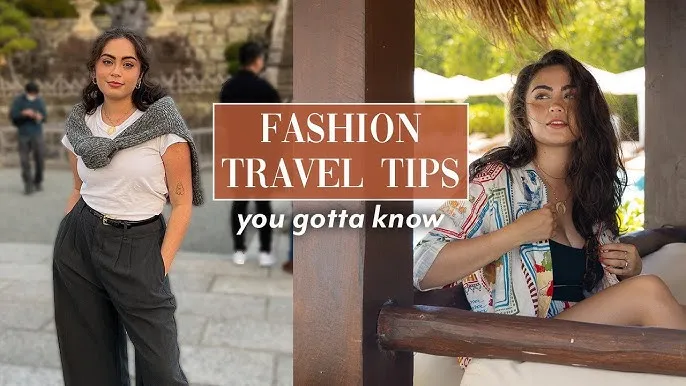
The V-neck creates a more open neckline by forming a V-shaped point at the center front. Compared with a crew neck, it exposes more of the upper chest and can give a T-shirt a lighter, sharper, and slightly more fashion-oriented appearance. The depth and width of the V must be carefully controlled because even a small pattern or sewing error can noticeably change the final look.
- Pros: Feels open, looks sharper/cleaner on many customers.
- Cons: V-point must be stitched perfectly or it looks cheap.
- Best for: Fashion basics, warm climates.
=> Read All: V-Neck T-Shirts: A Brand Owner’s Guide to Design, Risk, and Reorder Reality

A V-neck T-shirt creates a more open look. It feels cooler and less restrictive around the throat. – Standard V-neck T-shirt for fashion brands
3) Deep V-Neck
A deep V-neck takes the standard V-neck concept further by extending the neckline lower toward the chest. It creates a stronger fashion statement and is often used when a brand wants a more expressive, trend-driven silhouette rather than a traditional basic T-shirt. Because the neckline is larger and more open, fabric recovery, stabilization, and accurate grading become especially important.
- Pros: Strong style statement for trend-led drops.
- Cons: Smaller target market; needs stabilization to avoid stretching.
- Best for: Women’s fashion, influencer drops.
=> Read All: Deep V-Neck T-Shirts: Specs, Production, and Pros & Cons

A deep V-neck is a bolder, trend-driven version of the standard V.
4) Scoop Neck (U-Neck)
The scoop neck, also called a U-neck, has a wider and deeper curved opening than a standard crew neck. Its rounded shape creates a softer visual appearance and is especially common in women’s T-shirts, summer tops, and relaxed fashion basics. Since more fabric is removed around the neckline, good recovery and accurate pattern grading are essential to prevent gaping or distortion.
- Pros: Breathable, popular in women’s tees.
- Cons: Higher stretch risk; can gape if graded poorly.
- Best for: Women’s basics, summer capsules.
=> Read All: Scoop Neck (U-Neck) T-Shirts: Pros, Cons, and What Brand Owners Should Know
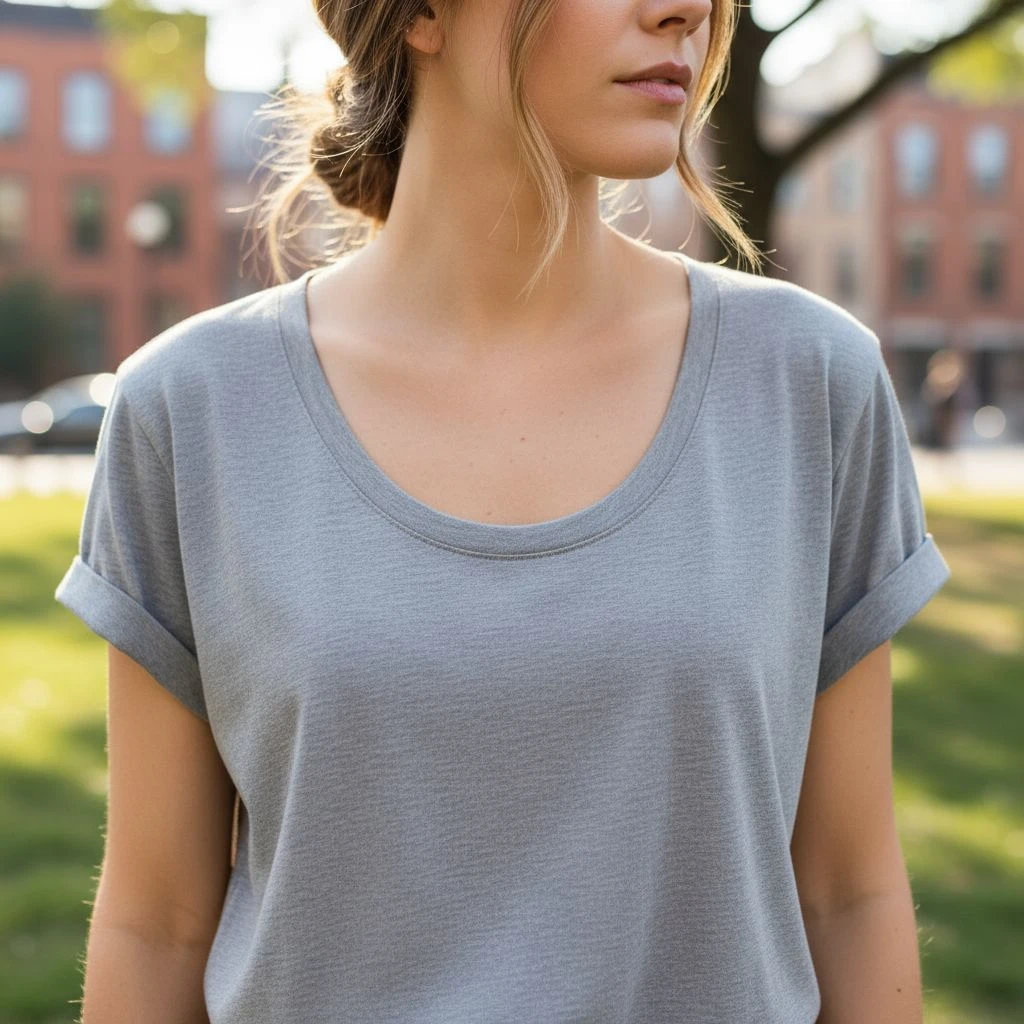

A scoop neck sits lower and wider, creating a softer look. – Scoop neck U-neck t-shirt style
5) Boat Neck (Bateau)
The boat neck, or bateau neckline, runs broadly across the upper chest and collarbone, often extending toward the shoulders. It creates a clean, elegant silhouette with a more refined appearance than a traditional crew neck. Because the neckline is wide and relatively shallow, the shoulder position and neckline tension must be carefully controlled to prevent slipping or poor fit.
- Pros: Refined, minimalist look.
- Cons: Can slip off shoulders; needs precise pattern control.
- Best for: Premium elevated basics.
=> Read All: Boat Neck (Bateau) T-Shirts: Pros, Cons, Specs, and What Brand Owners Must Control
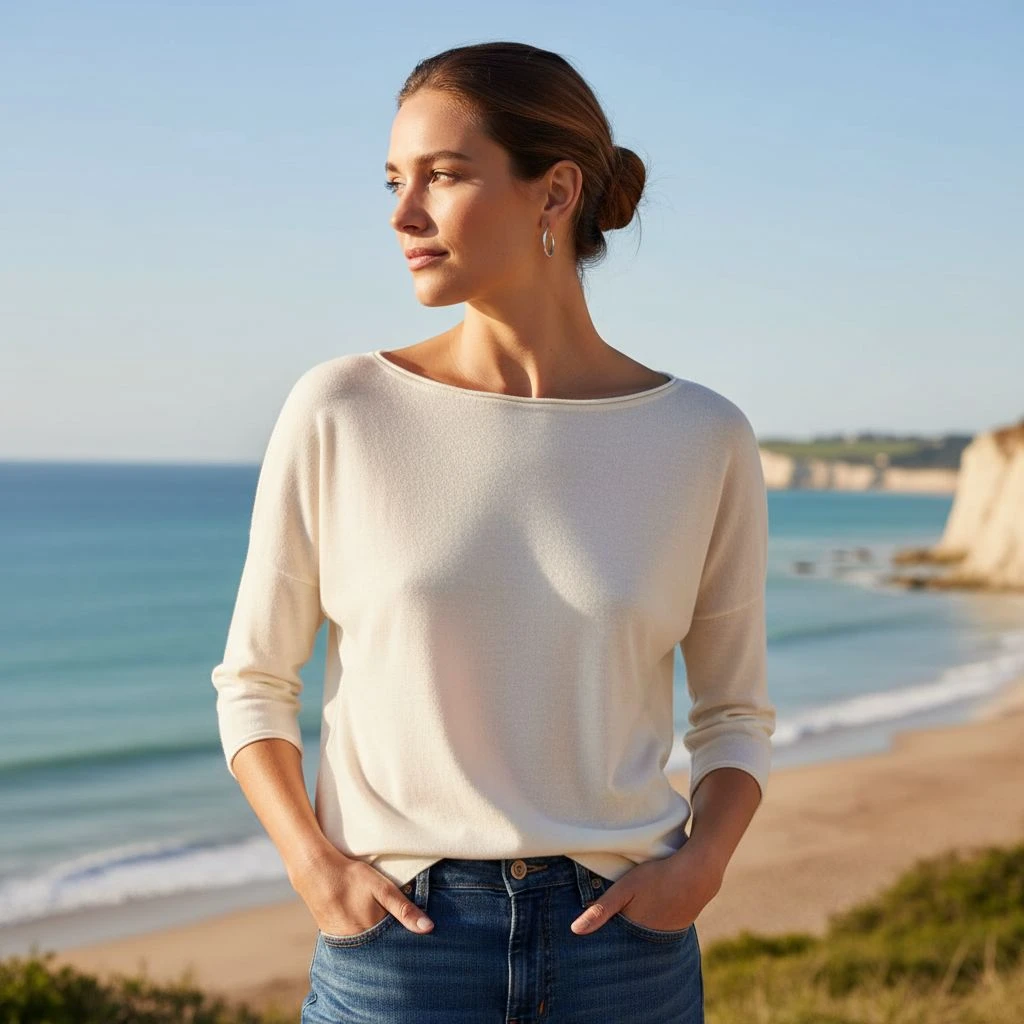
A boat neck runs horizontal across the collarbone for an elegant silhouette.
6) Square Neck
The square neck uses straight horizontal and vertical lines to create a structured frame around the neckline. It can give a simple T-shirt or fitted top a more distinctive fashion identity without requiring heavy decoration. The main production challenge is maintaining clean, symmetrical corners while preventing the neckline from stretching or becoming distorted.
- Pros: Trendy and clean. Great for rib-knit tops.
- Cons: Hard to achieve perfect corner symmetry.
- Best for: Women’s fashion tees.
=> Read All: Square Neck T-Shirts: Pros, Cons, and Why They Matter for Your Brand

A square neck provides a modern, structured frame for the collarbone.
7) Split / Notch Neck
A split or notch neck begins with a relatively simple neckline and adds a small vertical opening at the center front. This detail creates a casual, relaxed appearance while remaining less open than a traditional V-neck. Although the design looks simple, the bottom of the split becomes a stress point and usually needs accurate reinforcement and sewing control.
- Pros: Intentional casual look without being too open.
- Cons: Vertical split needs reinforcement or it will curl.
- Best for: Lifestyle, resort, and outdoors brands.
=> Read All: Split / Notch Neck T-Shirts: Pros, Cons, and How to Produce Them Right
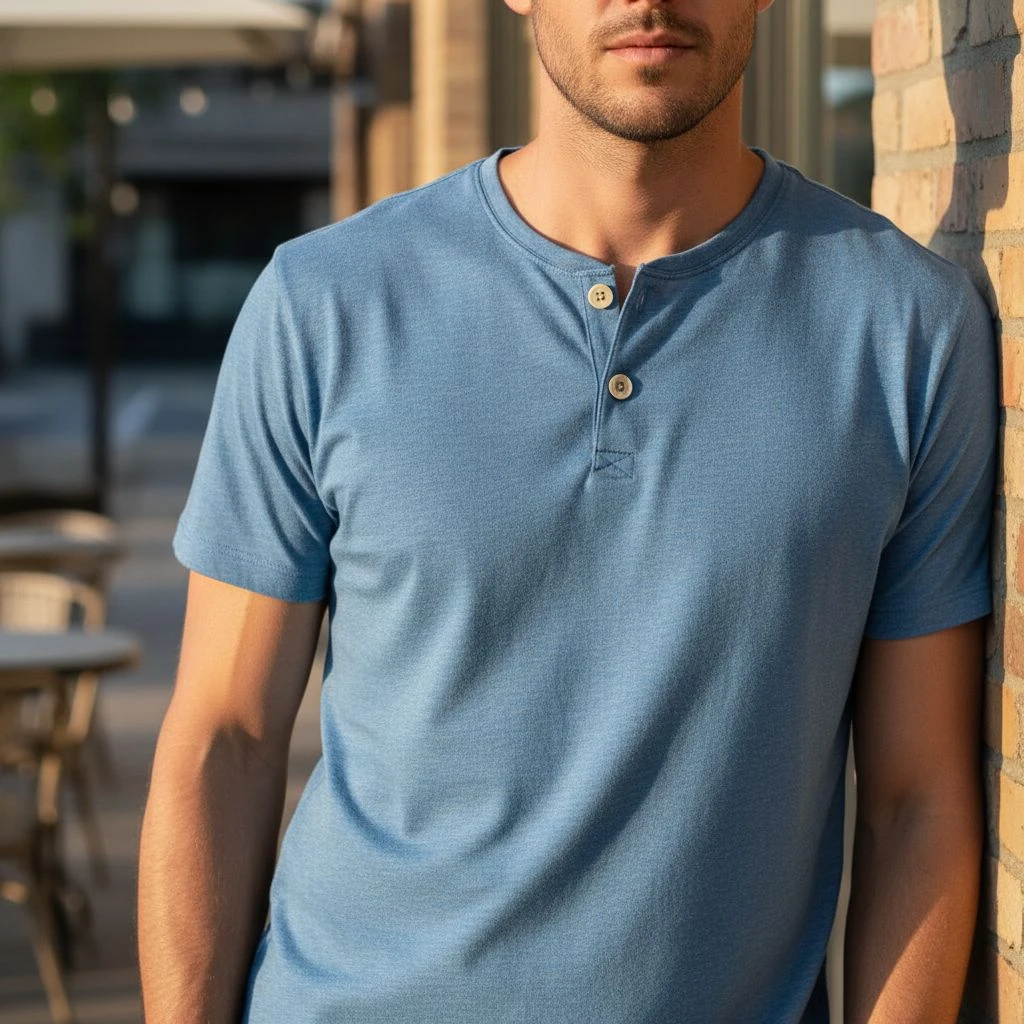
A split / notch neck is a crew neck with a small vertical cut.
8) Henley
A Henley neckline combines a round neckline with a short front placket and buttons. This construction gives a basic T-shirt more visual detail and can immediately make the garment feel more substantial, rugged, or premium. Compared with a normal crew neck, however, the Henley requires additional pattern pieces, placket construction, buttons, reinforcement, and quality control.
- Pros: Instant “upgrade” from a basic tee.
- Cons: Higher cost due to placket, buttons, and extra QC.
- Best for: Menswear, workwear casual.
=> Read All: Henley Neckline T-Shirts: Pros, Cons,… Guide for Brands
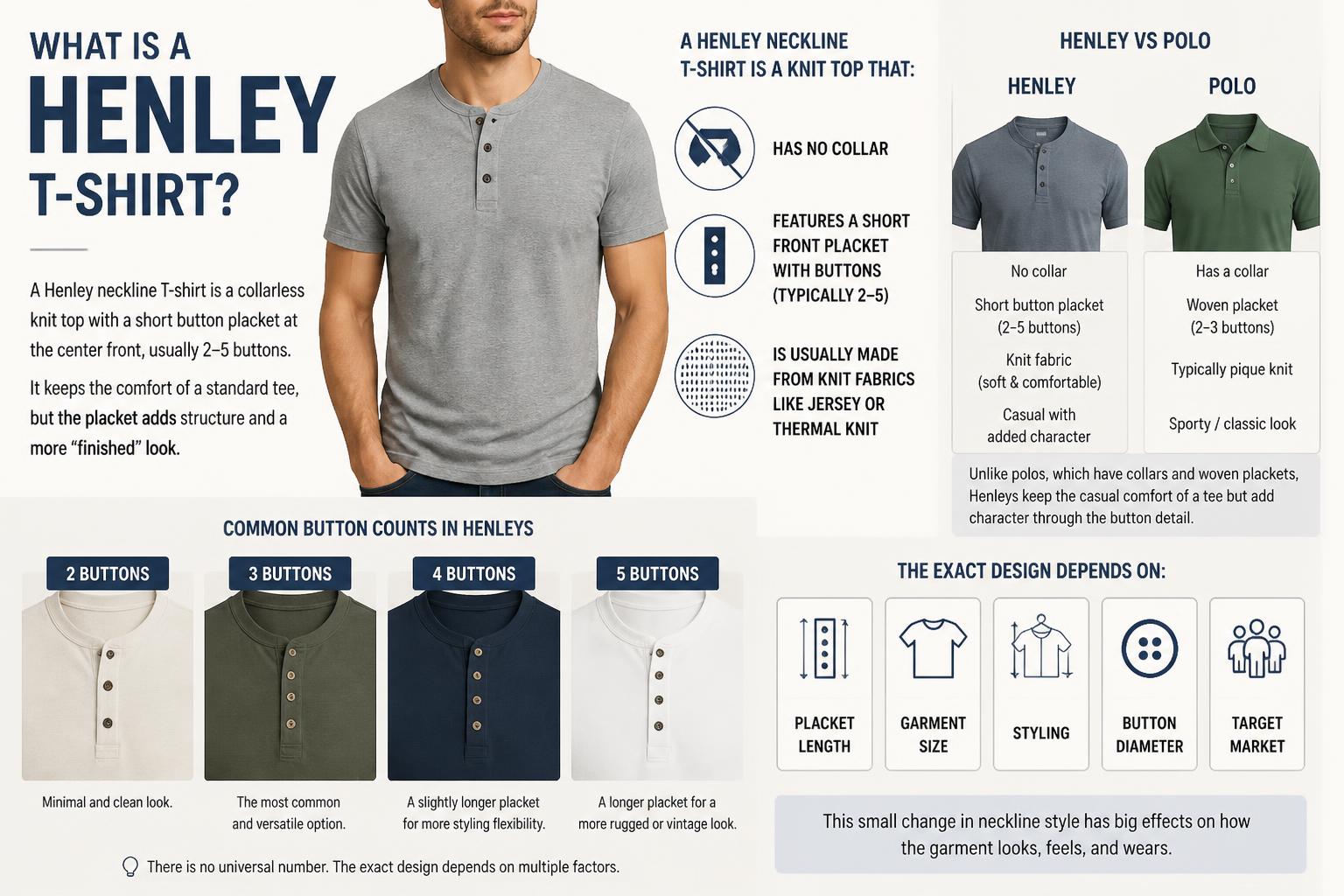
A Henley features a button placket, adding perceived value and rugged style.
9) Mock Neck
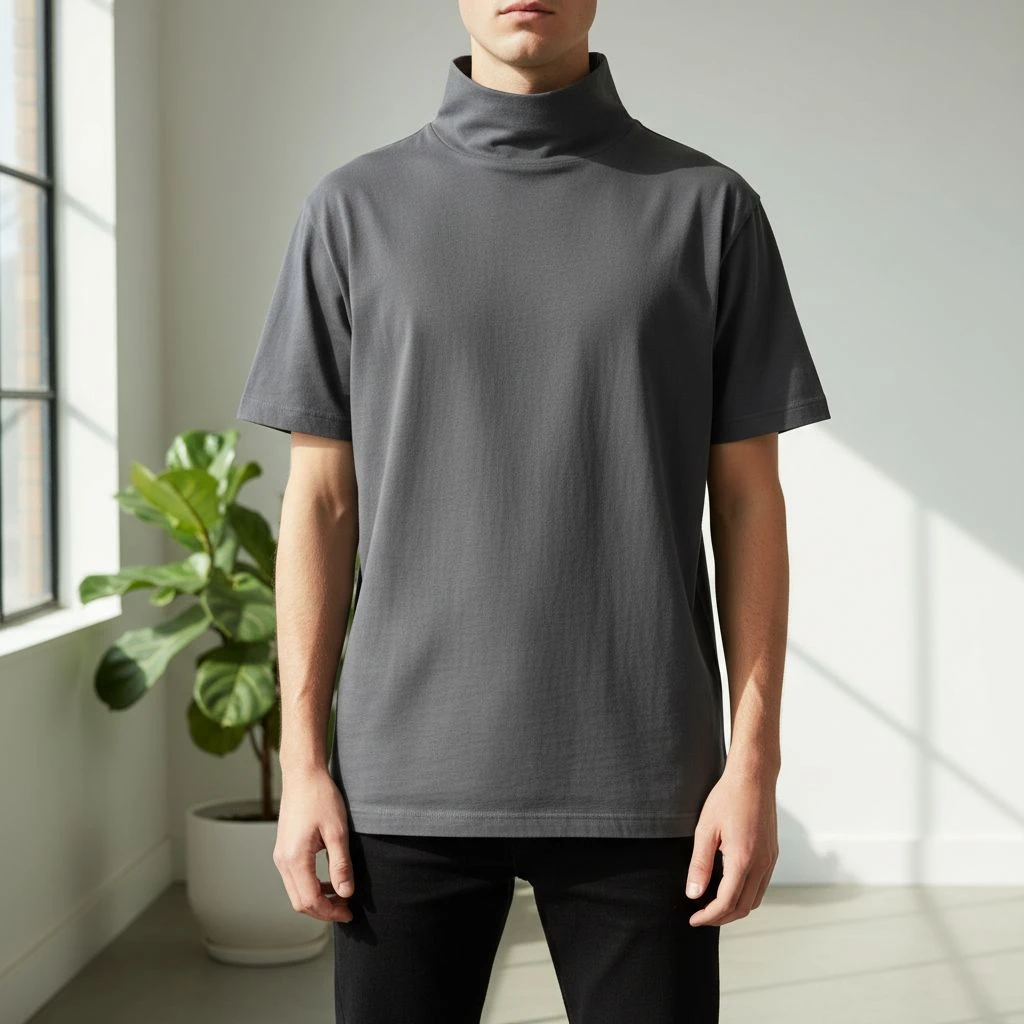
The mock neck extends upward from the neckline to create a short standing collar that does not fold over like a traditional turtleneck. It gives a T-shirt a clean, modern, and slightly more premium appearance while still remaining relatively simple in construction. Fabric stretch and recovery are critical because a weak collar can quickly sag, wave, or lose its intended height.
- Pros: Premium look; excellent for layering.
- Cons: Fabric recovery must be strong so it doesn’t sag.
- Best for: Minimalist streetwear, fall capsules.
=> Read All: Mock Neck T-Shirts: Pros, Cons, Specs,…, and Brand Owner Guide
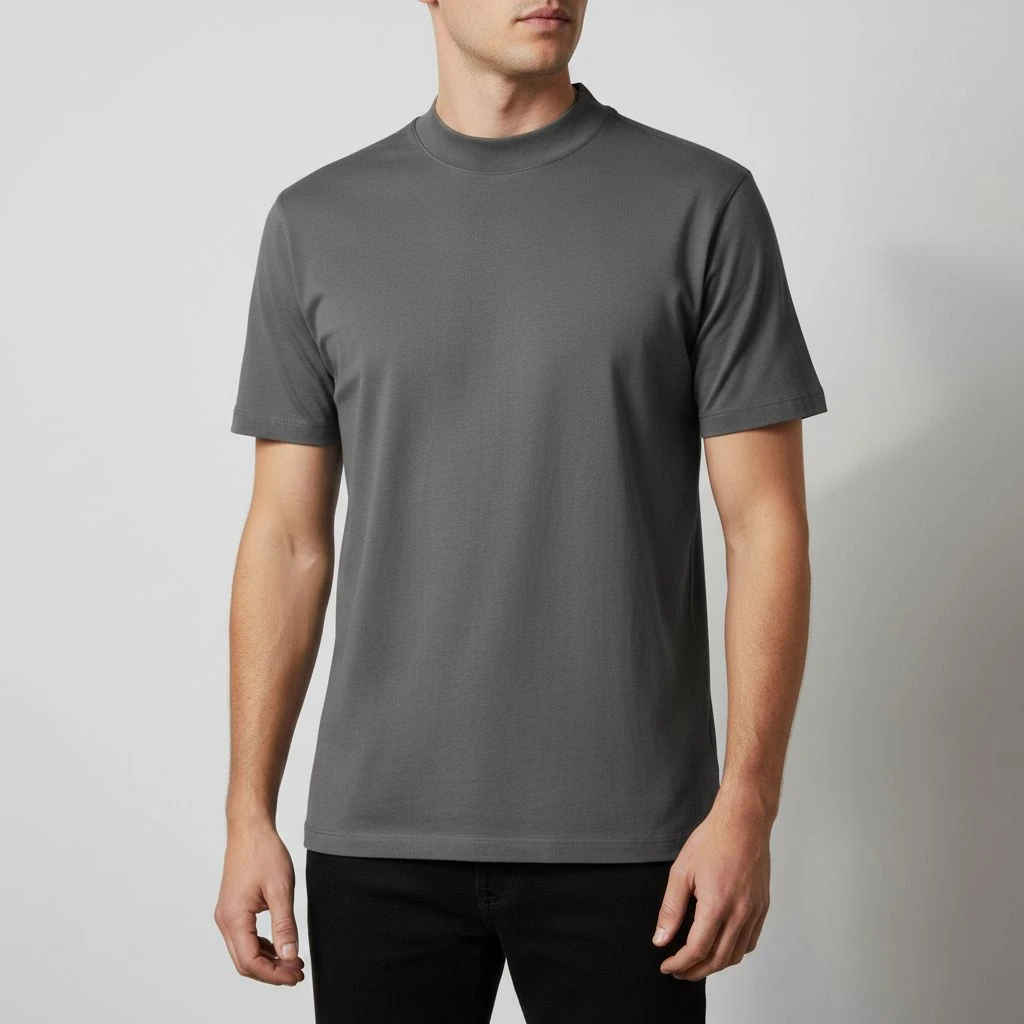

A mock neck is a high collar that doesn’t fold over, offering a modern, minimalist vibe.
10) High Neck (Raised Crew)
A high neck, sometimes called a raised crew, sits higher on the neck than a standard crew neckline but remains lower and simpler than a mock neck or turtleneck. It is often used to create a more structured, contemporary version of a basic T-shirt. The neckline opening must be carefully balanced so that it looks neat without becoming uncomfortable or difficult to pull over the head.
- Pros: Structured and structured; trendy “modern basic”.
- Cons: Comfort complaints if the opening is too tight.
- Best for: Athleisure, premium basics.
=> Read All: High Neck T-Shirts: Pros, Cons, and How Brand Owners Should Build Them Right
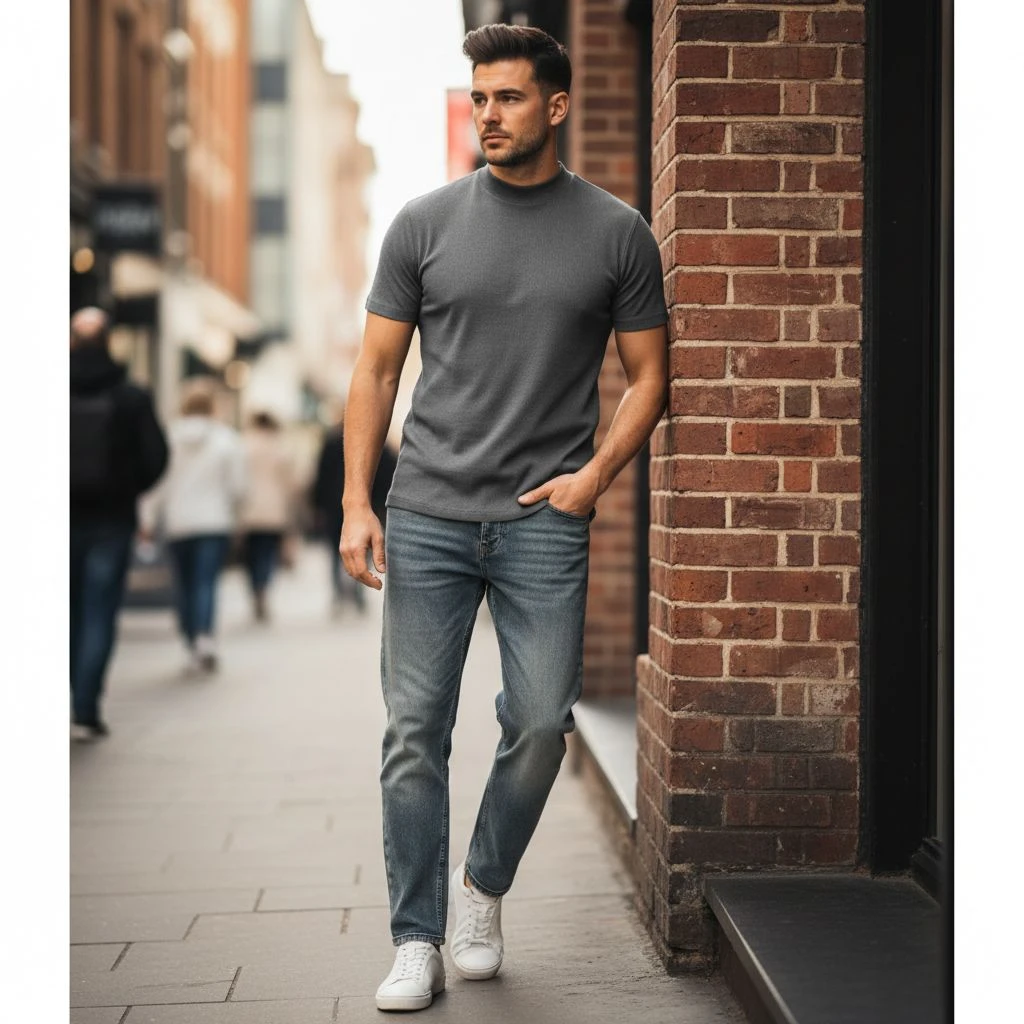
A high neck sits higher than a crew, bridging the gap between basic and turtleneck.
11) Turtleneck (Tee Version)
A T-shirt turtleneck features an extended neckline that rises around the neck and may fold over depending on the design. It adds warmth, coverage, and a clear seasonal identity, making it especially useful for autumn and winter layering collections. Because the collar is much taller than a standard T-shirt neckline, fabric recovery, stretch, collar height, and neck opening all have a major impact on comfort and appearance.
- Pros: Higher perceived value; seasonal identity.
- Cons: Neck height and fabric recovery are critical for fit.
- Best for: Winter layering brands.
=> Read All:
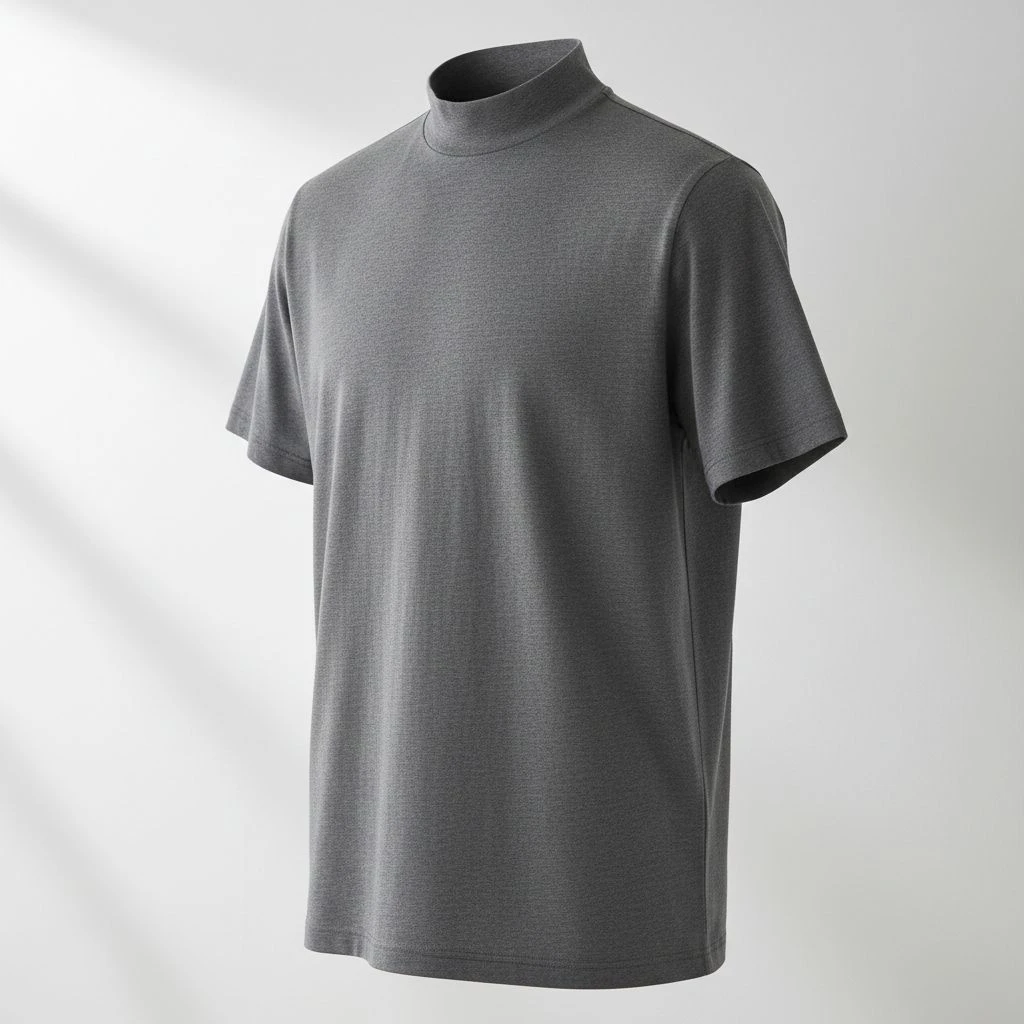
The T-shirt version of a turtleneck is a key winter layering piece.
12) Ringer Tee
The ringer tee is usually based on a classic T-shirt body but uses contrasting rib at the neckline and often the sleeve openings. This small change creates a recognizable retro, athletic, or campus-inspired look without requiring a complicated garment construction. The main production challenge is ensuring that the contrast rib matches the body fabric in shrinkage, recovery, and colorfastness.
- Pros: Retro look with minimal design effort.
- Cons: Rib shrinkage and color matching must be controlled.
- Best for: Vintage drops, campus merch.

=> Read All: Ringer Tee T-Shirts: Pros, Cons… and Guild for Brand Owners

A ringer tee uses contrast rib trim for a retro, sporty aesthetic.
13) Cowl Neck
The cowl neck uses extra fabric around the neckline to create soft folds and natural draping. Unlike a structured collar, its appearance depends heavily on gravity, fabric weight, softness, and pattern volume. It is often used for women’s fashion and loungewear because it can create an elegant visual effect without relying on additional trims or decoration.
- Pros: Visually elegant; great for loungewear.
- Cons: Highly dependent on fabric GSM and drape.
- Best for: Women’s loungewear.
=> Read All: Cowl Neck T-Shirts: Pros, Cons, and What Brands Must Know Before Using Them

A cowl neck creates a soft draped fold at the neckline.
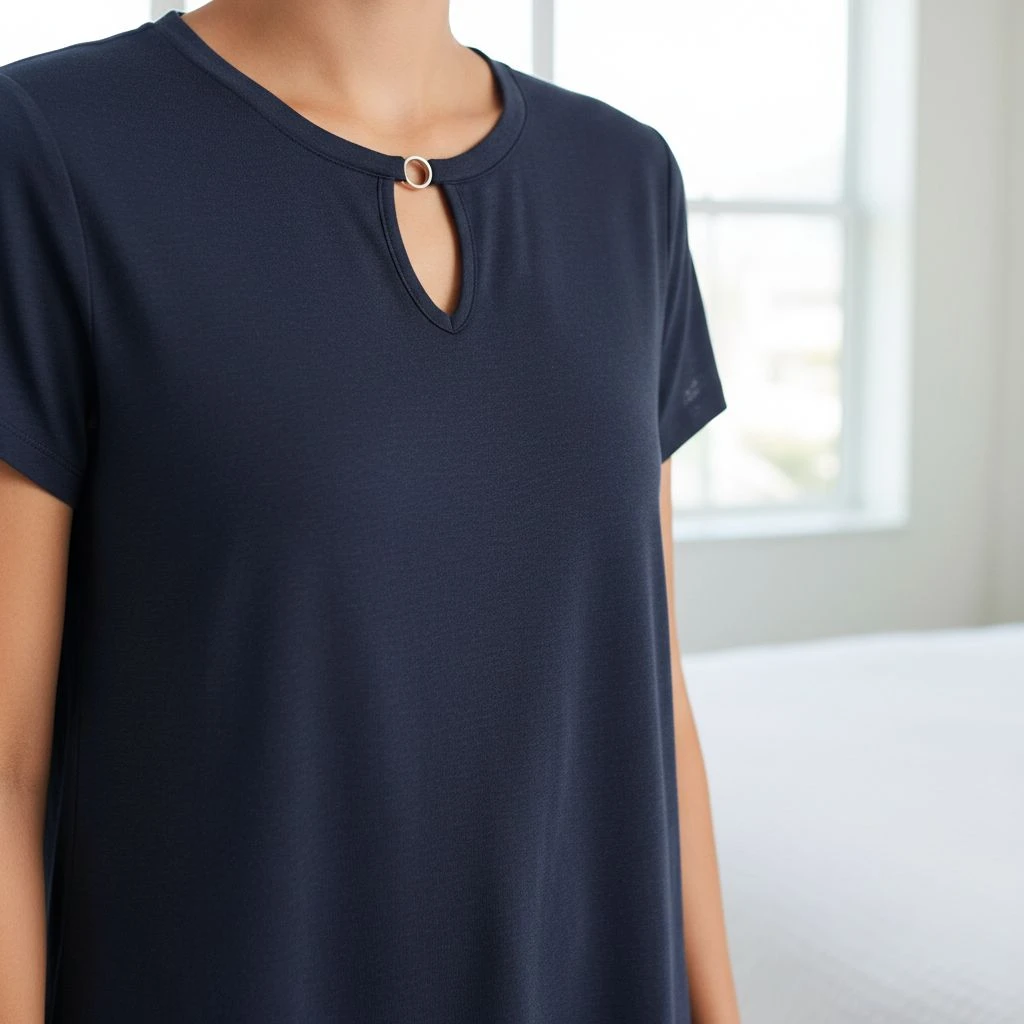
14) Keyhole Neck
The keyhole neck introduces a small opening or cutout near the neckline to add visual interest to an otherwise simple top. Depending on its size and shape, the keyhole can feel subtle and minimal or more decorative and feminine. Because the opening concentrates stress around a small area, reinforcement, edge finishing, and accurate symmetry are important for production quality.
- Pros: Differentiates a basic top with minimal effort.
- Cons: Needs reinforcement to prevent tearing.
- Best for: Boutique basics, feminine fashion.
=> Read All: Keyhole Neck T-Shirts: Pros, Cons,… and What Brand Owners Must Know
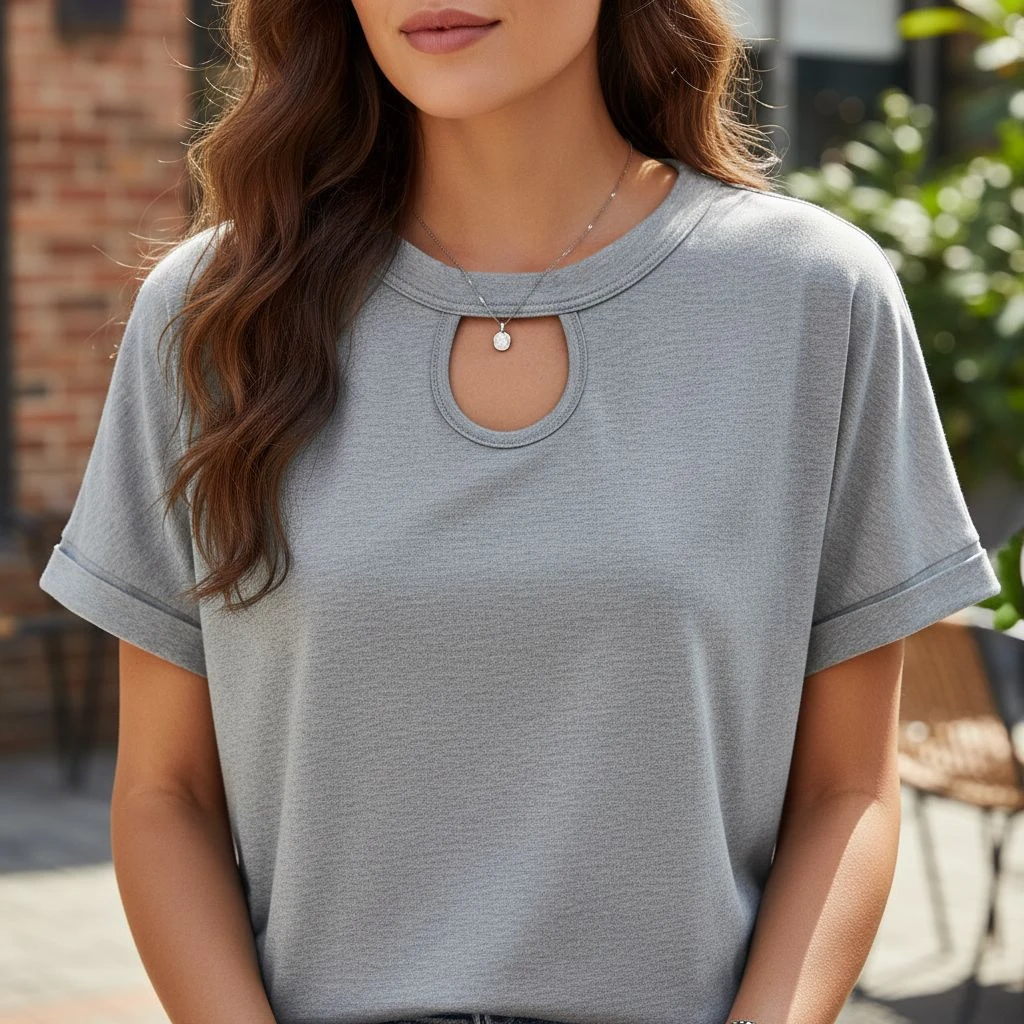
The keyhole neck adds a subtle cutout detail for a feminine touch.
Brand Owner Guide: Choosing Your Neckline Mix
A strong neckline mix helps your line feel intentional while protecting margins. Match your selection to your target market and fabric behavior.
- For Uniforms/Corporate: Stick to Crew and V-neck.
- For Retail Fashion: Add Scoop, Square, or Boat necks.
- For Outdoors: Henley and Split necks perform best.
Conclusion / Final Words
Choosing the right T-shirt neckline is a strategic decision that impacts reorders and comfort. For most brands, the safest foundation is a strong Crew and V-Neck, then building style with 1–2 specialty necks based on your audience. Treat your neckline choice like a technical spec—not just a trend—to ensure consistent quality and fewer returns.
FAQs About Types of T-Shirt Necklines
Why does the T-shirt neckline matter for brands?
Because the neckline directly affects comfort, fit perception, and durability. Customers feel the neckline all day, not the print. A neckline that is too tight, too loose, or poorly finished often leads to dissatisfaction and returns. Necklines alone do not fix a bad T-shirt. Fabric quality and overall fit usually matter more.
Which T-shirt neckline sells best overall?
The crew neck remains the most consistent and widely accepted option across markets, genders, and age groups. That said, V-necks often perform better in hot climates, while mock necks and high necks work best for premium or fashion-forward brands. Choosing trends without knowing your customer usually leads to poor sell-through.
Which necklines are the most difficult to produce?
Necklines with openings or added structure create the most problems, such as deep V-necks, scoop necks, notch necks, and keyhole necks. These styles require reinforcement, precise stitching, and fabrics with good recovery. Without that, they stretch, curl, or tear after washing. Necklines with openings or added structure create the most problems, such as deep V-necks, scoop necks, notch necks, and keyhole necks. These styles require reinforcement, precise stitching, and fabrics with good recovery. Without that, they stretch, curl, or tear after washing. => Read More: Which Necklines Are the Most Difficult to Produce?
Are some necklines more expensive to make?
Yes. Henley, mock neck, turtleneck, and cowl neck styles cost more due to extra fabric, additional sewing steps, and more quality control points. Basic crew and V-neck styles are the most cost-efficient A premium neckline only makes sense if the retail price supports the added cost.
Which necklines work best in hot or humid climates?
V-necks, scoop necks, and notch necks generally feel cooler because they open the neckline area. However, fabric choice matters just as much. A breathable fabric with a crew neck can feel cooler than a heavy fabric with an open neckline. => Read More: Which necklines work best in hot or humid climates?
Do wider necklines increase return rates?
They can, especially if grading or reinforcement is weak. Common issues include slipping off the shoulder, loose neck openings, and shape distortion after washing. This happens most often with boat necks, scoop necks, and square necks.
Which neckline looks the most premium to customers?
Mock necks, high necks, Henley necks, and cleanly finished notch necks are often perceived as more premium. However, customers judge quality by execution, not by style name. A poorly made mock neck looks cheaper than a well-finished crew neck.
How does neckline choice affect printing and branding?
Wider or deeper necklines reduce usable chest print space. This can limit logo placement and large graphic designs. Brands that rely on center-chest prints should be cautious with deep V-necks, scoop necks, and wide boat necks.
Can the same neckline be used for both men’s and women’s T-shirts?
Yes, but only for certain styles such as crew necks, shallow V-necks, and notch necks. More shaped styles usually require separate patterns instead of simple size grading.
Should new brands offer many neckline styles at once?
No. Starting with too many neckline variations increases cost, complexity, and risk. A better approach is to launch with one or two proven necklines, stabilize fabric and fit, then test new styles in small runs.
What is the most common mistake brands make with necklines?
Treating neckline choice as only a design decision. In reality, it depends on fabric behavior, sewing method, target market, climate, and price positioning. Ignoring these factors leads to avoidable quality and fit issues
How should a brand choose the right neckline?

Brands should first clarify who the customer is, where the T-shirt will be worn, the climate, the fabric weight, the retail price, and the logo placement. If these answers are unclear, the neckline choice will likely be wrong.