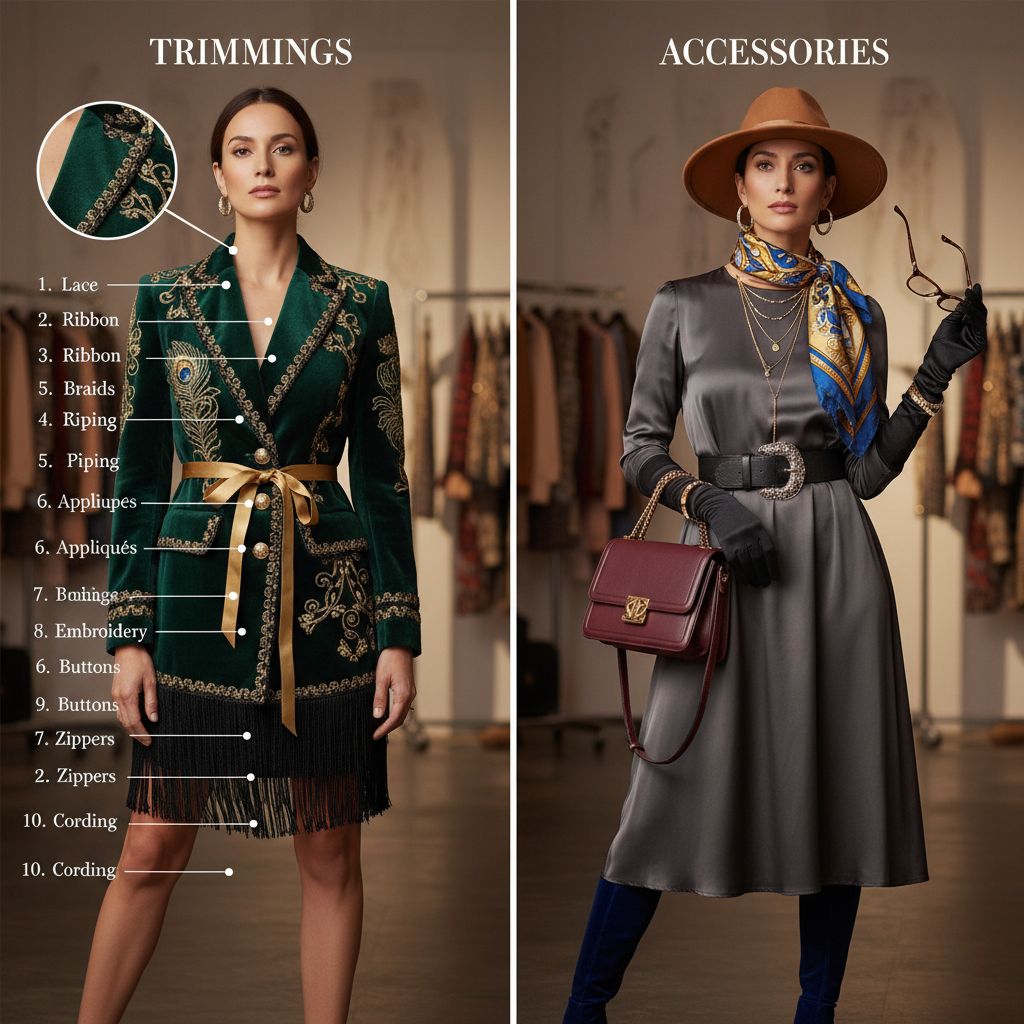

In the apparel industry, fabric is only one part of a finished garment. To turn fabric into a product that is ready to wear, sell, and ship, manufacturers use many additional materials. These materials usually fall into two broad groups: trimmings and accessories.
These two terms are often used together, and many people confuse them. Some even use them as if they mean the same thing. However, in garment manufacturing, trimmings and accessories are not identical. Each has a different role in production, costing, quality control, and shipment preparation. This article explains the difference between trimmings and accessories in simple terms, compares them side by side, and gives practical examples used in the apparel industry.
What Is the Main Difference Between Trimmings and Accessories?
The main difference is simple:
- Trimmings become part of the garment itself.
- Accessories are used to finish, identify, pack, protect, or present the garment.
This is the clearest way to understand the difference. Some older explanations say that trimmings are only functional and accessories are only decorative, but that idea is too narrow for modern garment production. For example, lace can be decorative but is still considered a trimming because it is attached to the garment. A polybag is not decorative at all, but it is an accessory because it is used for packing and protection.

Comparison Between Trimmings and Accessories
| Sl. No. | Subject | Trimmings | Accessories |
|---|---|---|---|
| 1 | Definition | Materials attached to the garment and forming part of the finished product | Materials used for finishing, labeling, packing, and presentation |
| 2 | Position in Garment | Remain on the garment during use | Usually not part of the garment during use |
| 3 | Main Role | Support garment construction, function, or decoration | Support branding, protection, packing, and shipment |
| 4 | Attachment Method | Sewn, fused, fixed, or directly attached | Usually inserted, hung, wrapped, packed, or applied externally |
| 5 | End User Use | Worn together with the garment | Usually removed before or after purchase |
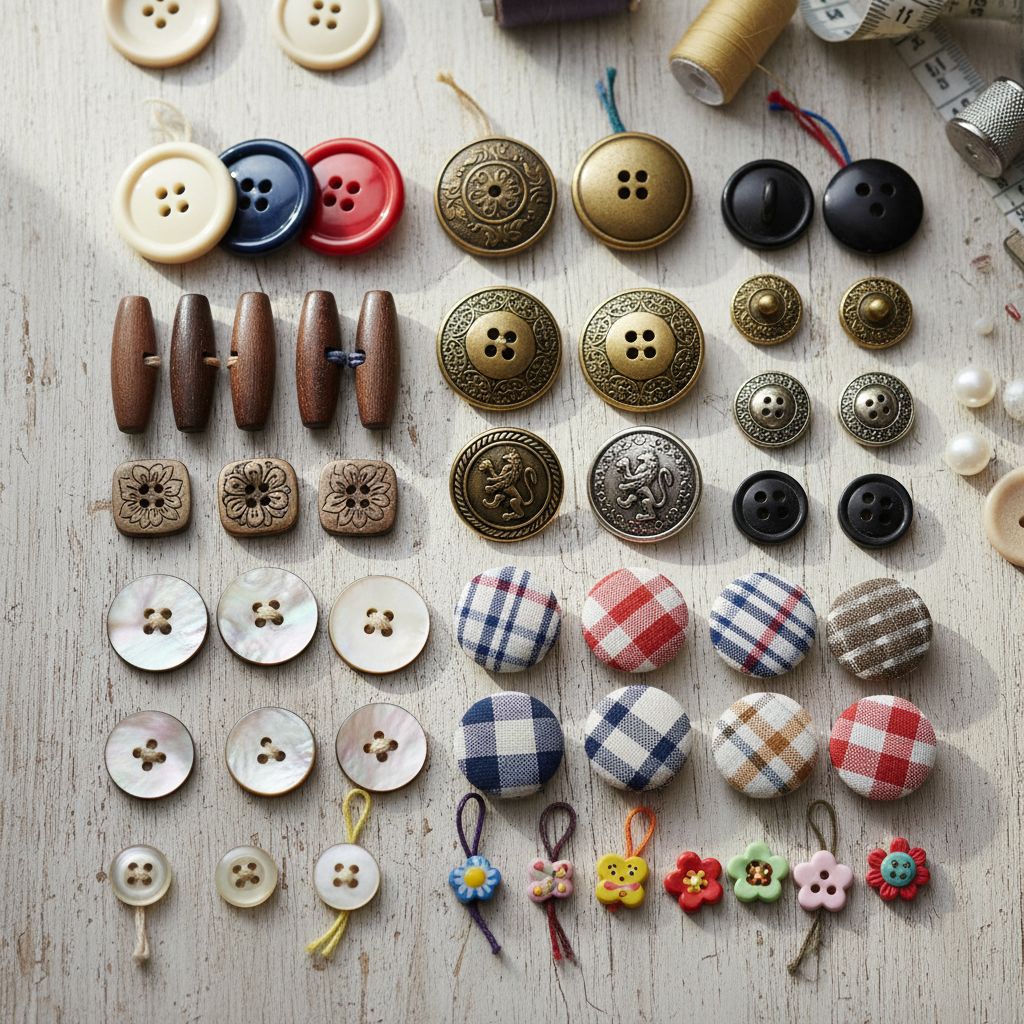
| 6 | Examples | Sewing thread, zipper, button, interlining, lace, elastic | Hangtag, price tag, barcode sticker, polybag, carton, gum tape |
Difference in Technical Definition
Trimmings are materials attached directly to the garment during manufacturing and remain with the garment in the final product. Accessories are materials used during garment finishing, labeling, packing, and delivery, but they are not usually worn as part of the garment.
Difference in Practical Use
Trimmings help form the garment and contribute to its function, appearance, and construction. Accessories help make the garment ready for sale, shipment, branding, and customer handling.
Difference in Attachment
Trimmings are generally sewn, fused, riveted, or otherwise fixed onto the garment. Accessories are generally added during finishing or packing and are not permanently attached in the same way.
Difference in End-User Experience
The customer normally wears the garment together with its trimmings. The customer usually removes, discards, or does not wear most accessories, such as tags, pins, polybags, and cartons.
Why Is It Important to Know the Difference?
Understanding the difference between trimmings and accessories is important for several reasons.
- First, it helps with material planning. Merchandisers, production teams, and sourcing staff need to know which items are part of the garment and which are needed for packing.
- Second, it improves costing accuracy. Trimmings and accessories are often listed separately in garment costing sheets, BOMs, and purchase plans.
- Third, it supports quality control. Quality teams must inspect not only garment construction but also trims quality, labeling accuracy, and packing compliance.
- Fourth, it helps with buyer communication. Buyers often provide separate requirements for trims and accessories, especially for branding, labeling, barcode systems, and export packing.


Are Trimmings Always Functional and Accessories Always Decorative?
- Not always. This is where many simple explanations become misleading. Some trimmings are functional, such as zippers, sewing thread, and interlining. But some trimmings are mainly decorative, such as lace or ornamental ribbons.
- In the same way, many accessories are not decorative at all. Polybags, cartons, barcode stickers, and gum tape are mainly practical and protective.
- So it is better not to separate them by saying one group is functional and the other is decorative. The better distinction is whether the item becomes part of the garment or is used to support it externally.
Final Thoughts / Conclusion
Trimmings and accessories are both essential in apparel manufacturing, but they do not mean the same thing. Trimmings are materials that become part of the garment and remain with it in the finished product. Accessories are materials used to finish, identify, protect, present, pack, or ship the garment.

A clear understanding of this difference helps garment manufacturers improve costing, sourcing, quality control, and production planning. It also helps buyers, merchandisers, and factory teams communicate more clearly throughout the order process. If you work in the apparel industry, knowing how to distinguish trimmings from accessories is a basic but important step toward better garment development and smoother production management.