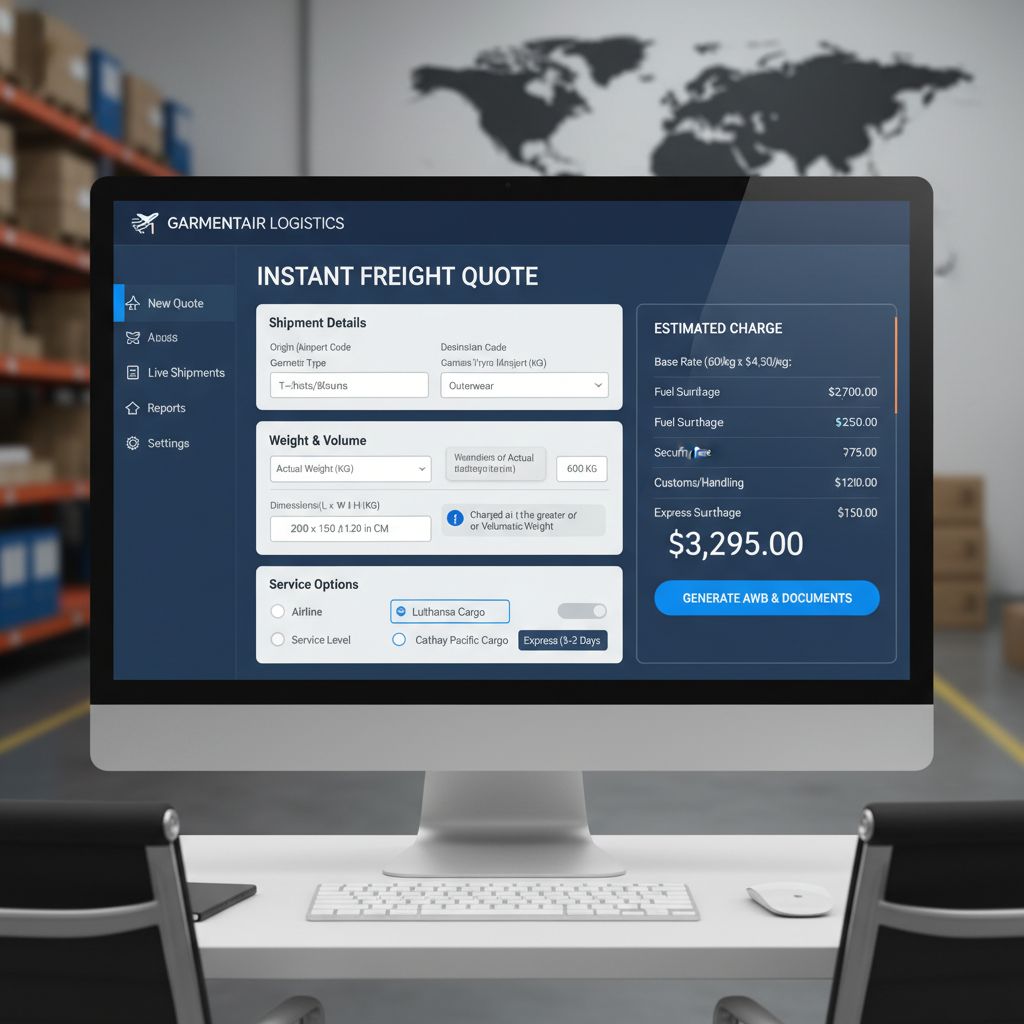

Air freight is the fastest shipping method in the garment import-export business, essential for urgent deliveries or seasonal deadlines. However, it is also the most expensive. Understanding how air freight charges are calculated is vital for garment exporters, merchandisers, and logistics teams to maintain accurate costing and profitability.
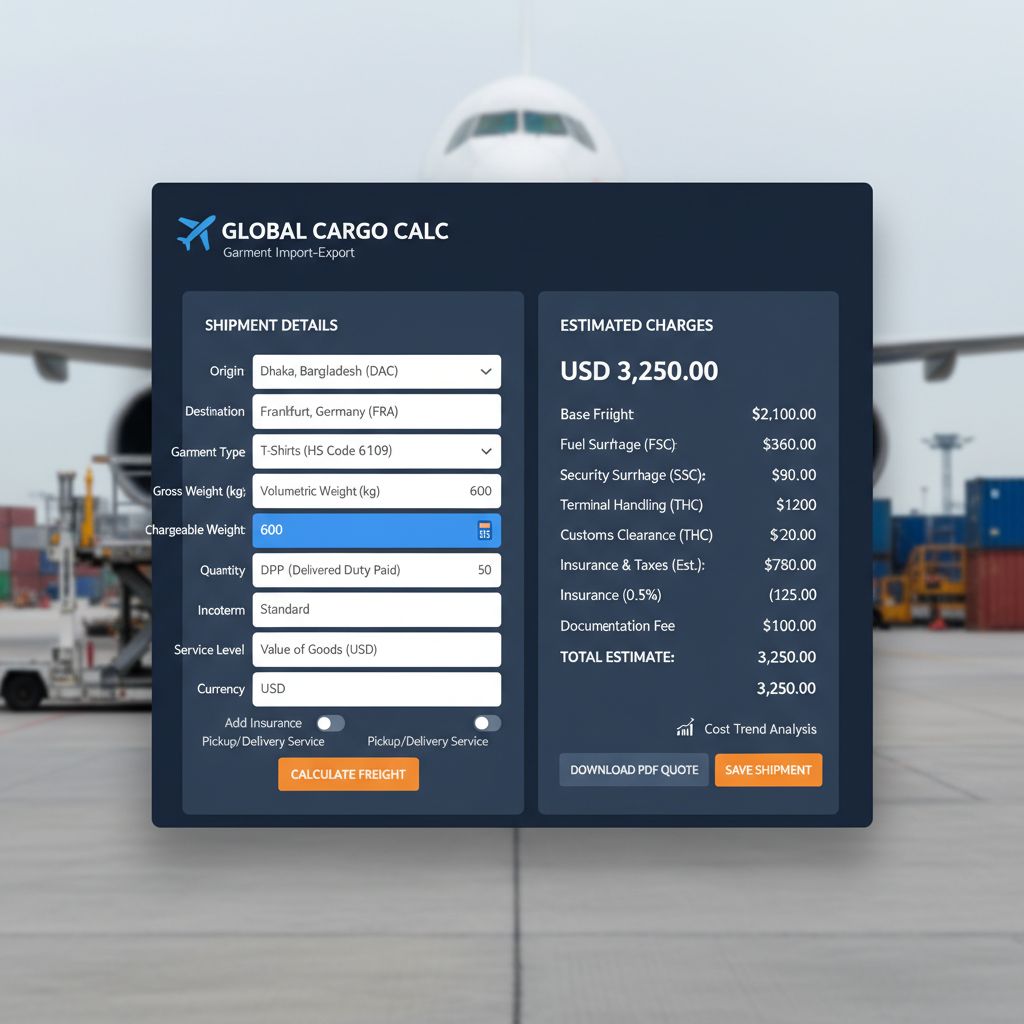
A common mistake is assuming charges are based only on actual weight. In reality, airlines use chargeable weight, which compares actual weight against volumetric weight. Whichever is higher is used for billing. This is particularly critical in the apparel industry, where products are often lightweight but bulky.
Why Air Freight Uses Chargeable Weight
Aircraft have finite weight and space capacity. If airlines only charged by actual weight, a shipment of cotton garments (bulky but light) would occupy vast space while paying very little compared to heavy, compact iron products. The chargeable weight system ensures fair pricing by considering both the mass and the space occupied by the cargo.
Key Terms and Calculations
- Actual/Gross Weight: The physical weight of the cargo including packaging, measured on a scale.
- Volumetric Weight: A value representing the space the cargo occupies, converted into weight.
- CBM (Cubic Meter): The total volume calculated as Length × Width × Height.
The Standard Formula
- Calculate CBM: Length (m) × Width (m) × Height (m)
- Calculate Volumetric Weight: CBM ÷ 0.006
- Determine Chargeable Weight: The higher value between Actual Weight and Volumetric Weight.
Real-World Examples in Garment Shipping
Example 1: Actual Weight is Higher
Shipment: 200 kg | Dimensions: 1.0m × 1.0m × 1.0m.
- CBM = 1.0 m³
- Volumetric Weight = 1.0 ÷ 0.006 = 166.67 kg
- Chargeable Weight = 200 kg (Actual is higher).
Example 2: Volumetric Weight is Higher (Common in Apparel)
Shipment: 140 kg | Dimensions: 0.98m × 0.95m × 0.96m.
- CBM = 0.89376 m³
- Volumetric Weight = 0.89376 ÷ 0.006 = 148.96 kg
- Chargeable Weight = 148.96 kg (Volumetric is higher).


Reducing Costs through Efficient Packing
Because garments are soft and light, exporters can often reduce costs by managing cargo space more effectively. Practical methods include:
- Optimizing carton sizes to eliminate empty space.
- Improving folding techniques to increase garment density per box.
- Designating “vacuum packing” for certain soft items.
- Confirming CBM calculations carefully before booking.

Conclusion
The chargeable weight system is the gold standard for air freight in the garment industry. By mastering the simple formulas (CBM and the 0.006 divisor), merchandisers can provide accurate quotes and avoid unexpected logistics expenses. Never look only at the kilograms; always measure the dimensions to ensure your shipping strategy is as cost-effective as possible.