Defect Categories in Garment Inspection (Critical / Major / Minor)

Quality control in the garment industry depends on more than just checking finished pieces; it relies on a clear system that helps everyone judge defects the same way. That system is built on three key categories: Critical, Major, and Minor defects. Each category shows how serious a problem is and how it affects safety, appearance, fit, and customer satisfaction.
=> Read More: Should You Use Third-Party Inspections in Vietnam?
What Is a Garment Defect?
A garment defect is any condition that does not meet the approved:
- Sample
- Specification
- Measurement tolerance
- Construction standard
- Appearance requirement
- Safety requirement
- Buyer quality standard
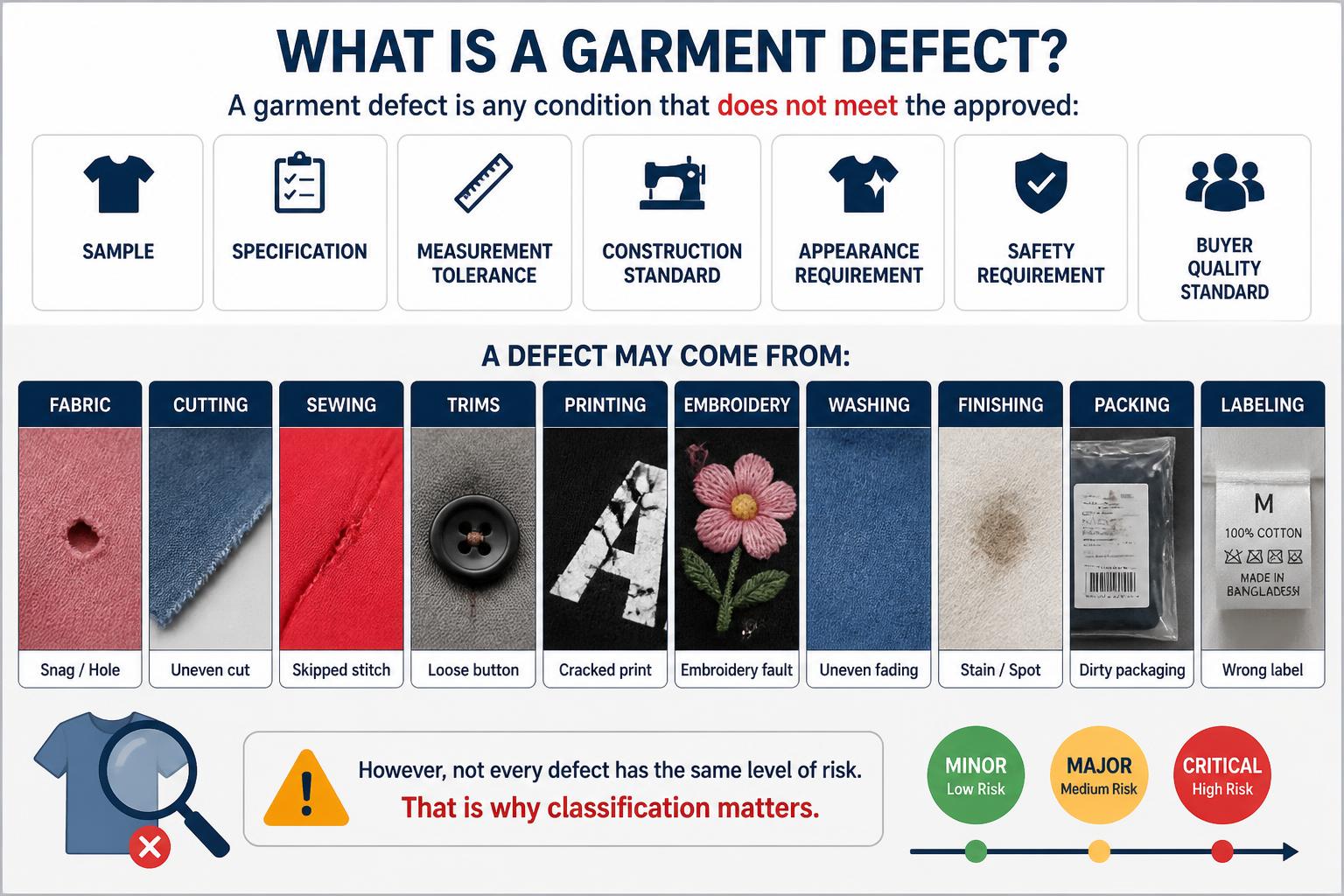
A defect may come from:
- Fabric
- Cutting
- Sewing
- Trims
- Printing
- Embroidery
- Washing
- Finishing
- Packing
- Labeling
However, not every defect has the same level of risk. That is why classification matters.
Why Garment Defects Are Divided Into Categories
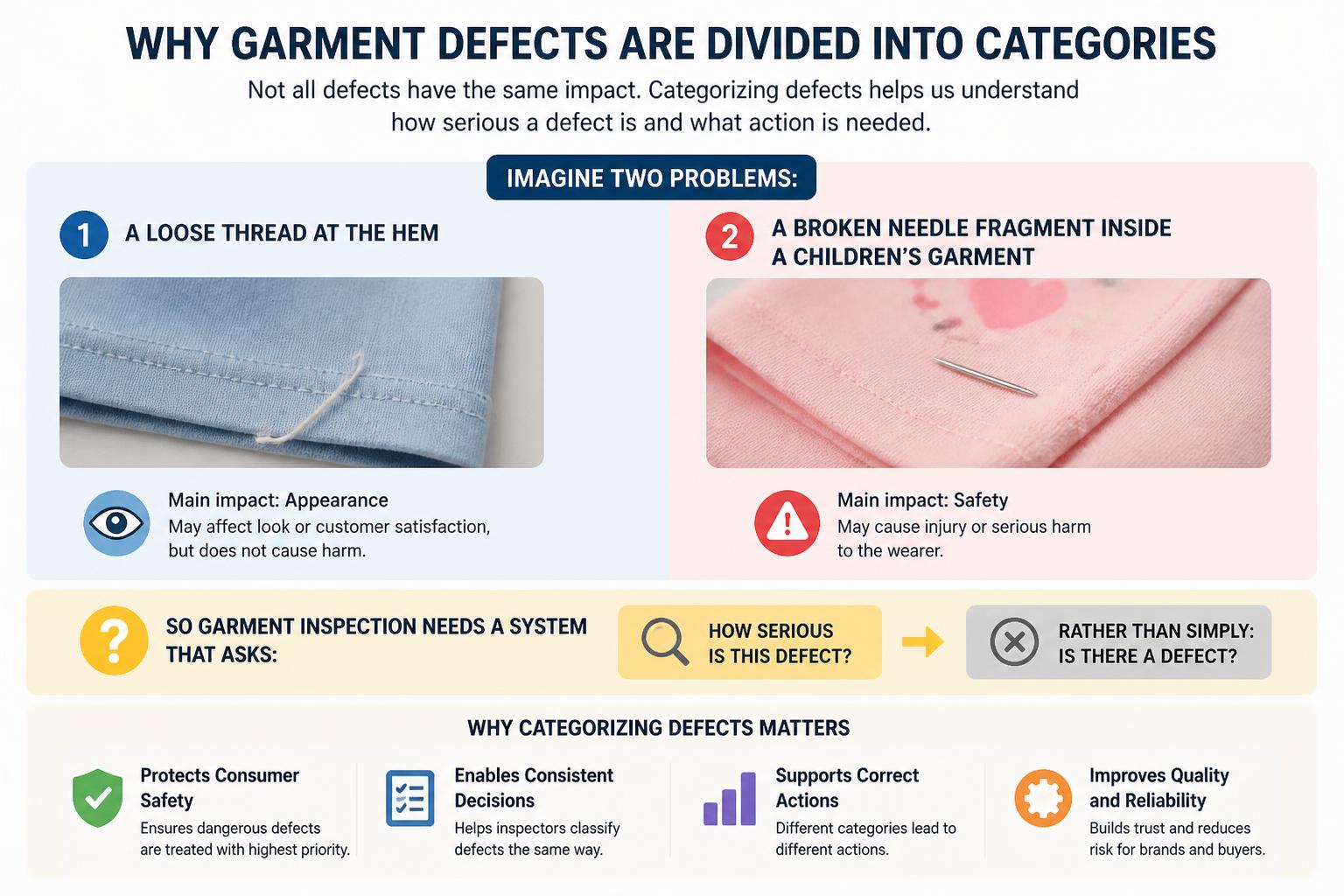
Imagine two problems:
- A loose thread at the hem
- A broken needle fragment inside a children’s garment

Both are defects. But they clearly do not have the same consequence. The loose thread may only affect appearance. The needle fragment may cause injury.
- So garment inspection needs a system that asks: How serious is this defect?
- rather than simply: Is there a defect?
| Category | Main Impact | Example |
|---|---|---|
| Critical | Safety / legal compliance | Needle fragment |
| Major | Function / fit / saleability | Broken zipper |
| Minor | Small appearance issue | Loose thread |
Critical major and minor defects in garments
1. Critical Defects (AQL 0%)
Critical defects are the highest-risk issues in any garment shipment. These defects can cause injury, safety hazards, legal violations, or health problems. Because the consequences are so serious, brands apply a zero-tolerance rule.
=> Read More: Acceptable Quality Limit (AQL): What It Means and How It Works
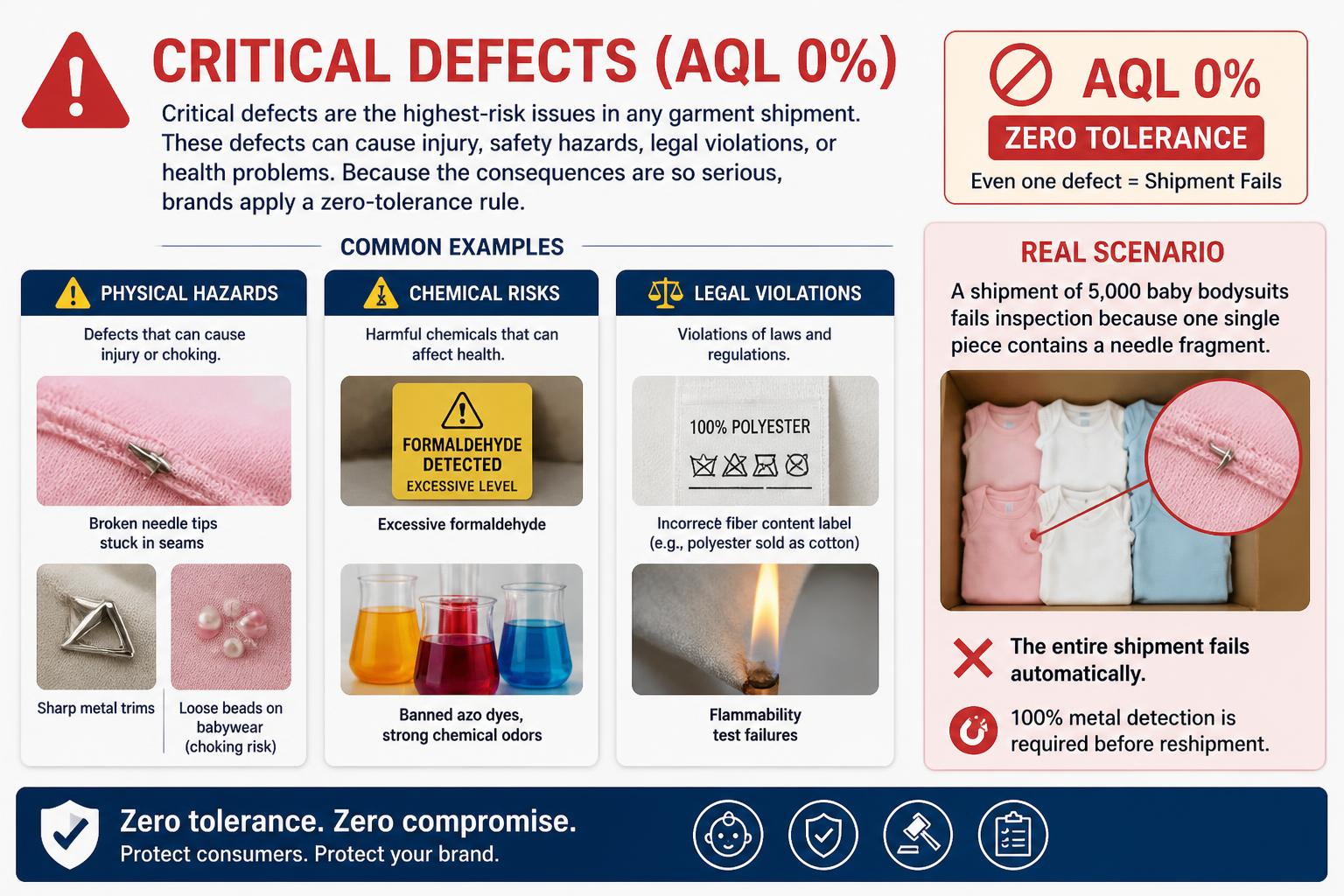
Common Examples:
- Physical Hazards: Broken needle tips stuck in seams, sharp metal trims, or loose beads on babywear (choking risk).
- Chemical Risks: Excessive formaldehyde, banned azo dyes, or strong chemical odors.
- Legal Violations: Incorrect fiber content label (e.g., polyester sold as cotton) or flammability test failures.
Real Scenario:
A shipment of 5,000 baby bodysuits fails inspection because one single piece contains a needle fragment. The entire shipment fails automatically, and 100% metal detection is required before reshipment.
2. Major Defects (Common AQL: 2.5%)
Major defects affect the garment’s function, appearance, fit, or durability. While they won’t harm the wearer, they make the product un-sellable or likely to be returned by a customer.
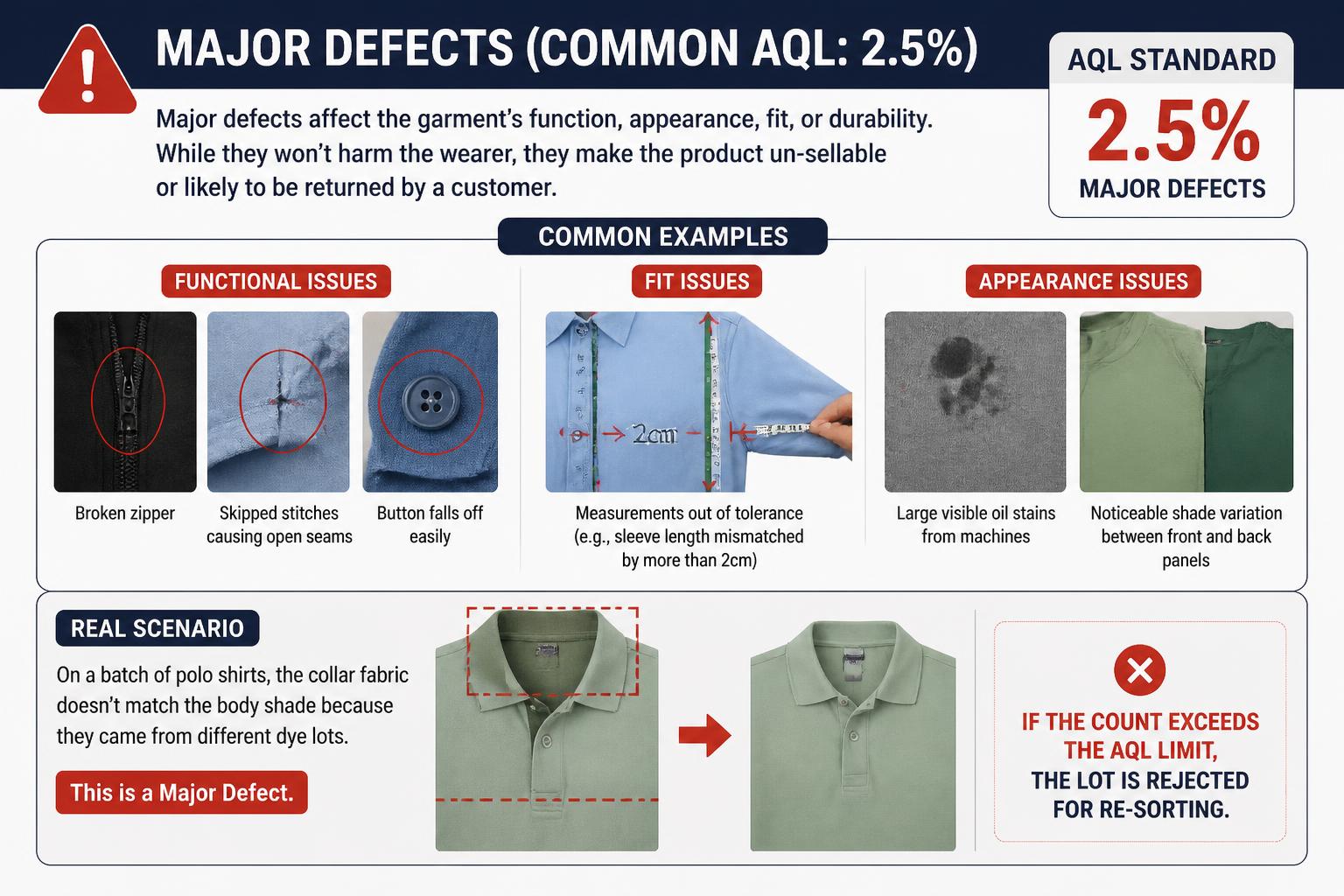
Common Examples:
- Functional Issues: Broken zippers, skipped stitches causing open seams, or buttons that fall off easily.
- Fit Issues: Measurements out of tolerance (e.g., sleeve length mismatched by more than 2cm).
- Appearance: Large visible oil stains from machines, or noticeable shade variation between front and back panels.
Real Scenario:
On a batch of polo shirts, the collar fabric doesn’t match the body shade because they came from different dye lots. This is a Major Defect. If the count exceeds the AQL limit, the lot is rejected for re-sorting.
3. Minor Defects (Common AQL: 4.0%)
Minor defects are small visual issues that do not affect how the garment is worn. They are often only noticeable upon close inspection. In mass manufacturing, a small percentage of these is expected and accepted to maintain efficiency.
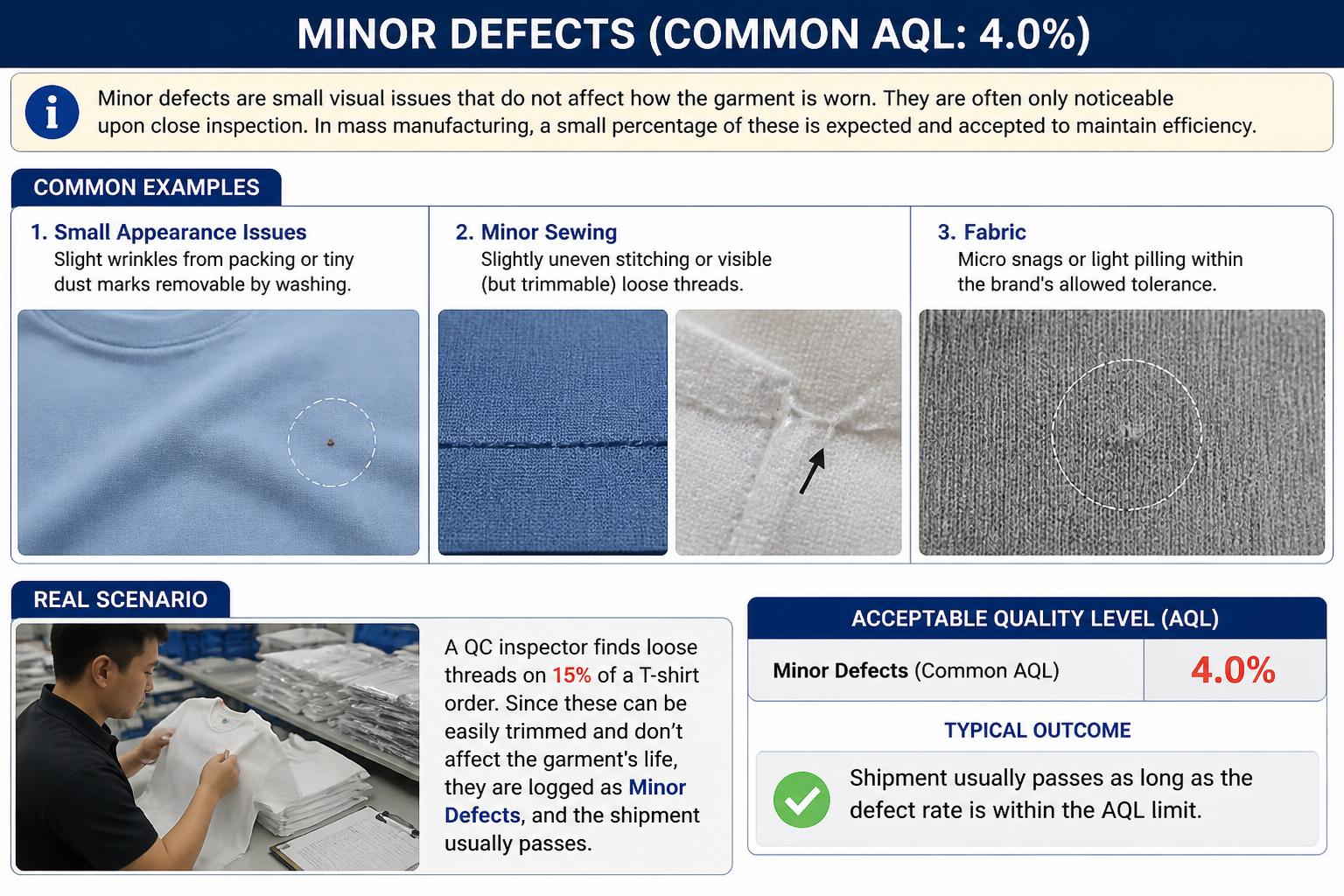
Common Examples:
- Small Appearance Issues: Slight wrinkles from packing or tiny dust marks removable by washing.
- Minor Sewing: Slightly uneven stitching or visible (but trimmable) loose threads.
- Fabric: Micro snags or light pilling within the brand’s allowed tolerance.
Real Scenario:
A QC inspector finds loose threads on 15% of a T-shirt order. Since these can be easily trimmed and don’t affect the garment’s life, they are logged as Minor Defects, and the shipment usually passes.
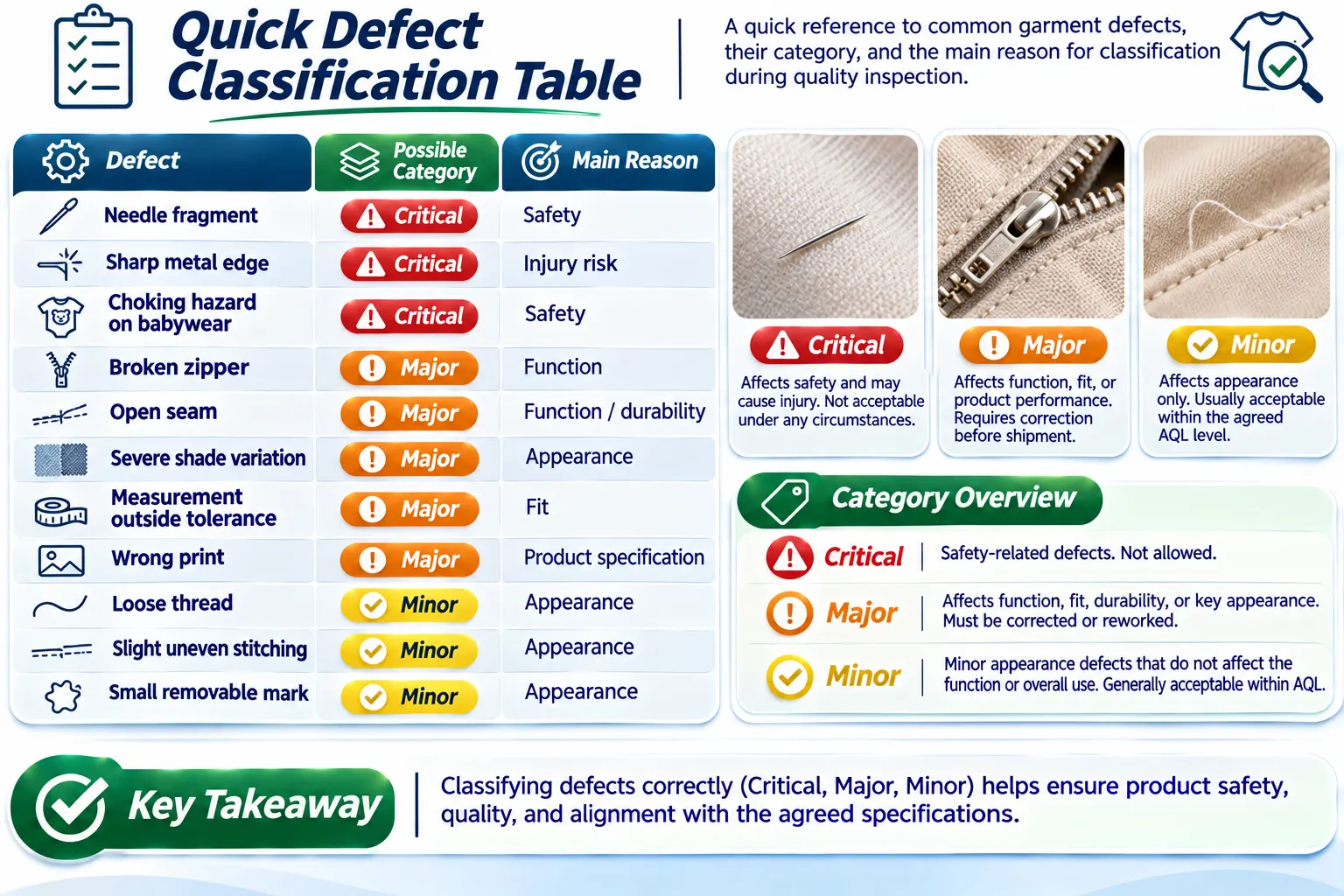
Quick Defect Classification Table
| Defect | Possible Category | Main Reason |
|---|---|---|
| Needle fragment | Critical | Safety |
| Sharp metal edge | Critical | Injury risk |
| Choking hazard on babywear | Critical | Safety |
| Broken zipper | Major | Function |
| Open seam | Major | Function / durability |
| Severe shade variation | Major | Appearance |
| Measurement outside tolerance | Major | Fit |
| Wrong print | Major | Product specification |
| Loose thread | Minor | Appearance |
| Slight uneven stitching | Minor | Appearance |
| Small removable mark | Minor | Appearance |
Summary Table of Defect Categories
| Category | AQL Limit | Primary Impact | Typical Decision |
|---|---|---|---|
| Critical | 0% | Safety & Legal | Automatic Rejection |
| Major | 1.5% – 2.5% | Fit & Function | Reject if over limit |
| Minor | 4.0% – 6.5% | Aesthetics | Usually accepted |
Conclusion / Final Words
Understanding these categories is the key to reliable quality control. Dividing issues into Critical, Major, and Minor levels allows factories like Mekong Garment and buyers to judge quality fairly and objectively. This system reduces disputes, prevents unnecessary rework, and ensures that every shipment meets the international standards your brand deserves.
FAQs About Defect Categories in Garment Inspection (Critical / Major / Minor)
1. What Are the Three Main Types of Garment Defects?
Garment defects are commonly classified into three categories: Critical, Major, and Minor. Critical defects involve serious safety or regulatory risks. Major defects significantly affect garment function, fit, appearance, or saleability. Minor defects are small imperfections that generally do not affect the garment’s intended use. The final classification should follow the buyer’s approved quality standards.
2. What Is a Critical Defect in Garment Manufacturing?
A critical defect is a serious problem that may create a safety hazard or violate an essential product safety requirement. Examples include broken needle fragments, dangerous sharp components, choking hazards on infant clothing, and failure to meet mandatory flammability requirements. Critical defects usually have zero tolerance under the agreed inspection plan.
3. What Is a Major Garment Defect?
A major defect is a problem that significantly affects the garment’s function, appearance, durability, fit, or commercial acceptability. Common examples include broken zippers, open seams, large visible stains, incorrect garment measurements, and noticeable shade differences between fabric panels. Major defects can lead to customer complaints, returns, or rejection during quality inspection.
4. What Is a Minor Garment Defect?
A minor defect is a small imperfection that does not significantly affect garment performance, appearance, or customer use. Examples may include a short loose thread, slightly uneven stitching, or a small removable mark. However, the same issue may be classified differently depending on its location, visibility, severity, and the buyer’s quality requirements.
5. What Is the Difference Between Critical, Major, and Minor Defects?
The main difference is the severity of the problem. Critical defects involve serious safety or compliance risks. Major defects substantially reduce garment quality, functionality, or saleability. Minor defects have limited impact and are generally cosmetic. Clear classification helps factories and buyers make consistent quality-control decisions.
6. What Does AQL Mean in Garment Inspection?
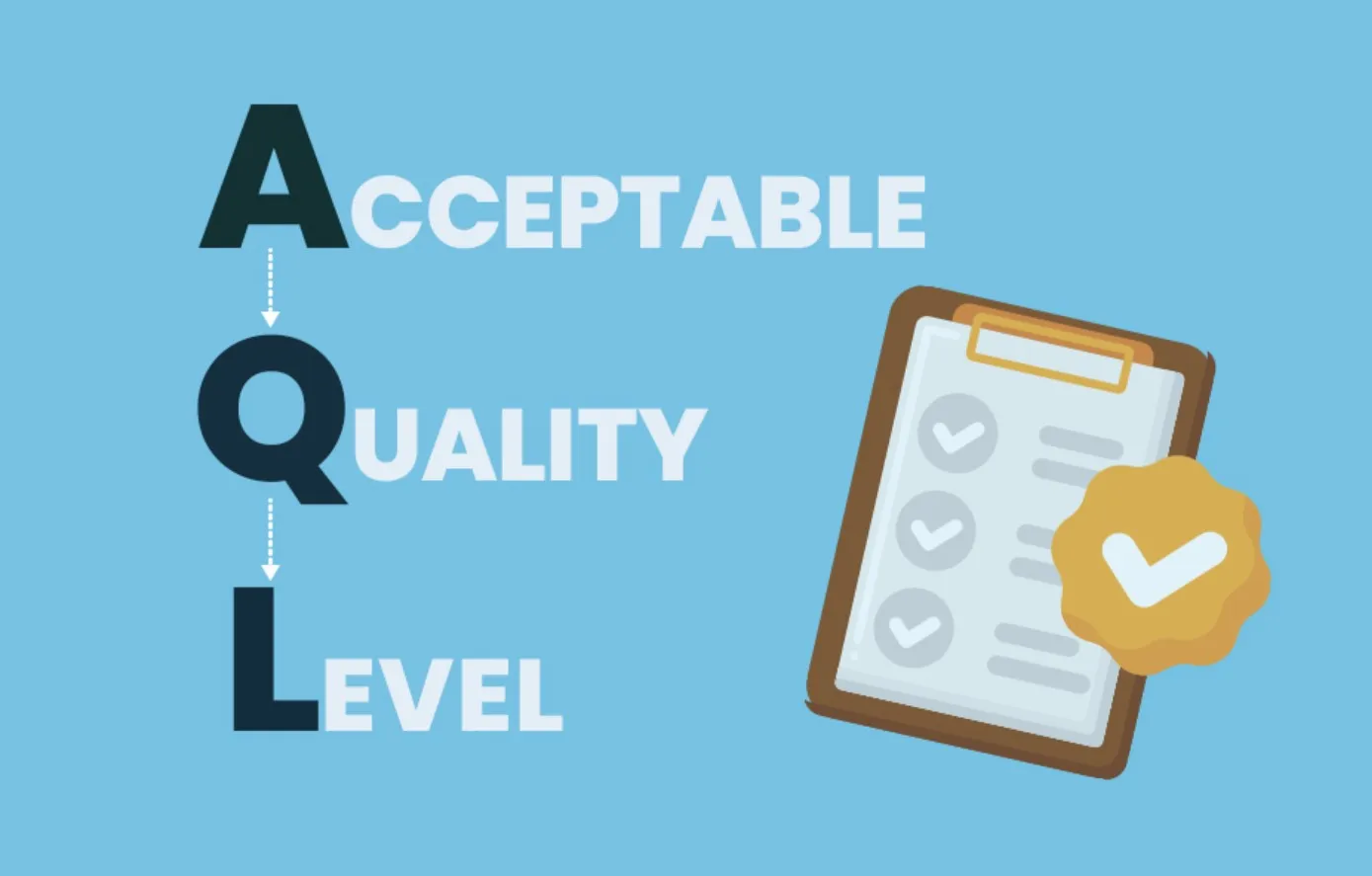
AQL stands for Acceptance Quality Limit. It is a statistical quality level used to select sampling plans and determine acceptance or rejection criteria for production lots. Inspectors use the lot size, inspection level, and selected AQL values to determine how many garments to inspect and the relevant acceptance and rejection numbers. Related Article: Acceptable Quality Limit (AQL): What It Means and How It Works.
7. What Are the Common AQL Levels for Garment Defects?
A commonly used garment inspection arrangement is zero tolerance for critical defects, AQL 2.5 for major defects, and AQL 4.0 for minor defects. However, these values are not mandatory for every garment order. Buyers may specify stricter or different inspection criteria depending on product type, safety requirements, brand standards, and commercial agreements.
8. Does AQL 2.5 Mean That 2.5% of Garments Can Be Defective?
No. AQL 2.5 does not automatically mean that 2.5% of the garments in a shipment may be defective. AQL is an index used with a statistical sampling plan. The permitted number of nonconforming items or defects in an inspection sample depends on the selected sampling standard, sample size, inspection level, and counting method.
9. Does One Critical Defect Automatically Fail an Entire Shipment?
Under a zero-acceptance critical-defect inspection rule, discovering one critical defect causes the inspected lot to fail that acceptance criterion. The shipment should be placed on hold while the issue is investigated and appropriate containment and corrective actions are taken. The required response, including sorting, additional testing, rework, or reinspection, depends on the hazard, applicable requirements, and buyer agreement.
10. Can One Garment Have More Than One Defect Category?
Yes. A garment may contain several different defects. For example, a shirt could have an open seam classified as major and a loose thread classified as minor. Inspectors must follow the agreed counting method and inspection instructions to determine how these findings affect the final result. A critical safety issue should always be addressed regardless of other defects.