
Cotton muslin fabric is one of the most versatile woven textiles used in clothing design, garment development, and home textiles. Known for its simple construction and wide range of weights, muslin can serve many purposes, from making affordable fitting samples to producing soft, lightweight clothing. Many people associate muslin with plain, unfinished cotton fabric. However, muslin is not limited to one texture or quality. Some varieties are coarse and economical, while others are fine, smooth, and suitable for finished garments.
In the fashion industry, cotton muslin plays an important role in pattern development. Designers use it to test garment shapes, check measurements, and improve fit before cutting expensive production fabrics. But what exactly is cotton muslin fabric? How does it compare with cotton gauze, lawn, and poplin? And when should clothing brands choose it? This guide explains the properties, types, advantages, disadvantages, and practical applications of cotton muslin fabric.
What Is Cotton Muslin Fabric?
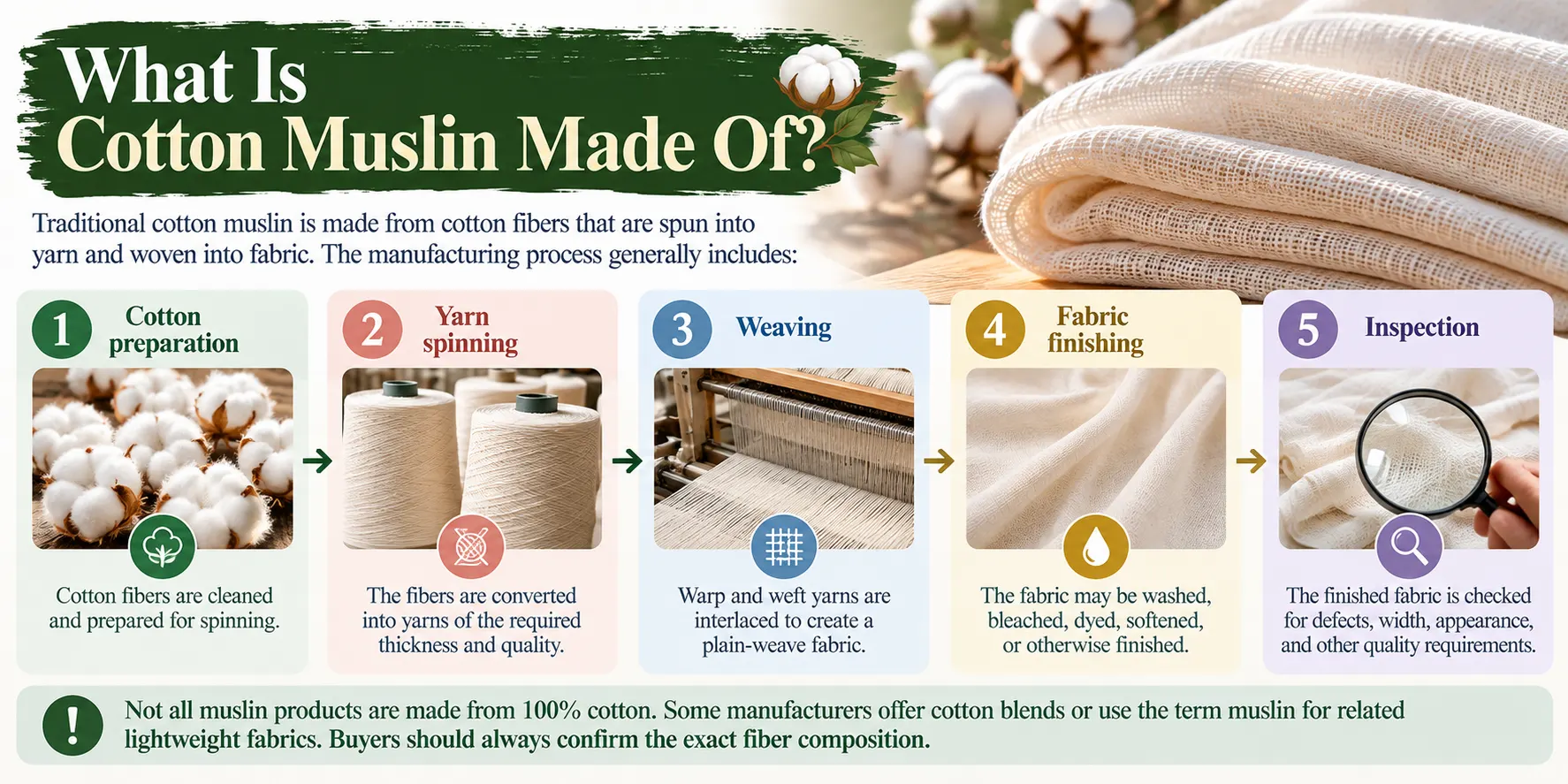
Cotton muslin is a woven fabric made from cotton yarns, usually using a plain-weave construction. It is available in different weights, yarn qualities, densities, and finishes. In a plain weave, the weft yarn passes alternately over and under the warp yarns. This creates a simple, balanced fabric structure. Muslin is often sold in natural, unbleached, or bleached shades. However, it can also be dyed, printed, or finished for specific applications. The appearance of muslin depends on how it is manufactured.
- Coarse muslin: A more economical fabric with a relatively rough texture.
- Medium-weight muslin: Commonly used for sewing practice, pattern testing, and garment prototypes.
- Fine muslin: Made with finer yarns and a smoother finish, making it suitable for selected clothing applications.
- Lightweight muslin: Often soft and airy, depending on its weave density and finishing process.
Unlike fabrics defined by a narrow set of characteristics, muslin covers a broad category of cotton textiles.
What Is Cotton Muslin Made Of?
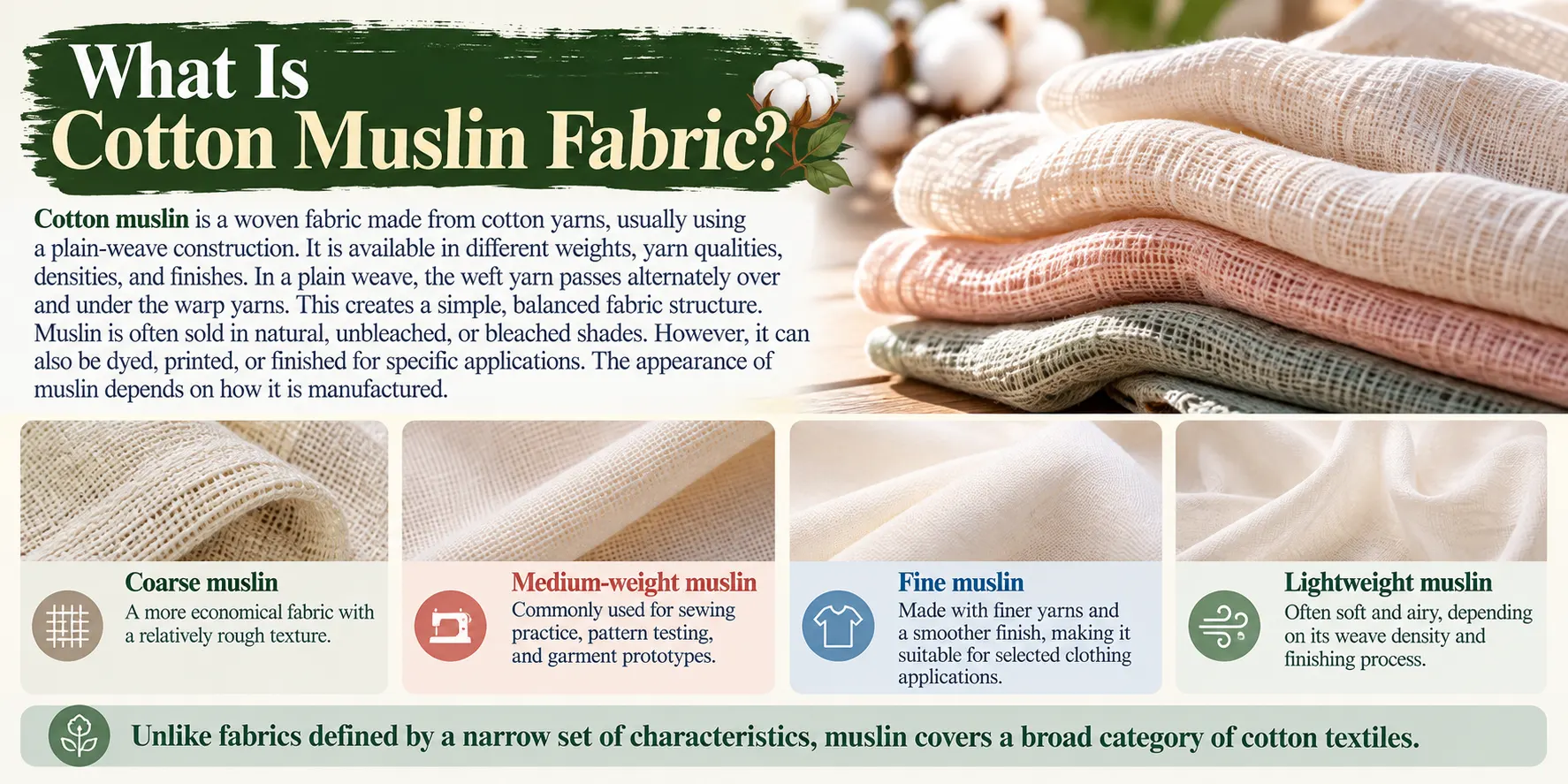
Traditional cotton muslin is made from cotton fibers that are spun into yarn and woven into fabric. The manufacturing process generally includes:
- Cotton preparation: Cotton fibers are cleaned and prepared for spinning.
- Yarn spinning: The fibers are converted into yarns of the required thickness and quality.
- Weaving: Warp and weft yarns are interlaced to create a plain-weave fabric.
- Fabric finishing: The fabric may be washed, bleached, dyed, softened, or otherwise finished.
- Inspection: The finished fabric is checked for defects, width, appearance, and other quality requirements.
Not all muslin products are made from 100% cotton. Some manufacturers offer cotton blends or use the term muslin for related lightweight fabrics. Buyers should always confirm the exact fiber composition.
Why Is It Called Muslin?
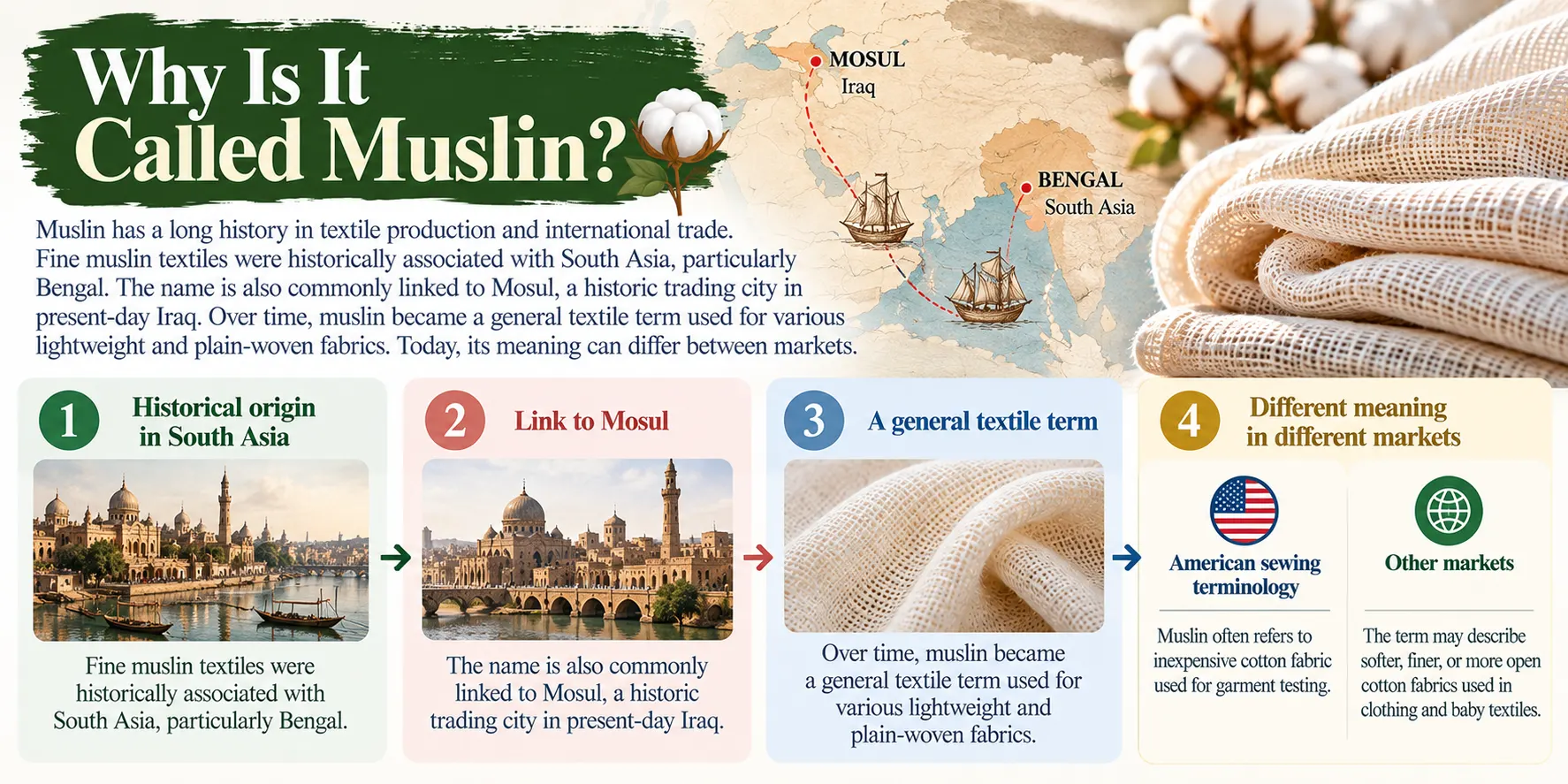
Muslin has a long history in textile production and international trade. Fine muslin textiles were historically associated with South Asia, particularly Bengal. The name is also commonly linked to Mosul, a historic trading city in present-day Iraq. Over time, muslin became a general textile term used for various lightweight and plain-woven fabrics. Today, its meaning can differ between markets. In American sewing terminology, muslin often refers to inexpensive cotton fabric used for garment testing. In other markets, the term may describe softer, finer, or more open cotton fabrics used in clothing and baby textiles.
Characteristics of Cotton Muslin Fabric
Cotton muslin has several properties that make it useful for clothing design and textile manufacturing. However, these characteristics vary depending on fabric weight, yarn quality, weave density, and finishing.
| Property | Description |
|---|---|
| Fiber composition | Usually cotton, although blends are available |
| Weave structure | Primarily plain weave |
| Fabric weight | Available from lightweight to relatively heavy |
| Texture | Ranges from coarse to fine and smooth |
| Breathability | Generally allows airflow, depending on fabric density |
| Softness | Depends on yarn quality and finishing |
| Stretch | Limited natural stretch in conventional woven muslin |
| Transparency | Lightweight or open constructions may be sheer |
| Durability | Varies with yarn strength, fabric density, and construction |
| Shrinkage | Cotton varieties may shrink during washing |
| Wrinkle resistance | Generally wrinkles more easily than many synthetic fabrics |
| Common uses | Garment samples, dresses, blouses, linings, and home textiles |
Different Types of Cotton Muslin Fabric
Cotton muslin is available in several varieties. The most suitable choice depends on the intended use.
| Type | Main Characteristics | Common Applications |
|---|---|---|
| Unbleached muslin | Natural color, basic finish | Prototypes, crafts, fitting samples |
| Bleached muslin | White appearance, varied quality | Linings, crafts, selected garments |
| Fine muslin | Fine yarns, smoother texture | Blouses, dresses, scarves |
| Medium-weight muslin | Balanced body and workability | Pattern development, garment testing |
| Heavyweight muslin | More body, generally thicker | Structured samples, covers, crafts |
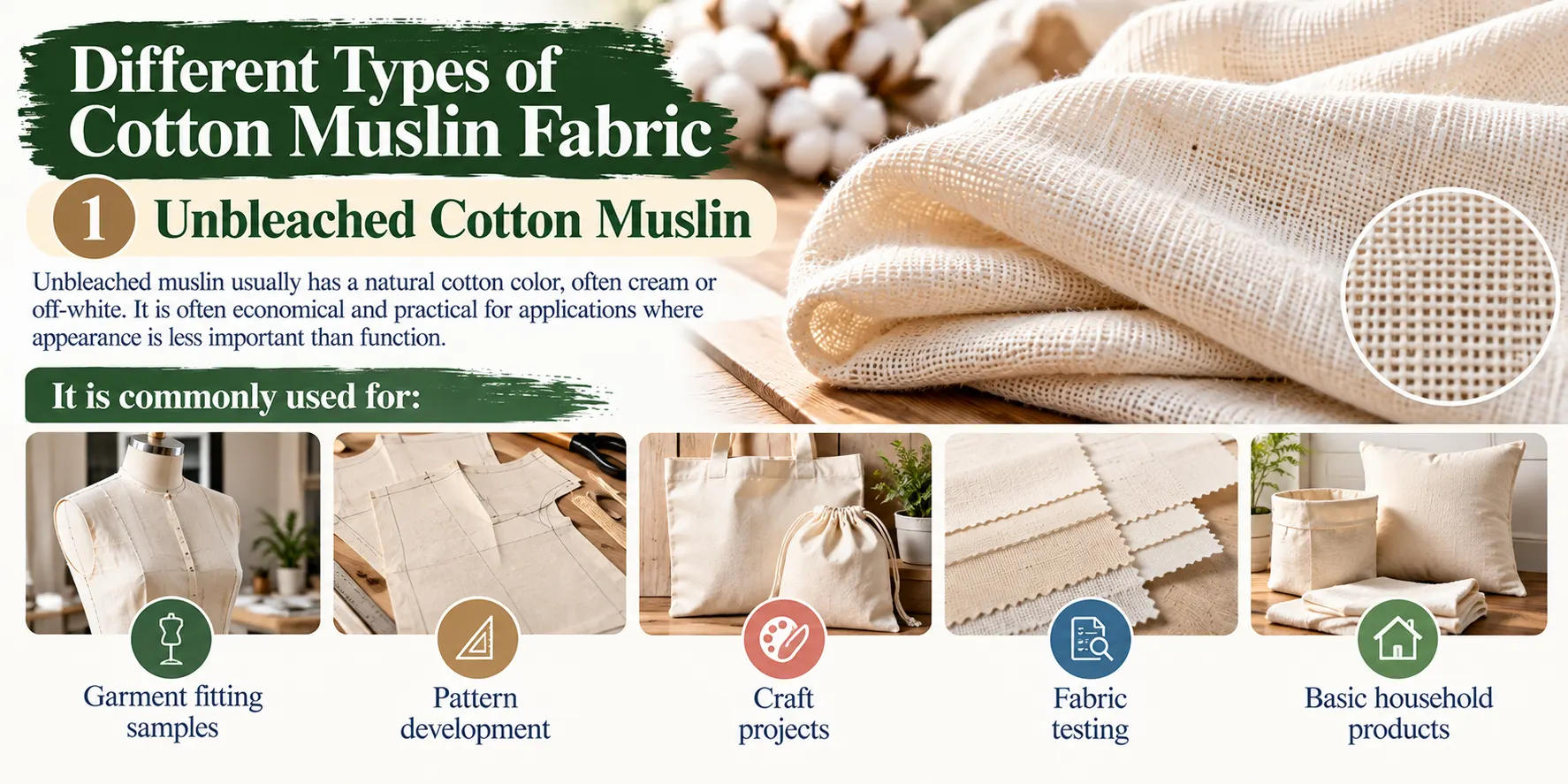
1. Unbleached Cotton Muslin
Unbleached muslin usually has a natural cotton color, often cream or off-white. It is commonly used for:
- Garment fitting samples
- Pattern development
- Craft projects
- Fabric testing
- Basic household products
Unbleached muslin is often economical and practical for applications where appearance is less important than function.
2. Bleached Cotton Muslin
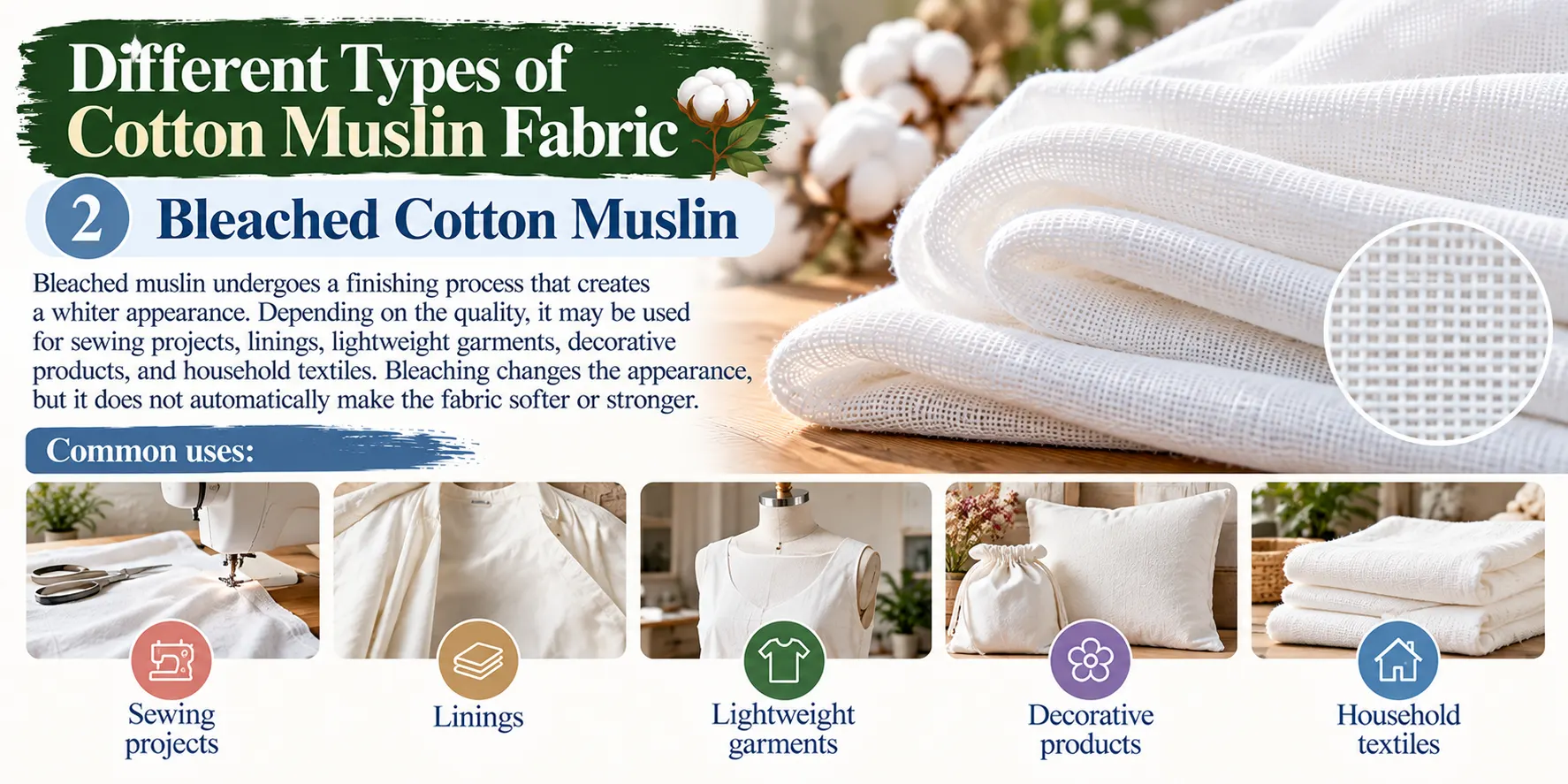
Bleached muslin undergoes a finishing process that creates a whiter appearance. Depending on the quality, it may be used for sewing projects, linings, lightweight garments, decorative products, and household textiles. Bleaching changes the appearance, but it does not automatically make the fabric softer or stronger.
3. Fine Cotton Muslin
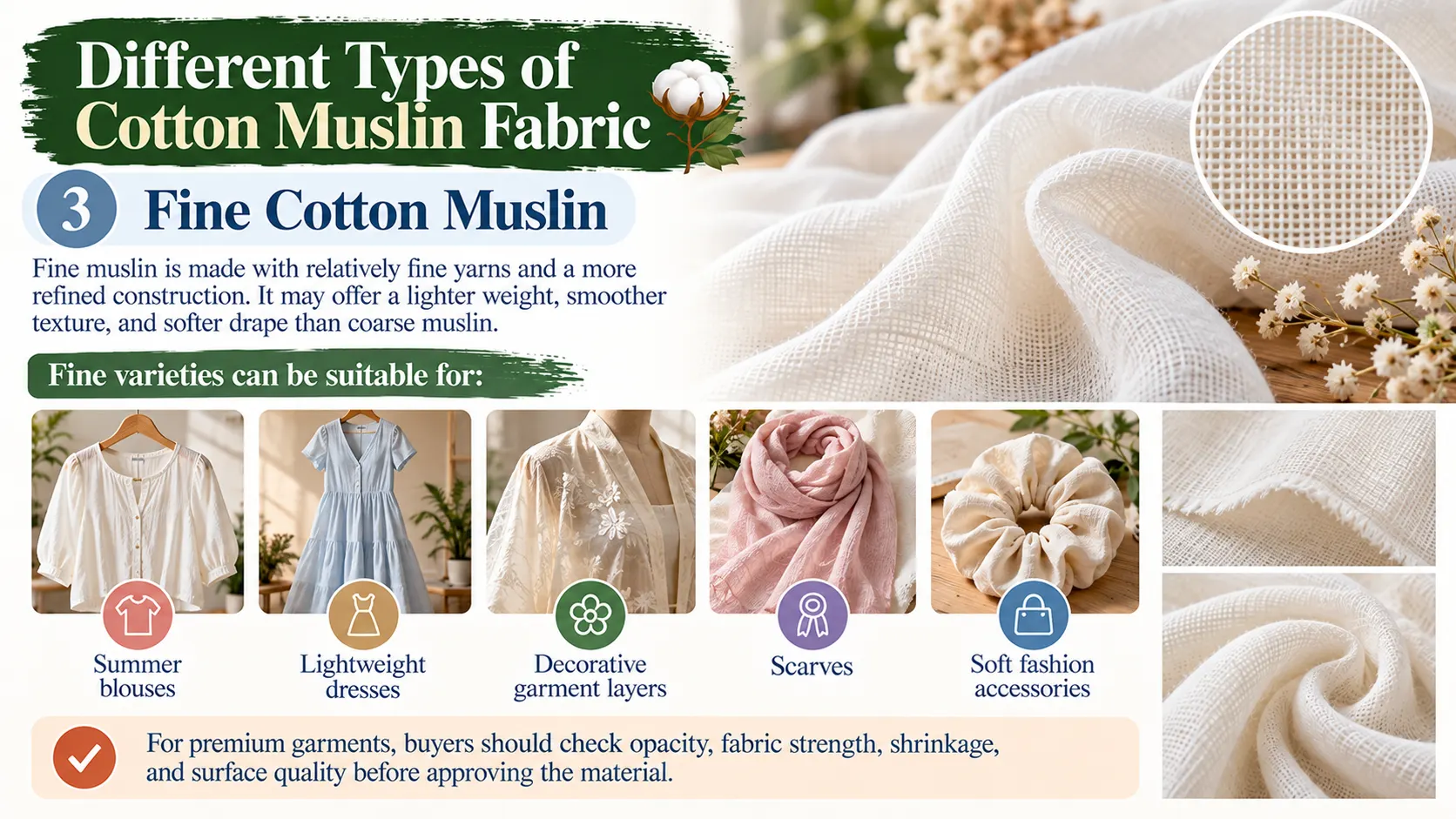
Fine muslin is made with relatively fine yarns and a more refined construction. It may offer a lighter weight, smoother texture, and softer drape than coarse muslin. Fine varieties can be suitable for:
- Summer blouses
- Lightweight dresses
- Decorative garment layers
- Scarves
- Soft fashion accessories
For premium garments, buyers should check opacity, fabric strength, shrinkage, and surface quality before approving the material.
4. Medium-Weight Cotton Muslin
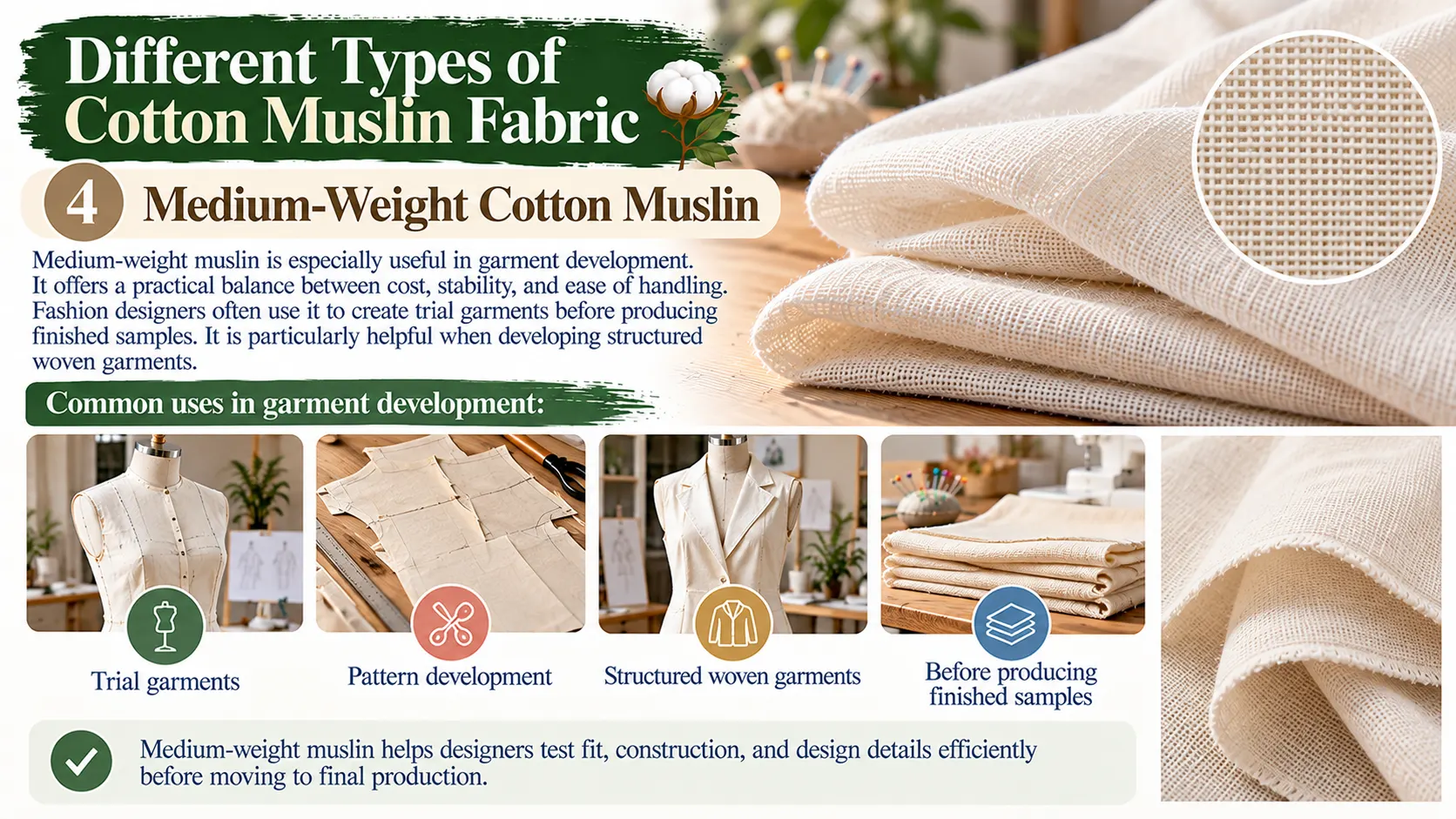
Medium-weight muslin is especially useful in garment development. It offers a practical balance between cost, stability, and ease of handling. Fashion designers often use it to create trial garments before producing finished samples. It is particularly helpful when developing structured woven garments.
5. Heavyweight Cotton Muslin
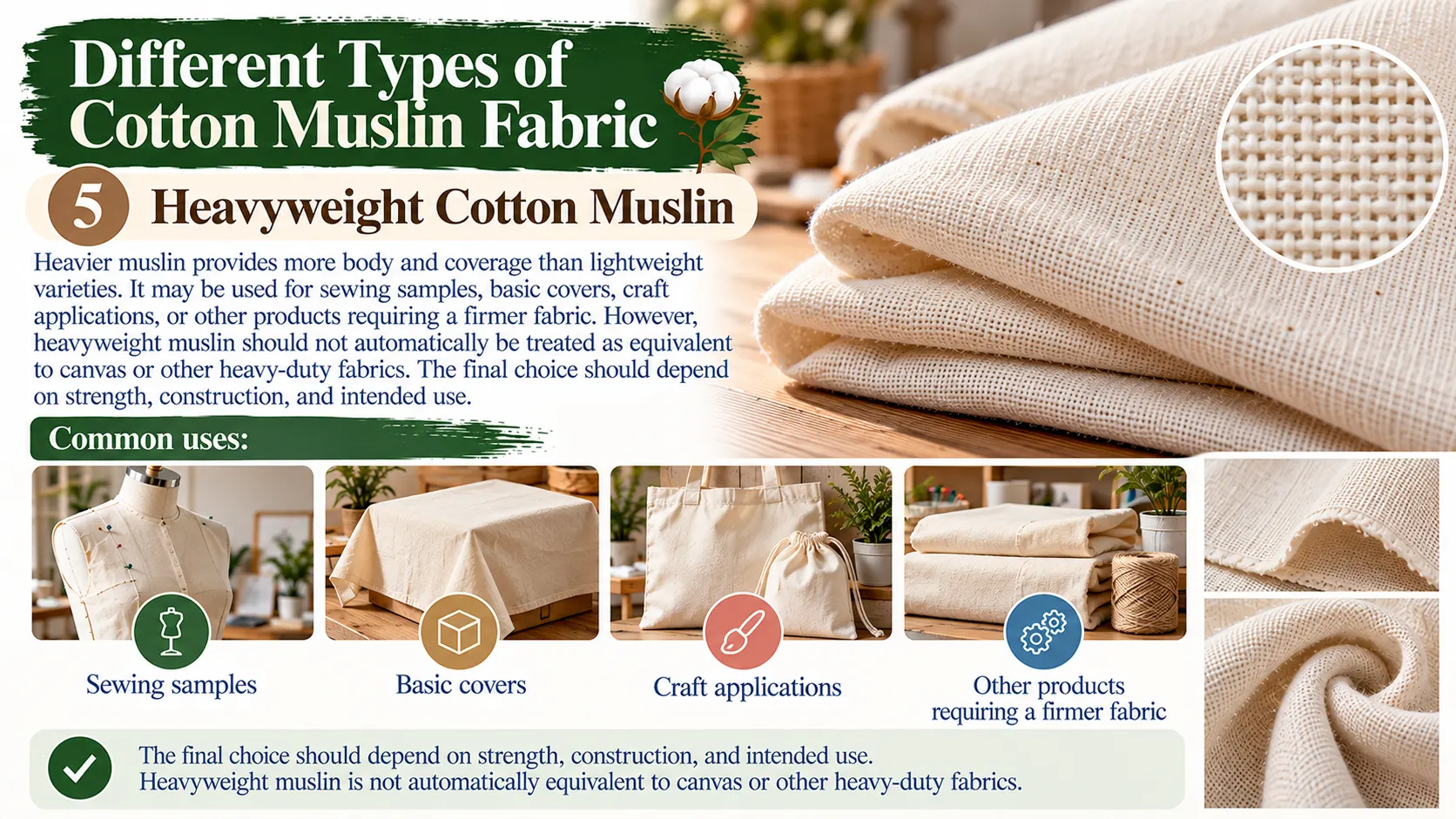
Heavier muslin provides more body and coverage than lightweight varieties. It may be used for sewing samples, basic covers, craft applications, or other products requiring a firmer fabric. However, heavyweight muslin should not automatically be treated as equivalent to canvas or other heavy-duty fabrics. The final choice should depend on strength, construction, and intended use.
Pros and Cons of Cotton Muslin Fabric
| Advantages | Disadvantages |
|---|---|
| Versatile fabric category | Quality varies between suppliers |
| Often affordable | Some varieties have a coarse texture |
| Useful for garment sampling | May shrink during washing |
| Generally easy to cut and sew | Limited natural stretch |
| Available in different weights | Can wrinkle easily |
| Fine varieties suit lightweight clothing | Some versions are sheer |
| Helpful for fit development | Open constructions may distort or fray |
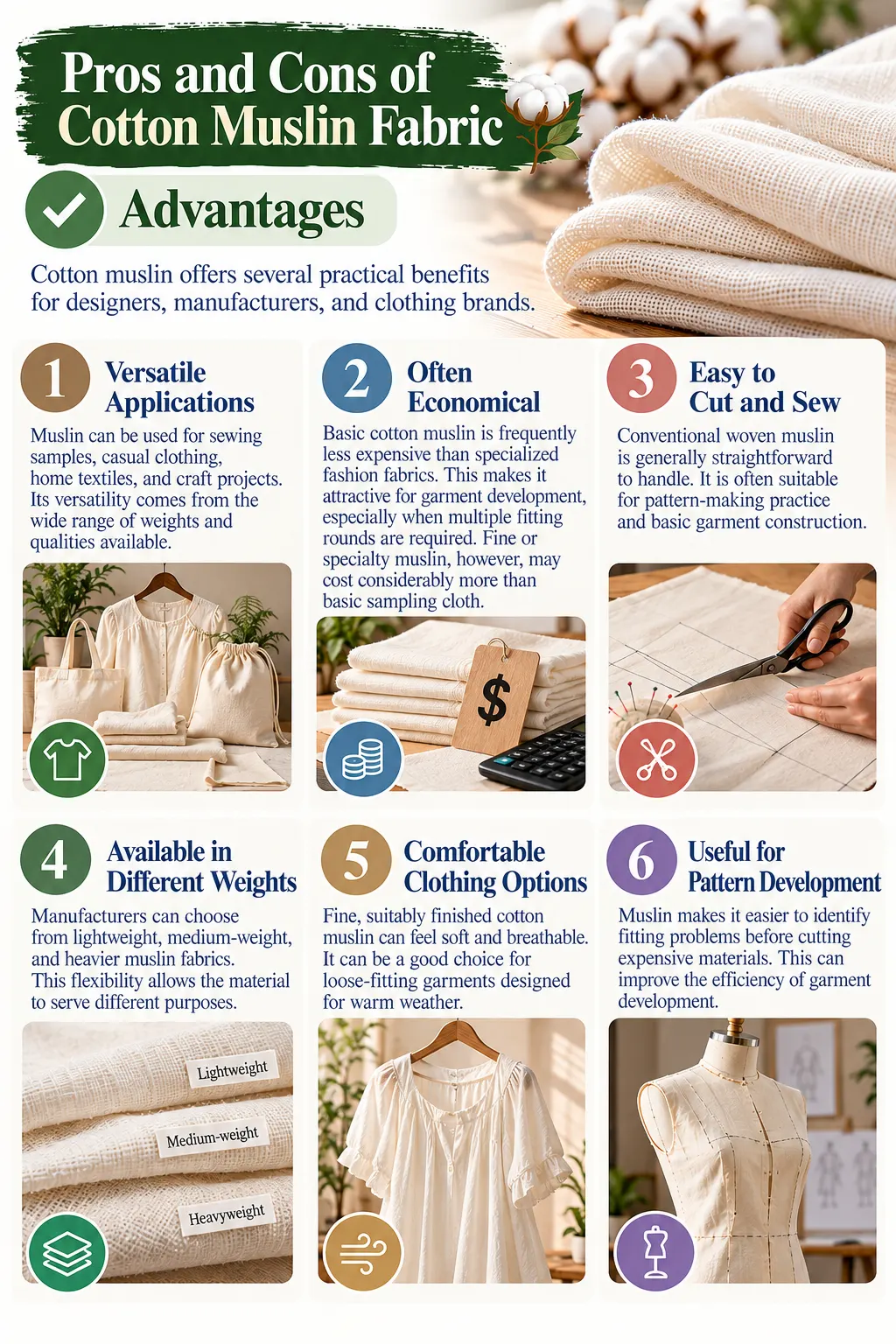
Advantages:
Cotton muslin offers several practical benefits for designers, manufacturers, and clothing brands.
- 1. Versatile Applications: Muslin can be used for sewing samples, casual clothing, home textiles, and craft projects. Its versatility comes from the wide range of weights and qualities available.
- 2. Often Economical: Basic cotton muslin is frequently less expensive than specialized fashion fabrics. This makes it attractive for garment development, especially when multiple fitting rounds are required. Fine or specialty muslin, however, may cost considerably more than basic sampling cloth.
- 3. Easy to Cut and Sew: Conventional woven muslin is generally straightforward to handle. It is often suitable for pattern-making practice and basic garment construction.
- 4. Available in Different Weights: Manufacturers can choose from lightweight, medium-weight, and heavier muslin fabrics. This flexibility allows the material to serve different purposes.
- 5. Comfortable Clothing Options: Fine, suitably finished cotton muslin can feel soft and breathable. It can be a good choice for loose-fitting garments designed for warm weather.
- 6. Useful for Pattern Development: Muslin makes it easier to identify fitting problems before cutting expensive materials. This can improve the efficiency of garment development.
Disadvantages:
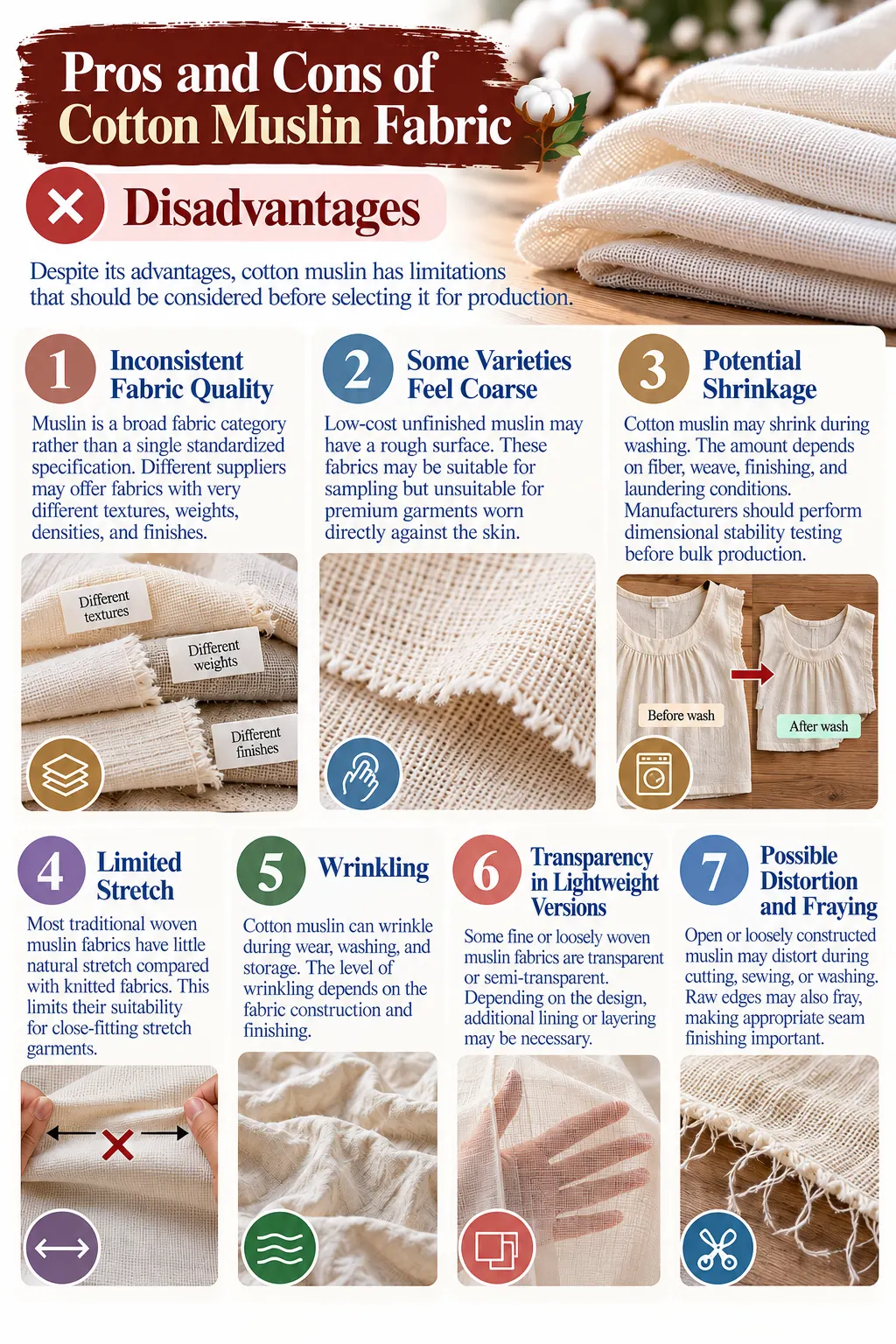
Despite its advantages, cotton muslin has limitations that should be considered before selecting it for production.
- 1. Inconsistent Fabric Quality: Muslin is a broad fabric category rather than a single standardized specification. Different suppliers may offer fabrics with very different textures, weights, densities, and finishes.
- 2. Some Varieties Feel Coarse: Low-cost unfinished muslin may have a rough surface. These fabrics may be suitable for sampling but unsuitable for premium garments worn directly against the skin.
- 3. Potential Shrinkage: Cotton muslin may shrink during washing. The amount depends on fiber, weave, finishing, and laundering conditions. Manufacturers should perform dimensional stability testing before bulk production.
- 4. Limited Stretch: Most traditional woven muslin fabrics have little natural stretch compared with knitted fabrics. This limits their suitability for close-fitting stretch garments.
- 5. Wrinkling: Cotton muslin can wrinkle during wear, washing, and storage. The level of wrinkling depends on the fabric construction and finishing.
- 6. Transparency in Lightweight Versions: Some fine or loosely woven muslin fabrics are transparent or semi-transparent. Depending on the design, additional lining or layering may be necessary.
- 7. Possible Distortion and Fraying: Open or loosely constructed muslin may distort during cutting, sewing, or washing. Raw edges may also fray, making appropriate seam finishing important.
What Is Cotton Muslin Fabric Used For?
Cotton muslin has a wide range of applications in fashion design, clothing production, and household textiles.
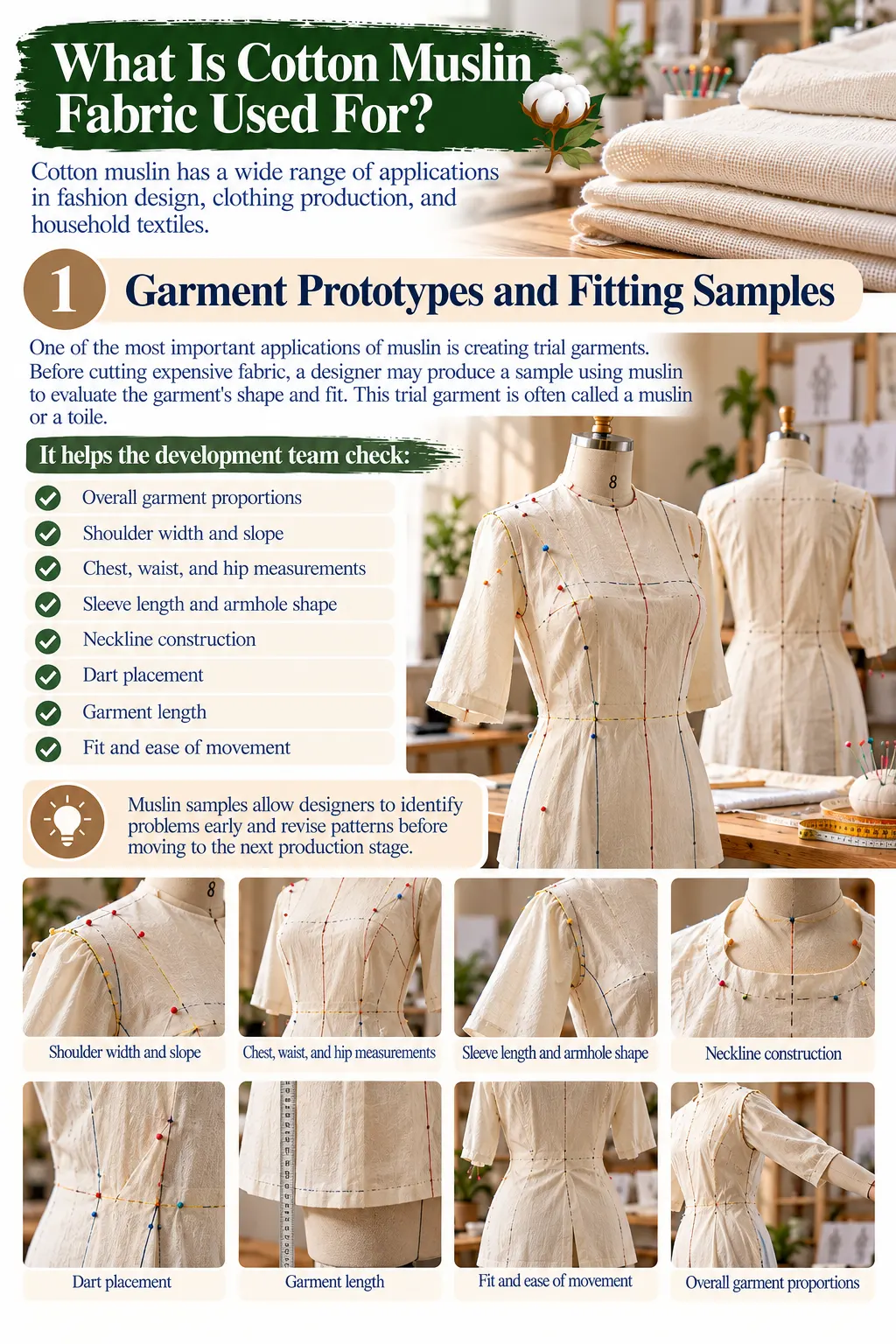
1. Garment Prototypes and Fitting Samples
One of the most important applications of muslin is creating trial garments. Before cutting expensive fabric, a designer may produce a sample using muslin to evaluate the garment’s shape and fit. This trial garment is often called a muslin or a toile. It helps the development team check:
- Overall garment proportions
- Shoulder width and slope
- Chest, waist, and hip measurements
- Sleeve length and armhole shape
- Neckline construction
- Dart placement
- Garment length
- Fit and ease of movement
Muslin samples allow designers to identify problems early and revise patterns before moving to the next production stage.
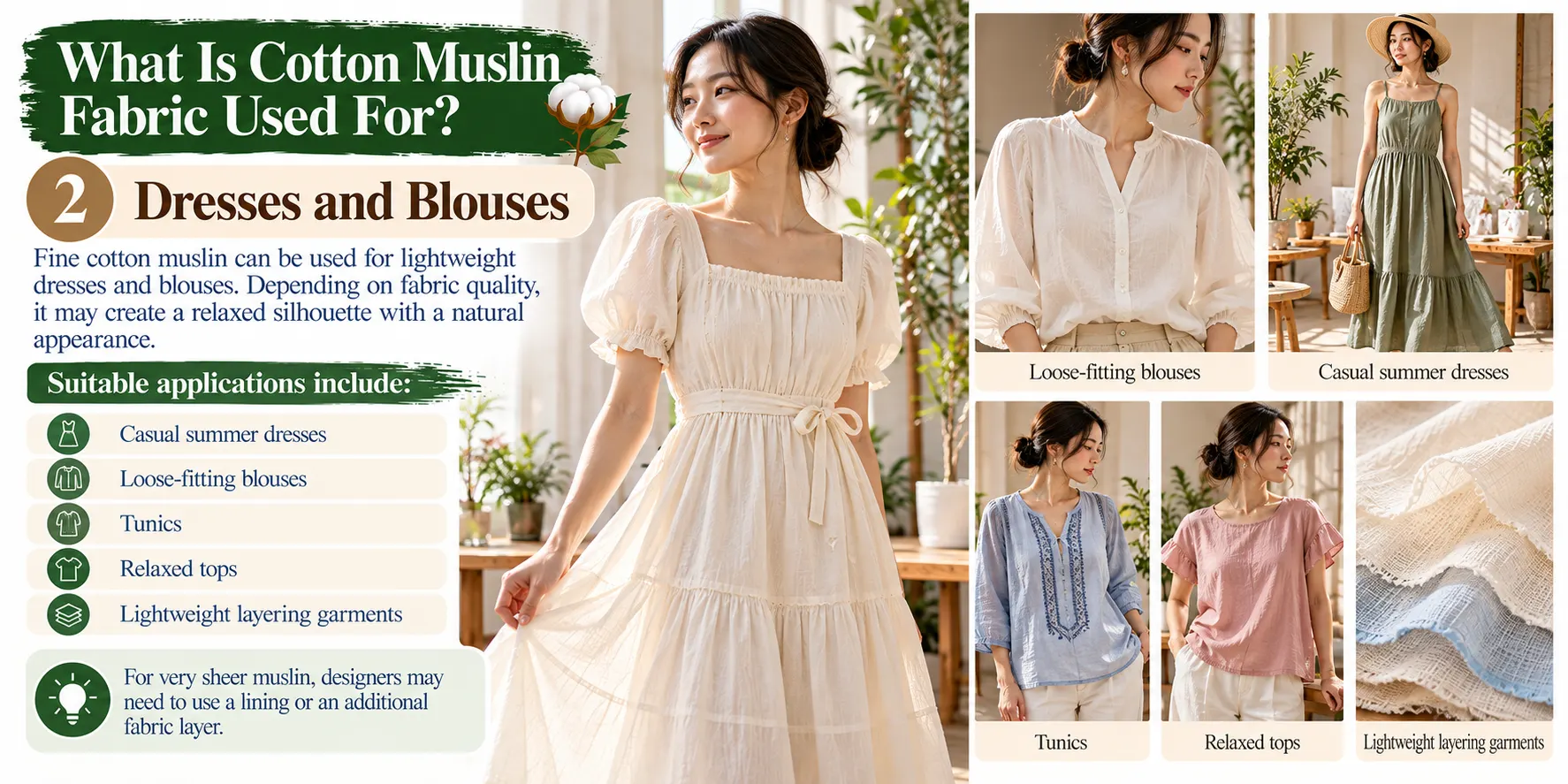
2. Dresses and Blouses
Fine cotton muslin can be used for lightweight dresses and blouses. Depending on fabric quality, it may create a relaxed silhouette with a natural appearance. Suitable applications include:
- Casual summer dresses
- Loose-fitting blouses
- Tunics
- Relaxed tops
- Lightweight layering garments
For very sheer muslin, designers may need to use a lining or an additional fabric layer.
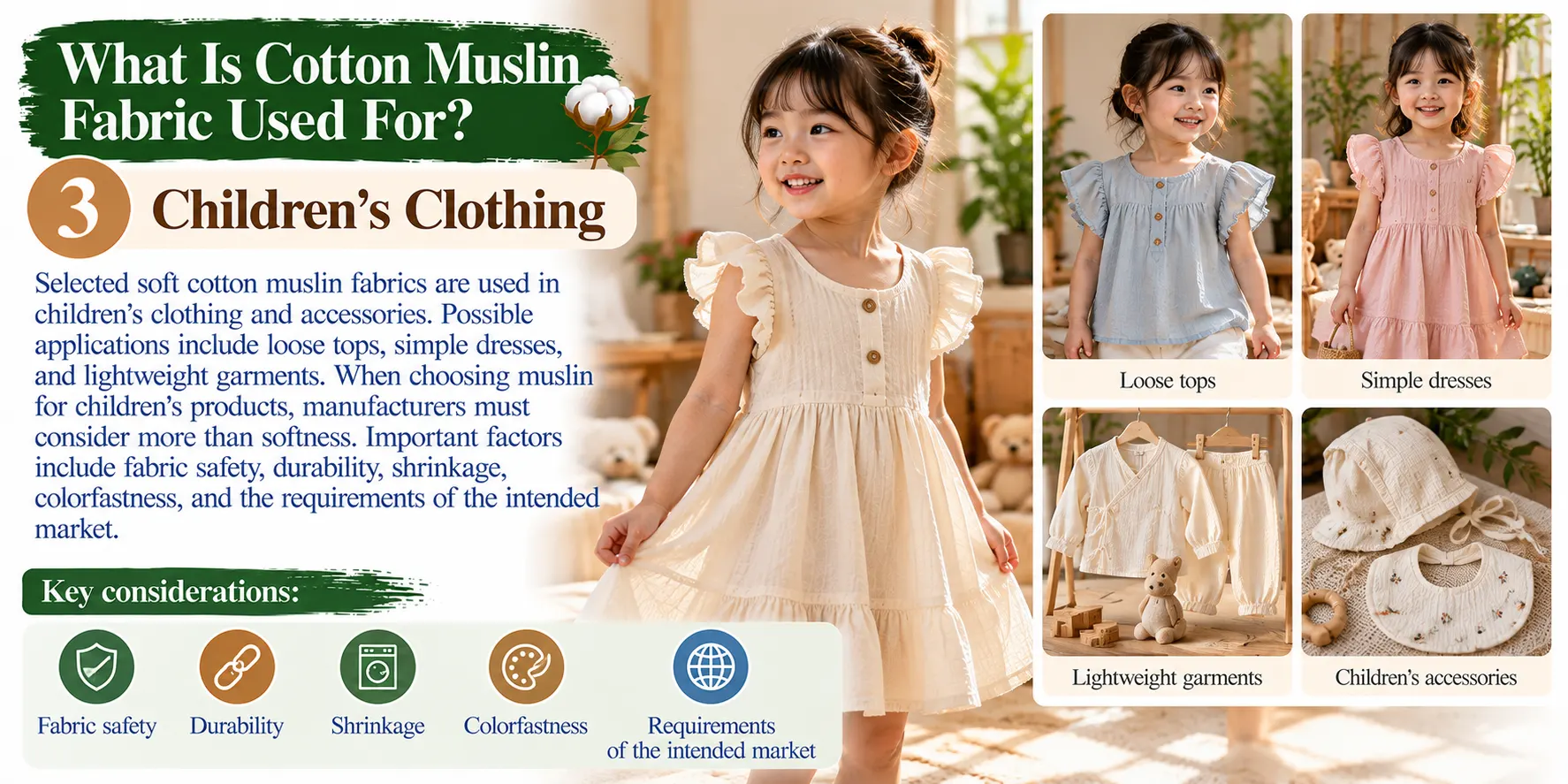
3. Children’s Clothing
Selected soft cotton muslin fabrics are used in children’s clothing and accessories. Possible applications include loose tops, simple dresses, and lightweight garments. When choosing muslin for children’s products, manufacturers must consider more than softness. Important factors include fabric safety, durability, shrinkage, colorfastness, and the requirements of the intended market.
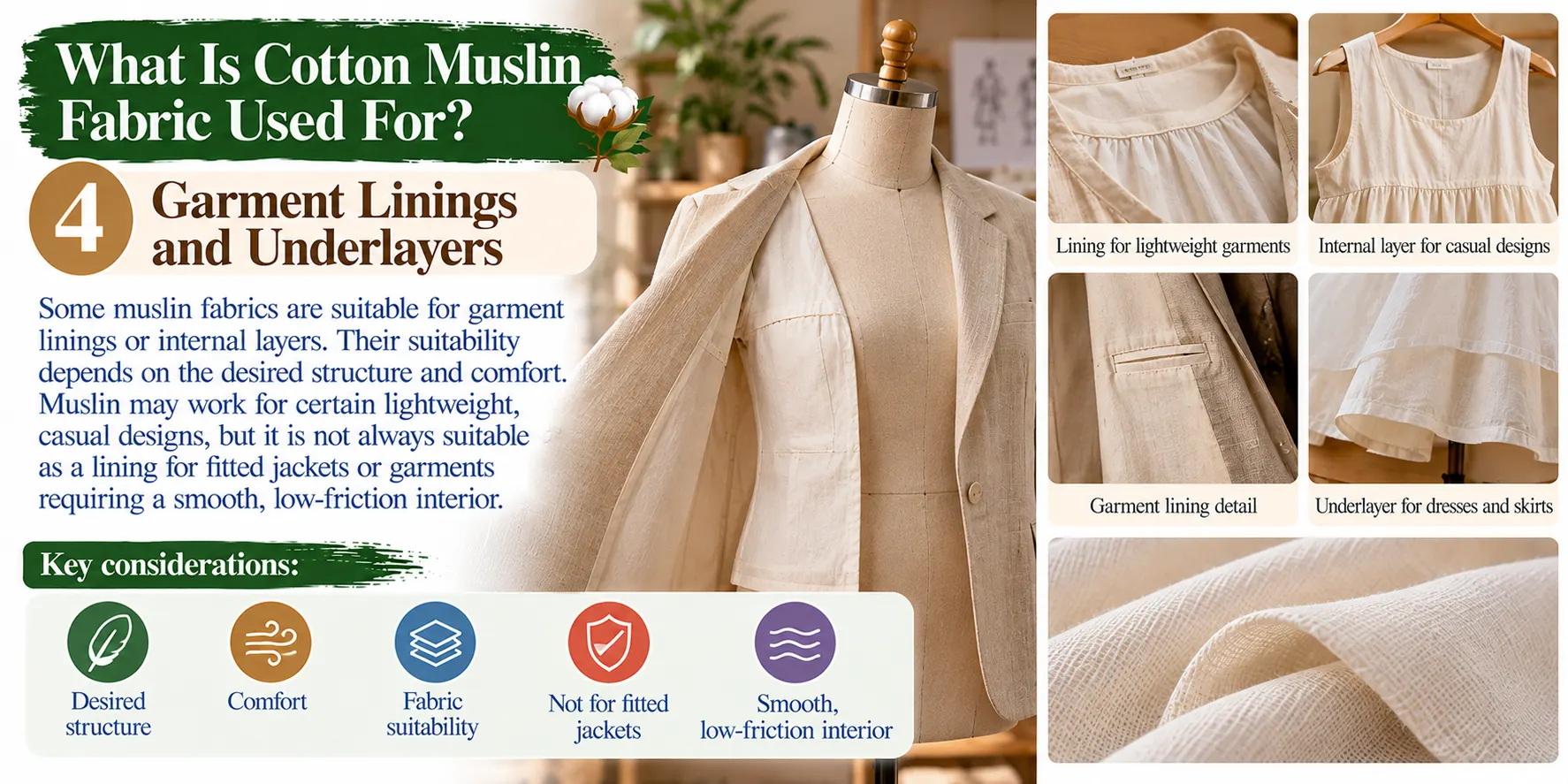
4. Garment Linings and Underlayers
Some muslin fabrics are suitable for garment linings or internal layers. Their suitability depends on the desired structure and comfort. Muslin may work for certain lightweight, casual designs, but it is not always suitable as a lining for fitted jackets or garments requiring a smooth, low-friction interior.
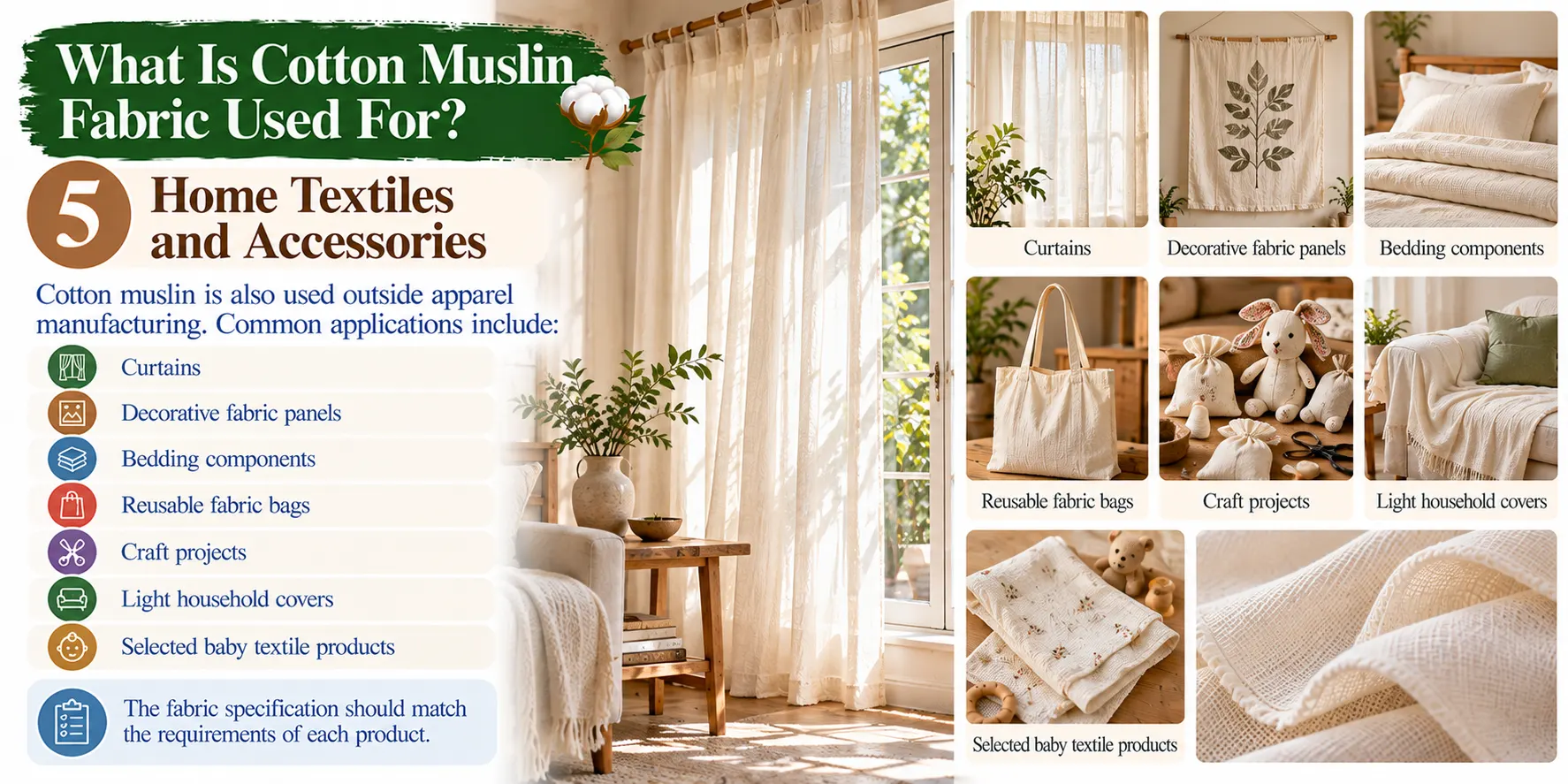
5. Home Textiles and Accessories
Cotton muslin is also used outside apparel manufacturing. Common applications include:
- Curtains
- Decorative fabric panels
- Bedding components
- Reusable fabric bags
- Craft projects
- Light household covers
- Selected baby textile products
The fabric specification should match the requirements of each product.
Cotton Muslin vs. Other Cotton Fabrics
Cotton muslin shares certain characteristics with other woven cotton fabrics, but there are important differences.
| Fabric | Typical Texture | Structure | Common Uses |
|---|---|---|---|
| Cotton muslin | Coarse to fine | Primarily plain weave | Prototypes, dresses, crafts |
| Cotton gauze | Soft, airy, often textured | Open weave; single or multiple layers | Summerwear, scarves, baby textiles |
| Cotton lawn | Fine and smooth | Fine plain weave | Blouses, dresses, shirts |
| Cotton poplin | Smooth and relatively crisp | Dense plain weave, often with a subtle rib | Shirts, uniforms, dresses |
| Cotton calico | Varies by regional definition | Usually plain weave | Samples, crafts, printed textiles |
The names above describe general fabric categories. Actual performance depends on each supplier’s specifications.
Cotton Muslin vs. Cotton Gauze
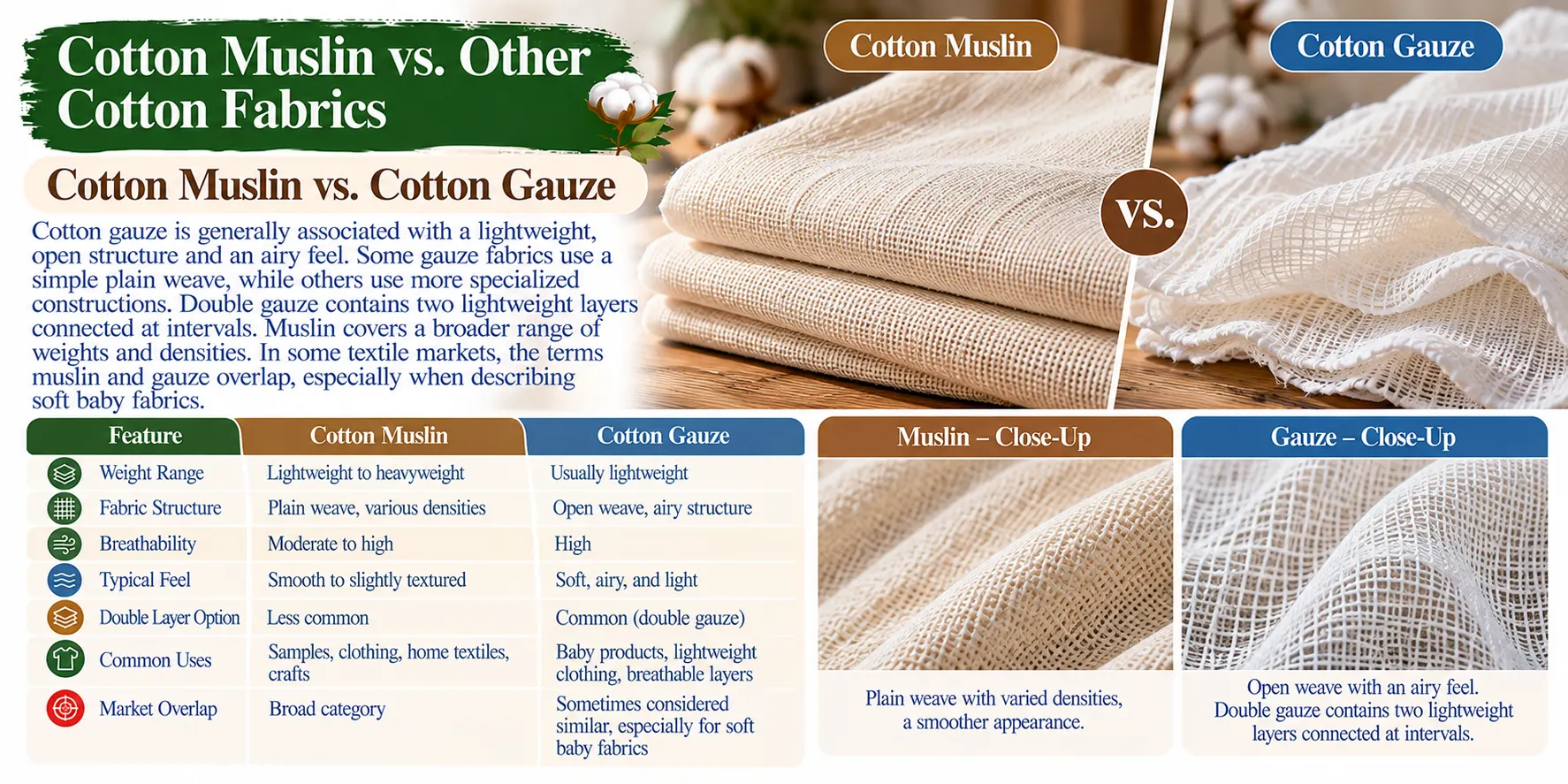
Cotton gauze is generally associated with a lightweight, open structure and an airy feel. Some gauze fabrics use a simple plain weave, while others use more specialized constructions. Double gauze contains two lightweight layers connected at intervals. Muslin covers a broader range of weights and densities. In some textile markets, the terms muslin and gauze overlap, especially when describing soft baby fabrics.
Cotton Muslin vs. Cotton Lawn
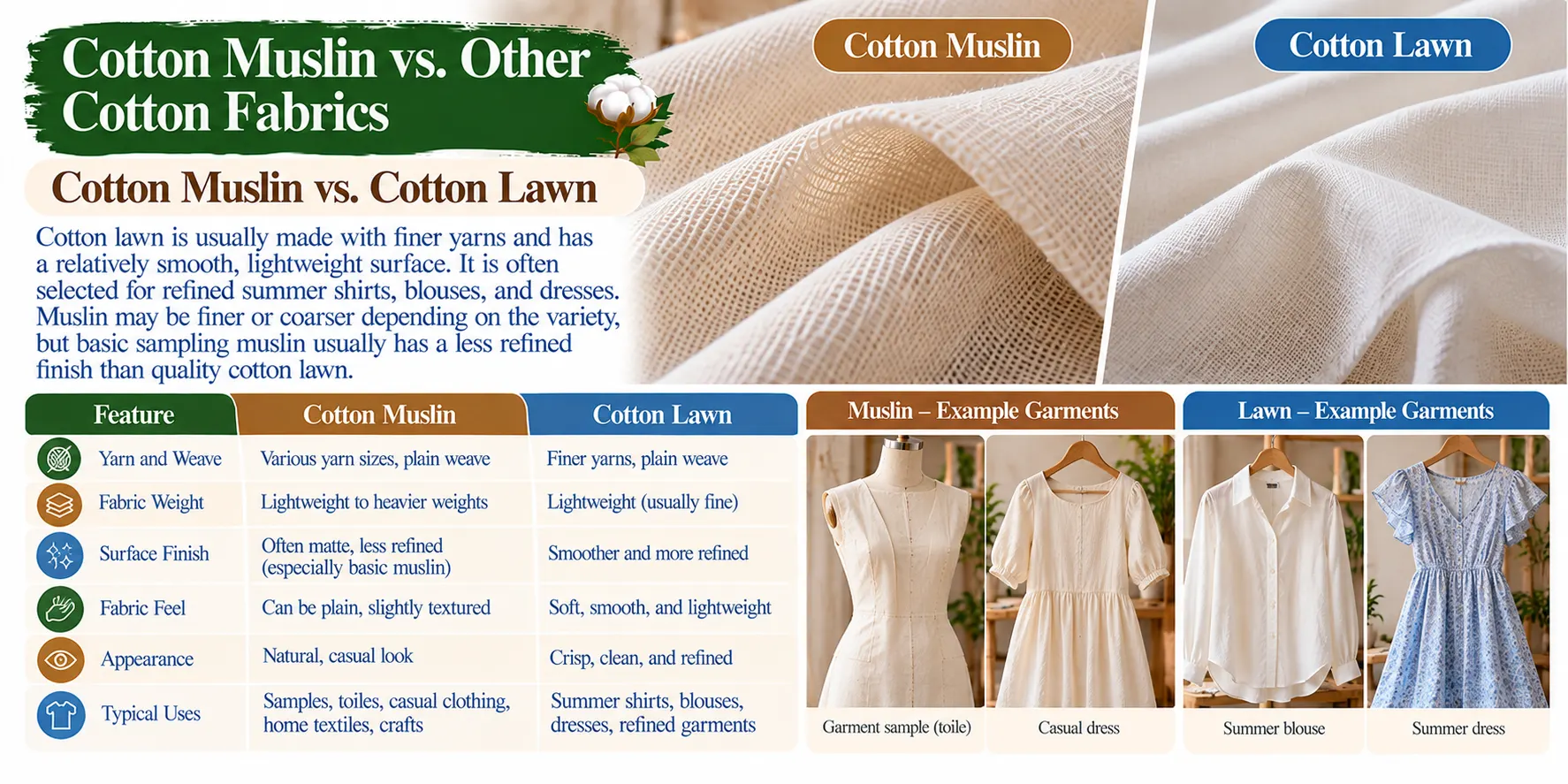
Cotton lawn is usually made with finer yarns and has a relatively smooth, lightweight surface. It is often selected for refined summer shirts, blouses, and dresses. Muslin may be finer or coarser depending on the variety, but basic sampling muslin usually has a less refined finish than quality cotton lawn.
Cotton Muslin vs. Cotton Poplin
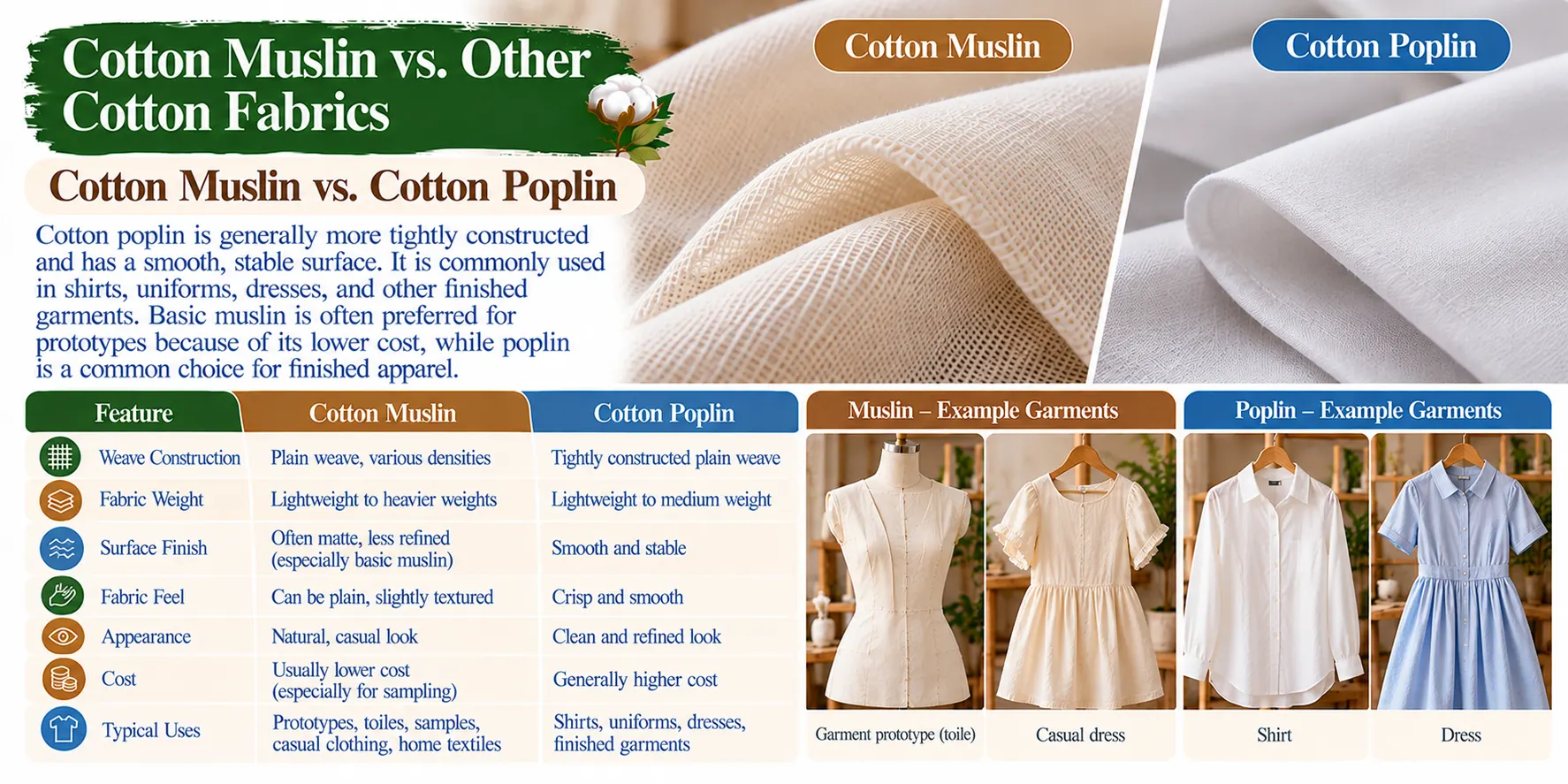
Cotton poplin is generally more tightly constructed and has a smooth, stable surface. It is commonly used in shirts, uniforms, dresses, and other finished garments. Basic muslin is often preferred for prototypes because of its lower cost, while poplin is a common choice for finished apparel.
Cotton Muslin vs. Calico
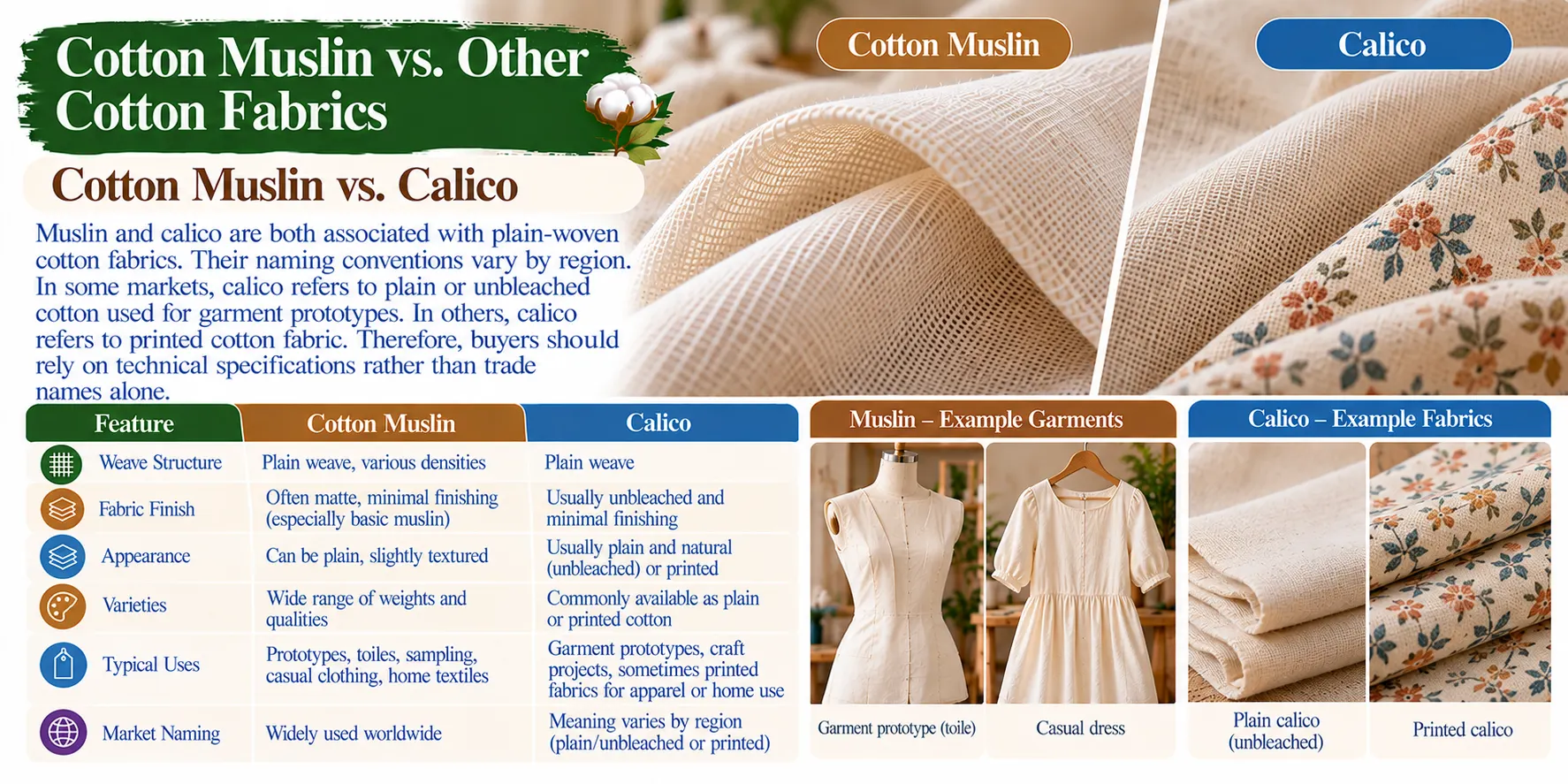
Muslin and calico are both associated with plain-woven cotton fabrics. Their naming conventions vary by region. In some markets, calico refers to plain or unbleached cotton used for garment prototypes. In others, calico refers to printed cotton fabric. Therefore, buyers should rely on technical specifications rather than trade names alone.
How to Wash and Care for Cotton Muslin Fabric
Proper care helps preserve the appearance and performance of cotton muslin. Because muslin varies widely in construction and finishing, care instructions should be based on the actual product.
Washing Cotton Muslin
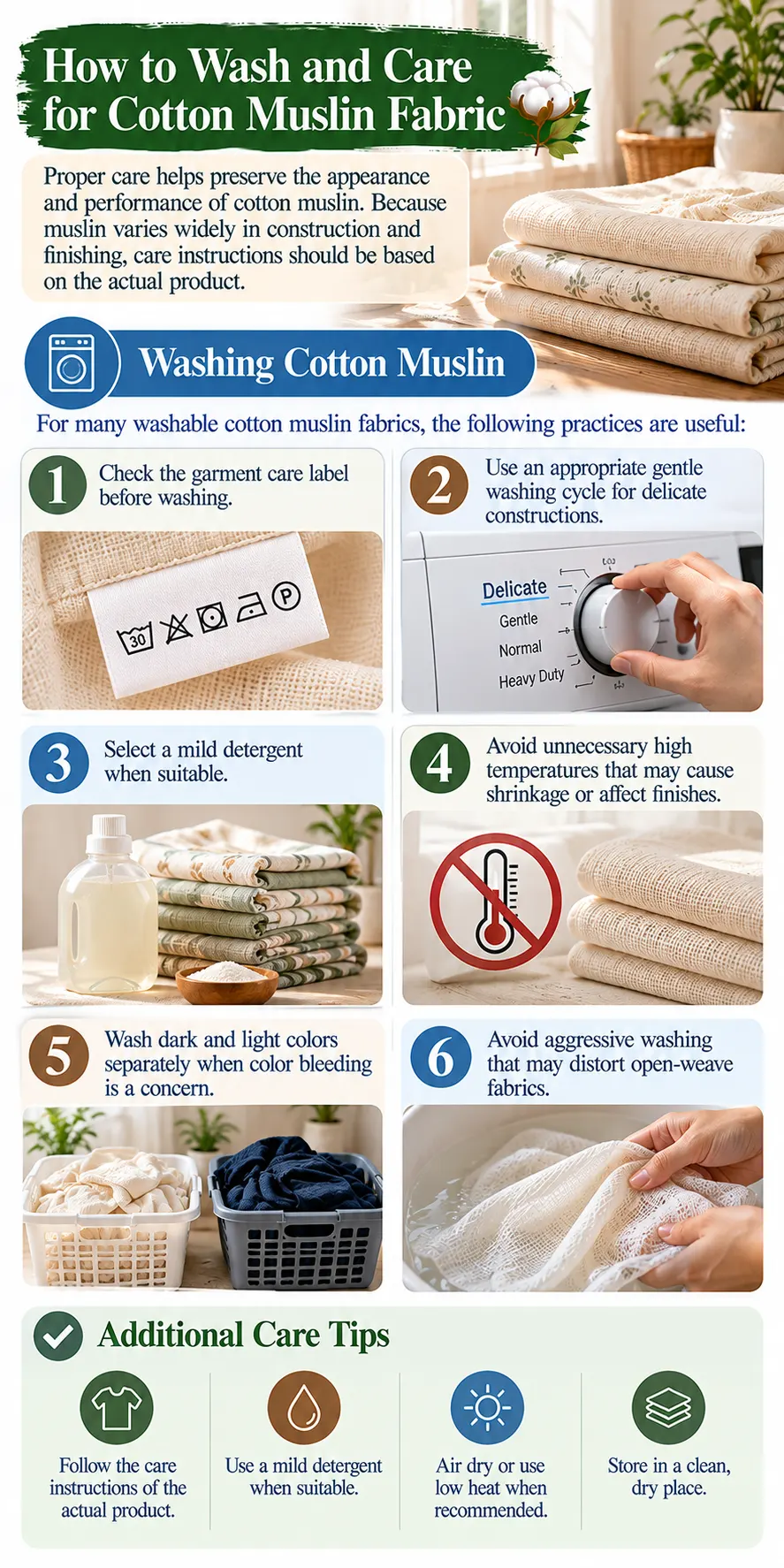
For many washable cotton muslin fabrics, the following practices are useful:
- Check the garment care label before washing.
- Use an appropriate gentle washing cycle for delicate constructions.
- Select a mild detergent when suitable.
- Avoid unnecessary high temperatures that may cause shrinkage or affect finishes.
- Wash dark and light colors separately when color bleeding is a concern.
- Avoid aggressive washing that may distort open-weave fabrics.
Drying Cotton Muslin
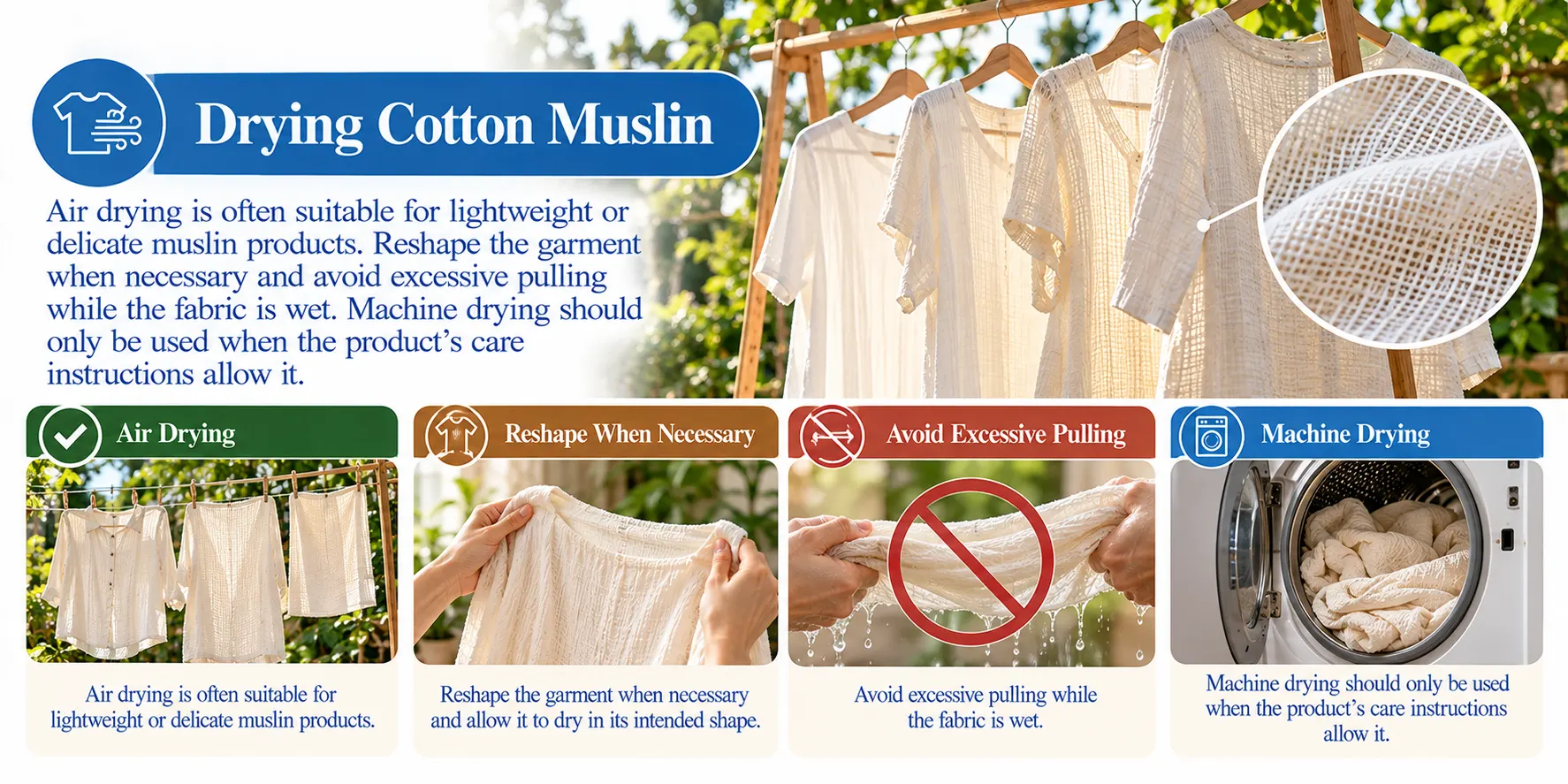
Air drying is often suitable for lightweight or delicate muslin products. Reshape the garment when necessary and avoid excessive pulling while the fabric is wet. Machine drying should only be used when the product’s care instructions allow it.
Ironing Cotton Muslin
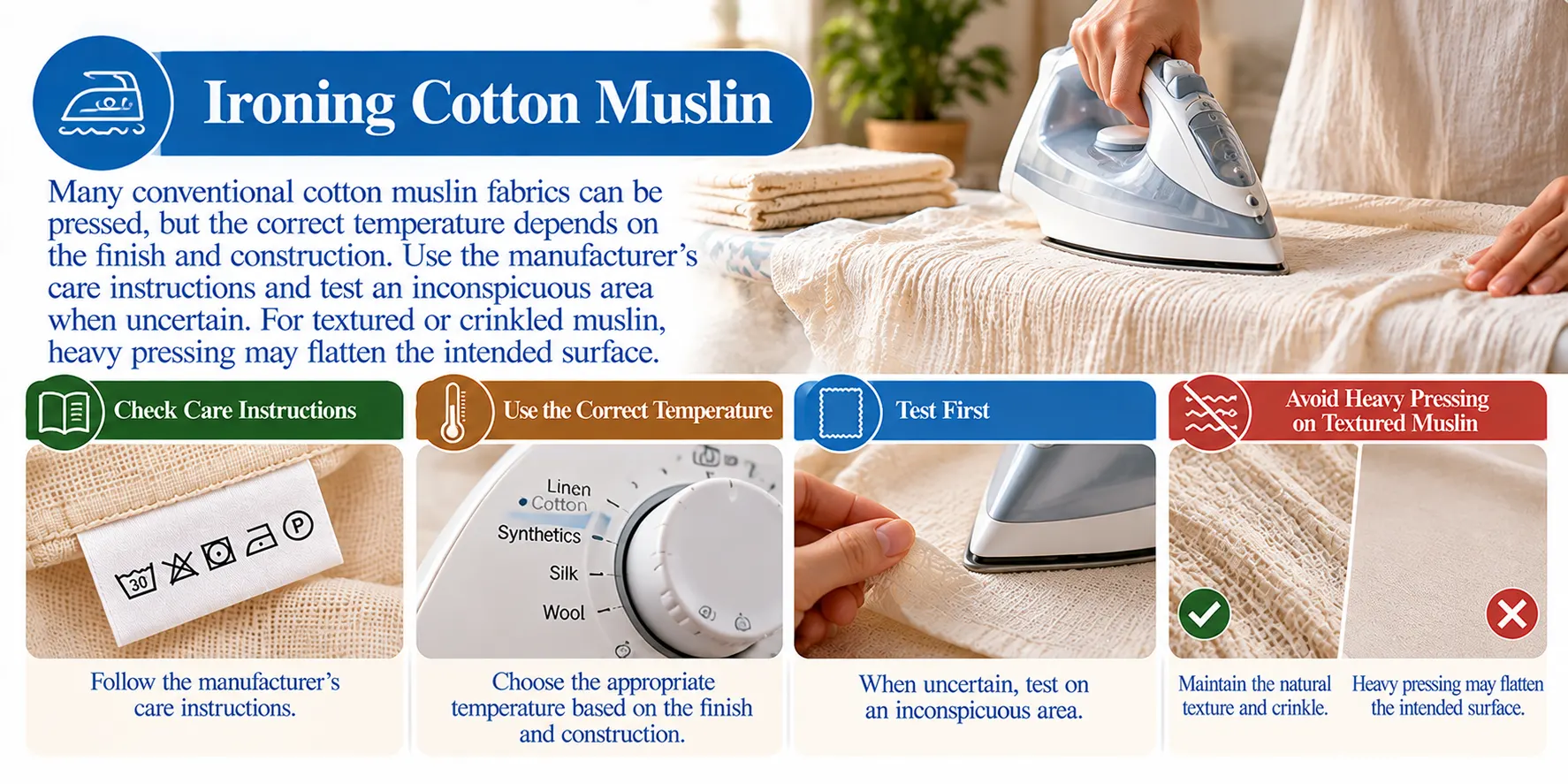
Many conventional cotton muslin fabrics can be pressed, but the correct temperature depends on the finish and construction. Use the manufacturer’s care instructions and test an inconspicuous area when uncertain. For textured or crinkled muslin, heavy pressing may flatten the intended surface.
Should Cotton Muslin Be Prewashed?
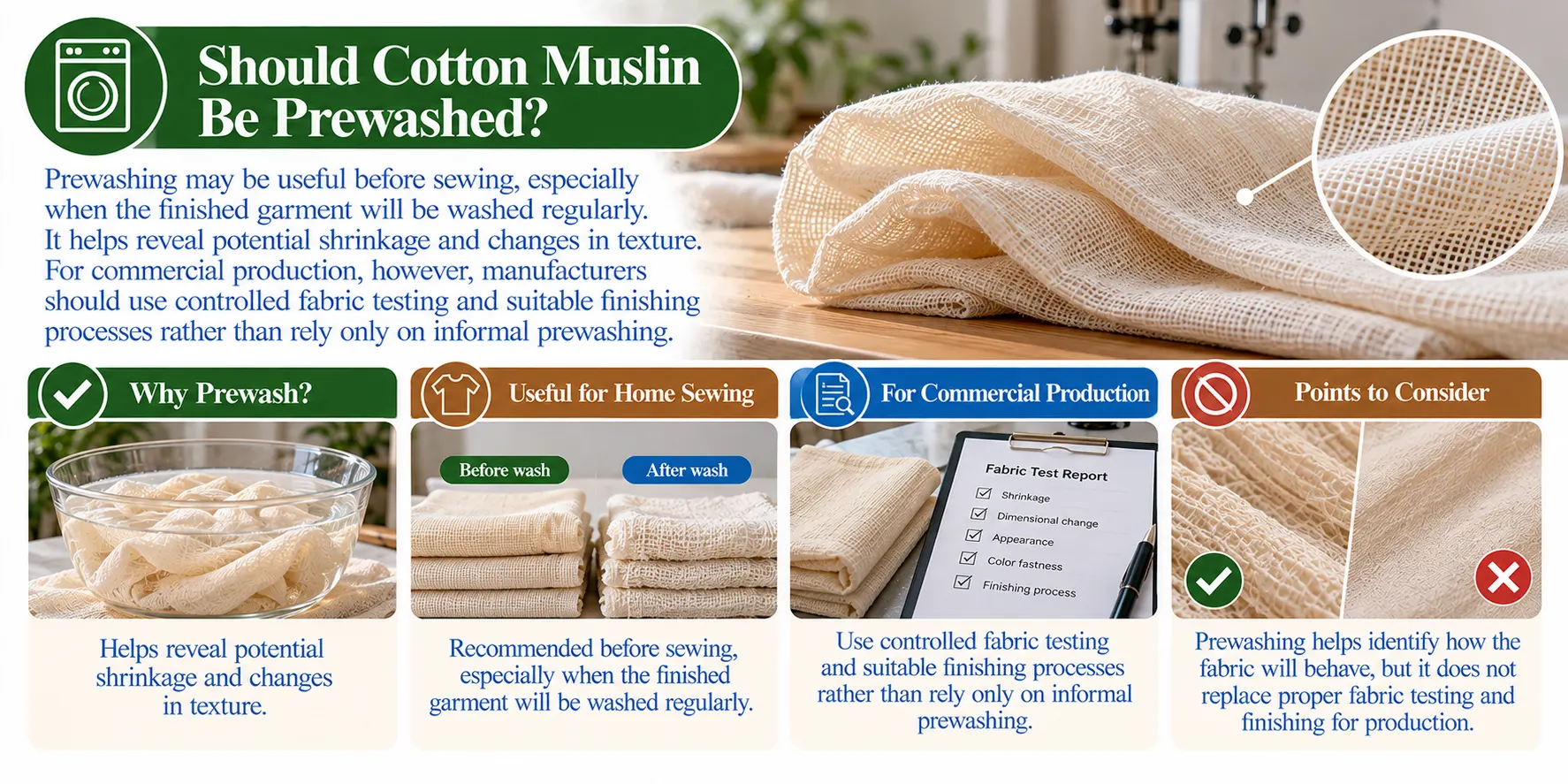
Prewashing may be useful before sewing, especially when the finished garment will be washed regularly. It helps reveal potential shrinkage and changes in texture. For commercial production, however, manufacturers should use controlled fabric testing and suitable finishing processes rather than rely only on informal prewashing.
Final Thoughts: Is Cotton Muslin Fabric the Right Choice?
Cotton muslin is a practical and versatile textile used in garment development, casual apparel, and household products. Its greatest strength is flexibility. Basic muslin provides an economical material for testing patterns, while finer varieties can be suitable for finished clothing. However, not every muslin is the same. Fabric weight, yarn quality, weave density, softness, shrinkage, and finishing can all affect its performance. For clothing brands, selecting cotton muslin should involve careful evaluation of both design needs and manufacturing requirements.