Sewing Thread Consumption: Formula, Stitch Ratios, Calculation, and Garment Examples

Sewing thread is one of the most important trims used in garment manufacturing. Although it may seem like a small item compared with fabric, its role in sewing quality, production efficiency, and garment costing is very significant.
Before starting bulk production, manufacturers need to estimate the approximate amount of thread required for each garment. This helps merchandisers, costing teams, and production planners prepare material requirements more accurately and avoid shortages during sewing. In practice, sewing thread consumption is never exactly the same for every product. It changes depending on garment type, stitch type, seam length, style details, and machine setup.
What Is Sewing Thread Consumption?
Sewing thread consumption means the total amount of thread required to manufacture one garment or sewn product.
It may be expressed as:
- Meters per garment
- Yards per garment
- Meters per seam
- Grams per garment
- Cones required for an order
For example, if one T-shirt requires approximately: 45 meters of thread
- and the order quantity is: 10,000 pieces
- then theoretical thread consumption is: 45 × 10,000 = 450,000 meters

But the factory normally needs additional thread for:
- Machine threading
- Chaining-off
- Thread trimming
- Thread breaks
- Repairs
- Rework
- Cone remnants
Therefore: Theoretical Consumption ≠ Final Purchasing Quantity
Why Sewing Thread Consumption Matters
Thread consumption is important because even a small trim must be available in the correct quantity before sewing begins. It affects several areas of garment production. Accurate sewing thread estimation is important for several reasons:
- It improves garment costing accuracy
- It supports better material planning and reduces shortage risks
- It helps control wastage on the sewing floor
- It gives merchandisers a faster way to prepare preliminary cost sheets
Garment Costing
The merchandiser needs thread consumption to calculate the trim cost of each garment.
Material Purchasing
The purchasing department needs to know:
- Thread type
- Thread size
- Color
- Cone length
- Number of cones required
Production Planning
A sewing line can stop if the correct thread is unavailable, even when the main fabric is ready.
Inventory Control
Good consumption estimates reduce unnecessary leftover cones.
BOM Preparation
Thread type, color, size, and expected consumption may be included in the Bill of Materials (BOM). So thread consumption is not simply a sewing-floor issue. It is also a costing and planning issue.
There Is No Single Thread Consumption Number for Every Garment
One common mistake is assuming that every garment category has a fixed consumption. For example: “One T-shirt always uses 35 meters.” That is not reliable. Two T-shirts can have completely different sewing constructions.
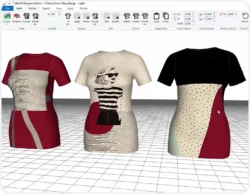
T-Shirt A
May include:
- Shoulder overlock
- Sleeve attachment
- Side seams
- Neck rib
- Sleeve hem
- Bottom hem
T-Shirt B
May additionally include:
- Chest pocket
- Shoulder tape
- Decorative topstitching
- Side vents
- Double-needle details
- Multiple labels
T-Shirt B will naturally consume more thread.
A better formula is: Garment Design + Seam Length + Stitch Construction = Base Thread Requirement
The Main Factors Affecting Sewing Thread Consumption
Thread consumption is influenced by several technical factors. Understanding them helps explain why a standard ratio should never be treated as an exact universal value.
Stitch Type
Different stitch classes create different thread paths. For example, one meter of:
- Lockstitch
- Chainstitch
- Overlock
- Coverstitch

will not require the same amount of thread. An overlock stitch wraps looper threads around the fabric edge, while a simple lockstitch has a much shorter thread path.
Generally: More Threads + More Loops + Wider Stitch Formation = More Thread Consumption
SPI — Stitches Per Inch
SPI tells us how many stitches are sewn in one inch. For example:
- 8 SPI
- 10 SPI
- 12 SPI
Higher SPI means more stitches in the same seam length.
All else being equal: Higher SPI → Usually Higher Thread Consumption
However, SPI should be selected according to:
- Fabric
- Seam strength
- Appearance
- Garment specification
It should not simply be reduced to save thread.
Fabric Thickness
Thread must travel through and around the material. A seam containing several layers of heavy denim generally requires a longer thread path than the same stitch formed on lightweight fabric. Fabric thickness becomes especially important with:
- Denim
- Canvas
- Heavy twill
- Quilted materials
- Multi-layer seams
Stitch Width
Stitch width strongly influences overlock, coverstitch, and flatseam consumption. A wider overedge stitch requires the looper thread to travel farther around the material.

Therefore: Wider Stitch → Generally More Looper Thread
Thread Tension
Machine tension changes how tightly the stitch is formed. Too much or too little tension can change consumption slightly and may also produce:
- Thread breakage
- Seam puckering
- Loose stitching
- Poor appearance
For accurate calculations, the production machine should be correctly adjusted.
Thread Size
Thread size can affect stitch formation and purchasing quantities. A thicker thread does not necessarily mean a dramatically greater length is needed for the seam. However, it affects:
- Cone capacity
- Weight
- Sewing tension
- Needle selection
- Cost
When ordering thread, always verify the supplier’s actual: Meters per Cone
3 Methods for Calculating Thread Consumption
Garment factories can estimate thread consumption in several ways.
The three most practical methods are:
- Actual stitch unraveling method
- Stitch-ratio calculation
- Historical garment consumption estimate
Each method has a different level of accuracy.
Method 1: Measuring Actual Thread From a Sewn Seam
This is one of the most useful methods when a real sample is available.
The process is simple:
- Sew or select a known seam length.
- Measure the seam.
- Carefully unravel the stitches.
- Measure each thread removed.
- Divide thread length by seam length.
- Calculate the consumption factor.
This gives you a factor based on the actual machine setup.
Method 2: Thread Consumption Ratio
During preliminary costing, there may not be enough time to unravel every seam. A faster method is to use an approximate thread consumption ratio. The general calculation is: Thread Required = Seam Length × Stitch Ratio For example: If the seam length is: 220 cm and the selected ratio is: 2.5 then: 220 × 2.5 = 550 cm or: 5.5 meters of thread before wastage.
Thread Consumption Ratios by Stitch Type – The following figures are useful as planning references, not universal constants.
| Stitch Class | Stitch Description | Approx. Total Thread / Seam Length |
|---|---|---|
| 101 | Single-Thread Chainstitch | Around 4× |
| 301 | Lockstitch | Around 2.5–3× |
| 304 | Zigzag Lockstitch | Around 6–8× |
| 401 | Two-Thread Chainstitch | Around 5–6× |
| 406 | 2-Needle, 3-Thread Coverstitch | Around 15–20× |
| 503 | 2-Thread Overedge | Around 10–13× |
| 504 | 3-Thread Overedge | Around 12–15× |
| 602 | Multi-Thread Coverstitch | Around 20–26× |
| 605 | Multi-Thread Coverstitch | Around 24–30× |
These ratios can change depending on:
- Stitch density
- Stitch width
- Thread tension
- Material thickness
- Machine configuration

So they are most useful for early costing.
Method 3: Historical Garment Estimates
During quotation, the exact pattern and sewing operation breakdown may not yet be available. Factories may therefore use historical consumption data. For example:
| Garment | Approximate Preliminary Thread Range |
|---|---|
| Basic Children’s T-Shirt | 20–35 m |
| Basic Adult T-Shirt | 30–50 m |
| Polo Shirt | 50–90 m |
| Blouse | 70–110 m |
| Casual Shirt | 80–130 m |
| Trousers | 100–200 m |
| Jeans | 140–220+ m |
| Jacket | 150–250+ m |
| Suit | 300–550+ m |
These figures should only be considered starting estimates. Construction complexity can change the result substantially.
How to Calculate Total Thread for One Garment
A garment should ideally be divided into individual sewing operations. Imagine a basic T-shirt.
| Sewing Operation | Stitch Type | Seam Length | Thread Factor |
|---|---|---|---|
| Shoulder | Overlock | — | — |
| Neck Rib | Overlock | — | — |
| Sleeve Setting | Overlock | — | — |
| Side Seam | Overlock | — | — |
| Sleeve Hem | Coverstitch | — | — |
| Bottom Hem | Coverstitch | — | — |
| Label | Lockstitch | — | — |
Calculate: Operation Thread = Seam Length × Stitch Factor
Then: Total Theoretical Thread = Operation 1 + Operation 2 + Operation 3 + …
Finally: Final Consumption = Total Theoretical Thread × (1 + Wastage %)
This is much more reliable than applying one multiplier to the entire garment.
Why Every Stitch Should Be Calculated Separately
Suppose a T-shirt has 6 meters of total seam length. It would be incorrect to simply say: 6 m × 10 = 60 m thread because some seams may use:
- 301 lockstitch
- 504 overlock
- 406 coverstitch
Each has a different thread requirement.
The correct approach is:
- Lockstitch Seams × Lockstitch Factor
- plus Overlock Seams × Overlock Factor
- plus Coverstitch Seams × Coverstitch Factor
Adding Thread Wastage
No factory uses exactly the theoretical thread required to form the stitches.
Additional thread is lost through:
- Machine threading
- Starting and stopping
- Chaining-off
- Trimming
- Thread breaks
- Repairs
- Rework
- Cone remnants
A simple formula is: Final Consumption = Theoretical Consumption × (1 + Wastage Rate)
Conclusion
Sewing thread may be a small component, but it has a clear impact on production cost and planning. Knowing approximate consumption for different garments and stitches helps merchandisers make faster, more practical decisions. For professional garment production, thread consumption should always be a strategic part of the overall costing process.