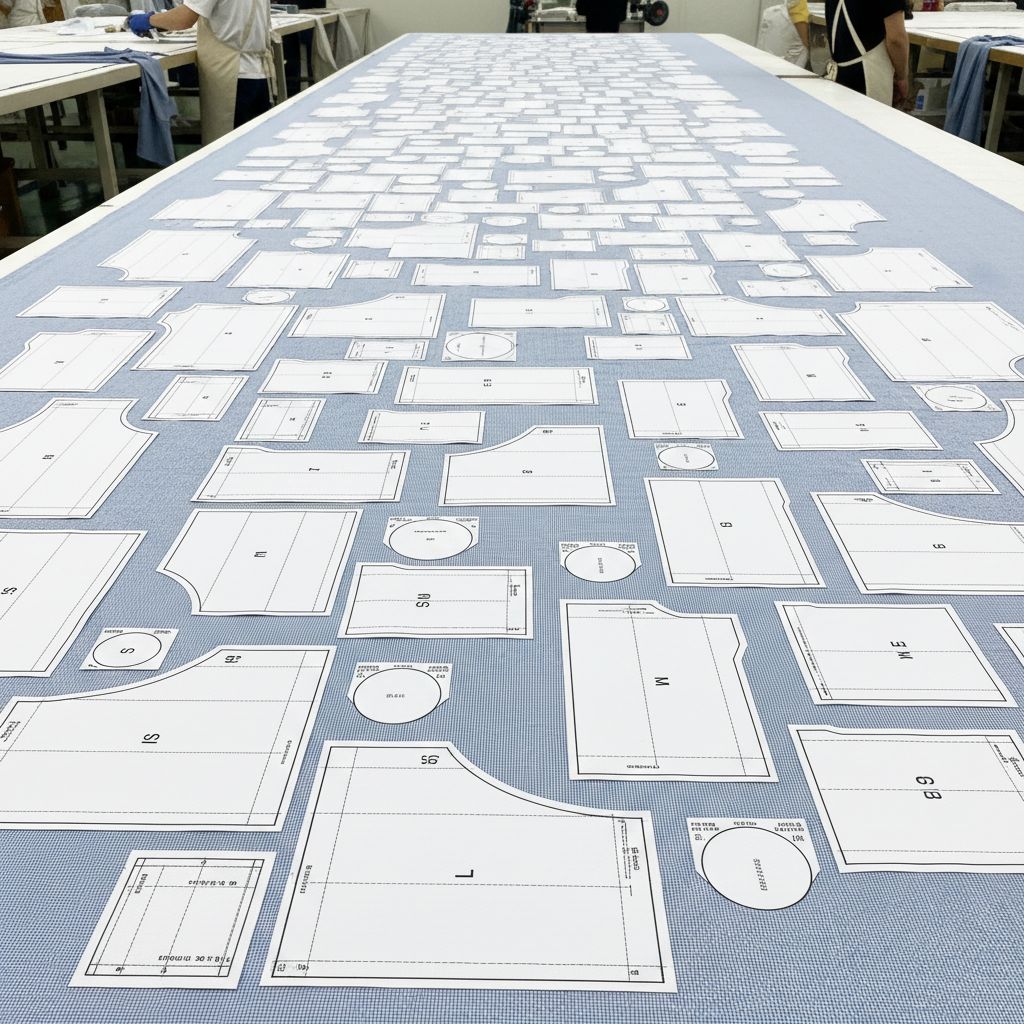


Fabric consumption plays a major role in garment costing, order planning, and production control. In the apparel industry, even a small mistake in fabric calculation can lead to fabric shortages, extra purchasing, delayed shipment, or reduced profit. That is why merchandisers, production planners, and costing teams must understand how to estimate fabric consumption correctly. In this article, we will explain the fabric consumption calculation method for a knitted polo shirt in a simple and practical way. We will break down each garment part, use a sample measurement chart, and show how to calculate fabric consumption step by step.
What Is Fabric Consumption in the Garment Industry?.
Fabric consumption is the amount of fabric required to produce a garment or a certain quantity of garments. It is usually calculated per piece, per dozen, or for the full order quantity. Accurate fabric consumption is important because it helps factories and buyers:
- estimate fabric requirement correctly
- control material cost
- reduce wastage
- avoid fabric shortages during production
- improve profit margin
For knitted garments such as polo shirts, fabric consumption is usually calculated by garment parts because different parts may use different fabric types and GSM.

Main Parts of a Knitted Polo Shirt
Before starting the calculation, it is necessary to identify the main parts of the garment. A basic knitted polo shirt usually includes the following components:
- body
- sleeves
- collar
- cuffs
- half-moon
The body and sleeves are generally made from the main body fabric. The collar and cuffs are often made from rib fabric. The pocket and half-moon may or may not be included, depending on buyer requirements and garment design.


Example Order Details for Fabric Consumption Calculation
Let us assume that a buyer places an order for 10,000 knitted polo shirts with the following fabric details:
- Body fabric: 100% cotton single jersey
- Used for: body, sleeves, pocket, and half-moon
- Fabric GSM: 160
- Collar and cuff fabric: 1 × 1 rib
- Fabric GSM: 230
To calculate fabric consumption, we also need the garment measurements with allowances.

Key Points to Remember
When calculating fabric consumption for a knitted polo shirt, keep these points in mind:
- always separate the garment by fabric parts
- use measurement with allowance, not actual measurement only
- apply the correct GSM for each fabric type
- add wastage after calculating the net consumption
- convert total pieces into dozen before calculating order quantity
A simple and organized calculation method helps improve costing accuracy and makes production planning easier.

Measurement Chart Used for Calculation
Below is the sample measurement chart for the knitted polo shirt:
Measurement Table
| Part | Actual Length/Width | Allowance | Measurement with Allowance |
|---|---|---|---|
| Body length | 70 cm | 6 cm | 76 cm |
| Sleeve length | 22 cm | 6 cm | 28 cm |
| 1/2 Chest width | 56 cm | 6 cm | 62 cm |
| Collar length | 40 cm | 0 cm | 40 cm |
| Collar width | 8 cm | 3 cm | 11 cm |
| Cuff length | 22 cm | 4 cm | 26 cm |
| Cuff width | 3 cm | 2 cm | 5 cm |
| Pocket length | 10 cm | 3 cm | 13 cm |
| Pocket width | 9 cm | 3 cm | 12 cm |
| Half-moon length | 16 cm | 3 cm | 19 cm |
| Half-moon width | 8 cm | 3 cm | 11 cm |
These measurements with allowance will be used in the fabric consumption formulas.

Fabric Consumption Calculation Formula for Knitted Polo Shirt
Each garment part is calculated separately. After that, the total consumption is grouped by fabric type. Finally, an extra percentage is added for wastage.
The following formulas are commonly used in this example.
- For Body and Sleeve Parts: Fabric Consumption (kg per dozen) = ((Body length + Sleeve length) × (1/2 Chest width) × 2 × GSM × 12) ÷ 10,000,000
- For Collar: Fabric Consumption (kg per dozen) = (Collar length × Collar width × 12 × GSM) ÷ 10,000,000
- For Cuff: Fabric Consumption (kg per dozen) = (Cuff length × Cuff width × 2 × 12 × GSM) ÷ 10,000,000
- For Pocket: Fabric Consumption (kg per dozen) = (Pocket length × Pocket width × 12 × GSM) ÷ 10,000,000
- For Half-Moon: Fabric Consumption (kg per dozen) = (Half-moon length × Half-moon width × 12 × GSM) ÷ 10,000,000

Step-by-Step Fabric Consumption for Each Part
1. Fabric Consumption for Body and Sleeves
For the body and sleeves, the main body fabric with GSM 160 is used.
Formula:
Fabric Consumption (kg per dozen) = ((76 + 28) × 62 × 2 × 160 × 12) ÷ 10,000,000

Calculation:
- = (104 × 62 × 2 × 160 × 12) ÷ 10,000,000
- = 2.48 kg per dozen
So, the fabric consumption for the body and sleeves is:
- 2.48 kg/dozen

2. Fabric Consumption for Collar
The collar uses 1 × 1 rib fabric with GSM 230.
Formula:
- Fabric Consumption (kg per dozen) = (40 × 11 × 12 × 230) ÷ 10,000,000
Calculation:
- = 0.12144 kg per dozen
So, the fabric consumption for the collar is:
- 0.12144 kg/dozen

3. Fabric Consumption for Cuff
The cuffs also use rib fabric with GSM 230. Since there are two cuffs in each garment, the calculation includes a multiplier of 2.
Formula:
- Fabric Consumption (kg per dozen) = (26 × 5 × 2 × 12 × 230) ÷ 10,000,000
Calculation:
- = 0.072 kg per dozen
So, the fabric consumption for the cuffs is:
- 0.072 kg/dozen

4. Fabric Consumption for Pocket
The pocket uses the main body fabric with GSM 160.

Formula:
Fabric Consumption (kg per dozen) = (13 × 12 × 12 × 160) ÷ 10,000,000
Calculation:
= 0.03 kg per dozen
So, the fabric consumption for the pocket is:
- 0.03 kg/dozen
5. Fabric Consumption for Half-Moon
The half-moon also uses the main body fabric with GSM 160.
Formula:
- Fabric Consumption (kg per dozen) = (19 × 11 × 12 × 160) ÷ 10,000,000
Calculation:
- = 0.04 kg per dozen
So, the fabric consumption for the half-moon is:
- 0.04 kg/dozen
Total Main Fabric Requirement for the Order
Now we will calculate the total amount of cotton single jersey fabric needed. This includes:
- body and sleeves
- half-moon
Main Fabric Consumption per Dozen
- = Body and sleeves + Pocket + Half-moon
- = 2.48 + 0.03 + 0.04
- = 2.55 kg/dozen
Now add 10% wastage:
- = 2.55 + 10%
- = 2.805 kg/dozen
So, total cotton single jersey fabric required is:
- 2.805 kg/dozen
Main Fabric Consumption for 10,000 Pieces
10,000 pieces = 833.33 dozen
So,
- = 2.805 × 833.33
- = 2337.5 kg
Therefore, the total amount of 100% cotton single jersey fabric required for 10,000 polo shirts is:
- 2337.5 kg
Total Rib Fabric Requirement for the Order
Now we will calculate the total rib fabric needed for:
- collar
- cuffs
Rib Fabric Consumption per Dozen:
- = Collar + Cuff
- = 0.12144 + 0.072
- = 0.19344 kg/dozen
Now add 10% wastage:
- = 0.19344 + 10%
- = 0.213 kg/dozen
So, total rib fabric required is:
- 0.213 kg/dozen
Rib Fabric Consumption for 10,000 Pieces
- 10,000 pieces = 833.33 dozen
So,
- = 0.213 × 833.33
- = 177.50 kg
Therefore, the total amount of 1 × 1 rib fabric required for 10,000 polo shirts is:
- 177.50 kg
Final Fabric Consumption Summary
To make the result easy to understand, here is the final summary:
Fabric Requirement Per Dozen
| Fabric Type | Consumption per Dozen |
|---|---|
| Cotton single jersey | 2.805 kg |
| 1 × 1 Rib | 0.213 kg |
Fabric Requirement for 10,000 Pieces
| Fabric Type | Total Required |
|---|---|
| Cotton single jersey | 2337.5 kg |
| 1 × 1 Rib | 177.50 kg |
Why Accurate Fabric Consumption Matters for Polo Shirt Production
Fabric is one of the most expensive raw materials in garment manufacturing. If consumption is calculated incorrectly, the factory may face several problems during production. Too little fabric can stop the line and delay shipment. Too much fabric can increase inventory and waste money. For knitted polo shirts, accurate calculation is especially important because the garment may involve more than one fabric type. The body fabric, rib collar, and cuff fabric must all be estimated correctly. Even small trims like pockets or half-moon pieces can affect the final requirement. That is why merchandisers and costing teams should always calculate each garment part carefully and include a reasonable wastage percentage.

Conclusion / Final Words
The fabric consumption calculation method for a knitted polo shirt is not difficult when the garment parts, measurements, and formulas are clearly defined. By calculating body parts, collar, cuffs, pocket, and half-moon separately, factories can estimate fabric requirement more accurately and manage material planning better. In the example above, the total requirement for an order of 10,000 pieces is 2337.5 kg of cotton single jersey fabric and 177.50 kg of 1 × 1 rib fabric. This method is useful for merchandisers, costing teams, and garment professionals who need a practical way to estimate fabric consumption for knitted polo shirts. If you are working in garment merchandising or production planning, mastering this method can help you reduce wastage, improve costing accuracy, and support smoother order execution.