Air Freight Charge Calculation System for Garments Import-Export

Air freight is one of the fastest shipping methods in the garment import-export business. It is widely used when delivery time is urgent, production is delayed, or buyers need goods quickly for sales, promotions, or seasonal deadlines. Although air shipment is fast, it is also more expensive than sea freight. That is why understanding how air freight charges are calculated is very important for garment exporters, merchandisers, and logistics teams.

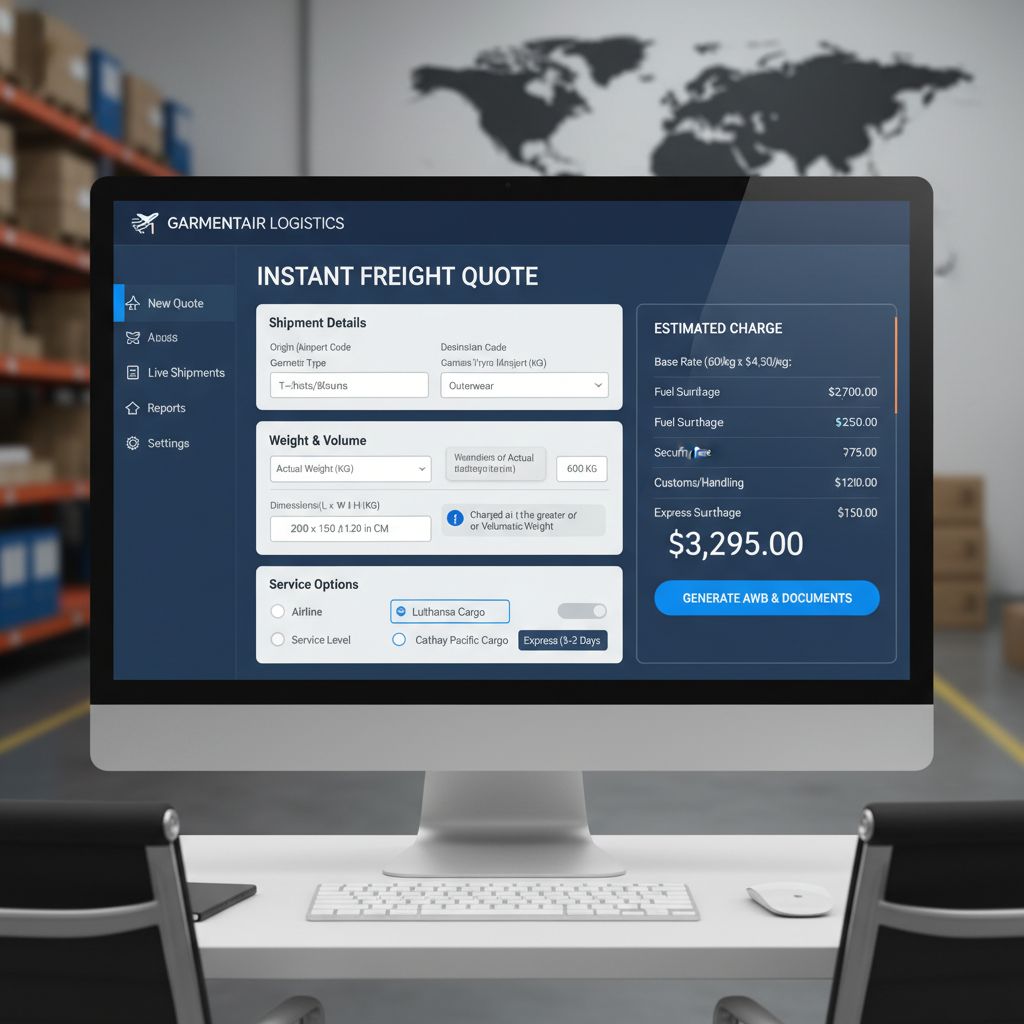
Many people assume air freight is charged only by actual weight. That is not correct. In air shipment, freight charges are based on chargeable weight, and chargeable weight is determined by comparing actual weight and volumetric weight. Whichever is higher becomes the weight used for billing. This system is especially important in the garment industry because apparel products are often light in weight but large in volume. A shipment may not weigh much, but it can still take up a lot of space on an aircraft. That is why airlines do not charge by actual weight alone.

Why Air Freight Charges Are Not Based Only on Actual Weight

An aircraft has two limits: weight capacity and space capacity. Some cargo is very heavy and compact, while some cargo is light but bulky. If airlines charged only by actual weight, shipments that occupy a large amount of space but have low weight would not be priced fairly.

For example, imagine two shipments that both weigh 500 kg. One shipment contains cotton garments, and the other contains iron products. Both have the same actual weight, but the cotton garments need much more space. Since aircraft space is limited and valuable, the airline must consider volume as well as weight. This is the reason why air freight uses the concept of chargeable weight.

What Is Chargeable Weight?

Chargeable weight is the weight used by the airline or freight forwarder to calculate the air freight cost.

It is determined by comparing:

  • Actual weight or gross weight
  • Volumetric weight or dimensional weight

The higher of these two values becomes the chargeable weight.

In simple terms:

  • If actual weight is higher than volumetric weight, freight is charged by actual weight
  • If volumetric weight is higher than actual weight, freight is charged by volumetric weight

This rule ensures that both cargo mass and cargo space are fairly considered.

Key Terms You Should Know

Before calculating air freight charges, it is important to understand a few basic terms.

  • Actual Weight or Gross Weight: Actual weight is the real physical weight of the cargo, usually measured on a scale. In shipping practice, this may also be called gross weight if packaging is included.
  • Volumetric Weight: Volumetric weight represents the space occupied by the cargo. It converts cargo volume into a weight value for billing purposes.
  • CBM: CBM stands for cubic meter. It is the volume of cargo calculated from its length, width, and height.

Formula for Air Freight Chargeable Weight

The first step is to calculate the cargo volume in cubic meters.

  • CBM = Length × Width × Height – The dimensions must be converted into meters before applying the formula. After calculating CBM, volumetric weight can be calculated using the following formula:
  • Volumetric weight = CBM ÷ 0.006 – Then compare volumetric weight with actual weight. Chargeable weight = whichever is higher: actual weight or volumetric weight

This is the basic air freight charge calculation system used in practice.

Step by Step Metho

  • Step 1: Measure the Cargo Dimensions – Measure the cargo length, width, and height. Make sure the dimensions are accurate and converted into meters.
  • Step 2: Calculate CBM – Multiply the length, width, and height to find the cargo volume in cubic meters. CBM = Length × Width × Height
  • Step 3: Calculate Volumetric Weight – Divide the CBM by 0.006. Volumetric weight = CBM ÷ 0.006
  • Step 4: Compare with Actual Weight – Compare the volumetric weight with the actual weight. If actual weight is higher, use actual weight. If volumetric weight is higher, use volumetric weight.

The higher value is the chargeable weight.

Example 1: Actual Weight Is Higher

Suppose the shipment details are:

  • Actual weight = 200 kg
  • Length = 100 cm = 1.00 m
  • Width = 100 cm = 1.00 m
  • Height = 100 cm = 1.00 m

Calculate CBM:

  • CBM = 1.00 × 1.00 × 1.00
  • CBM = 1.00 m³

Calculate Volumetric Weight:

  • Volumetric weight = 1.00 ÷ 0.006
  • Volumetric weight = 166.67 kg

Compare the Two Weights:

  • Actual weight = 200 kg
  • Volumetric weight = 166.67 kg

Since actual weight is higher, the chargeable weight is 200 kg.

Example 2: Volumetric Weight Is Higher

Suppose the shipment details are:

  • Actual weight = 140 kg
  • Length = 98 cm = 0.98 m
  • Width = 95 cm = 0.95 m
  • Height = 96 cm = 0.96 m

Calculate CBM:

  • CBM = 0.98 × 0.95 × 0.96
  • CBM = 0.89376 m³

Calculate Volumetric Weight:

  • Volumetric weight = 0.89376 ÷ 0.006
  • Volumetric weight = 148.96 kg

Compare the Two Weights:

  • Actual weight = 140 kg
  • Volumetric weight = 148.96 kg

Since volumetric weight is higher, the chargeable weight is 148.96 kg.

Why This Matters in Garment Export

This calculation system is very important in the garment industry because garment shipments are often bulky compared to their weight. Finished garments are soft, light, and usually packed in cartons that take up considerable space. This means the volumetric weight can easily become higher than the actual weight. As a result, a garment exporter may think the shipment is light and should be cheap, but the air freight cost may still be high because of the space used. That is why garment exporters should never look only at kilograms. They should always check both:

  • actual weight
  • shipment dimensions

Ignoring cargo dimensions can lead to poor freight cost estimates and unexpected logistics expenses.

Common Mistakes in Air Freight Calculation

Several mistakes are common when calculating chargeable weight. One common mistake is using the wrong term in the CBM formula. The correct formula is:

  • Length × Width × Height
  • Not length × weight × height.

Another mistake is forgetting to convert centimeters into meters before calculating CBM. A third mistake is assuming freight is always charged by actual weight. In air shipment, that is often not true, especially for garments and other low-density cargo. Some teams also forget that packaging design affects freight cost. Large cartons, loose packing, or inefficient carton sizes can increase volumetric weight even if actual garment weight stays the same.

How to Reduce Air Freight Cost in Garment Shipment

Garment exporters can reduce air freight costs by managing cargo space more efficiently. A few practical ways include:

  • optimize carton size
  • reduce empty space inside cartons
  • improve folding and packing methods
  • avoid oversized packaging
  • check dimensions carefully before booking shipment

This is where logistics planning becomes important. Sometimes better packing can lower volumetric weight and reduce freight charges without changing the goods themselves.

Practical Advice for Merchandisers and Export Teams

A merchandiser or export coordinator should understand this system clearly before confirming shipment plans. It is not enough to know only the carton count or gross weight. The full shipping dimensions must also be checked.

Before booking an air shipment, always confirm:

  • carton dimensions
  • number of cartons
  • total actual weight
  • total shipment volume
  • estimated chargeable weight

This helps avoid surprises and supports more accurate costing.

Conclusion / Final Words

The air freight charge calculation system for garments import-export is based on chargeable weight, not just actual weight. Chargeable weight is determined by comparing actual weight with volumetric weight, and the higher value is used for freight billing. The formulas are simple:

  • CBM = Length × Width × Height
  • Volumetric weight = CBM ÷ 0.006
  • Chargeable weight = whichever is higher: actual weight or volumetric weight

For garment exporters, this is especially important because apparel products are often light but bulky. A shipment with low actual weight may still have a high freight cost if it occupies too much cargo space. Understanding this system helps merchandisers, exporters, and logistics teams estimate freight cost more accurately, control shipping expenses, and make better shipping decisions.

Related posts