



What SPQ Really Means in Garment Industry (and What It Doesn’t)?

You see it on a quote: “SPQ: 50”. Some buyers shrug. Some panic. Some assume it means “you must order in 50s.” That last one is the common mistake. SPQ is a packing rule. It tells you how the supplier packs goods into cartons or boxes. It is not the same thing as MOQ. It is not a production limit. But it can still change your cost if you ignore it. Let’s make SPQ behave like a normal, honest label, not a surprise fee monster

What SPQ Means?

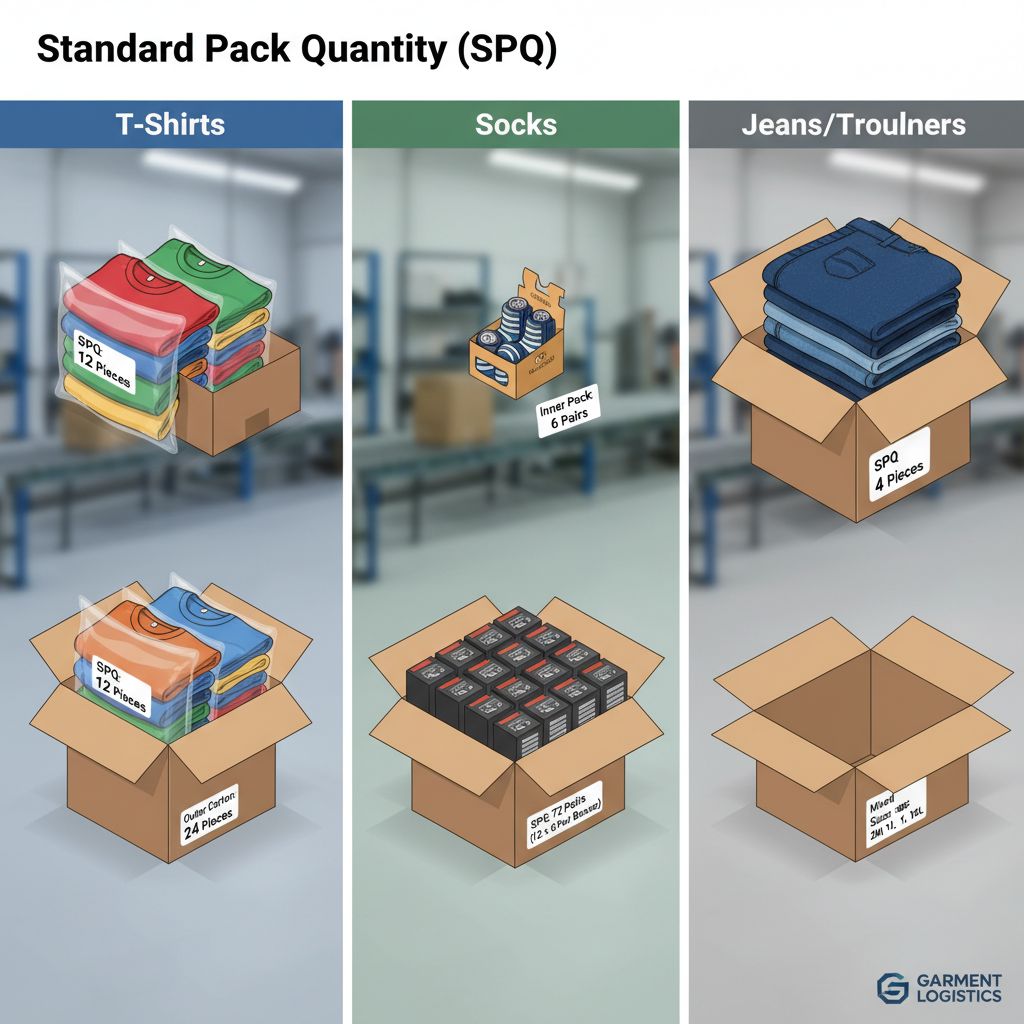
SPQ stands for Standard Pack Quantity, which is the number of units packed into one carton or box. It tells you how the supplier ships and stores the product, not how the product is made. On quotes, you often see it as something like “SPQ: 50,” meaning 50 pieces per carton. This matters because packaging rules can quietly shape your logistics plan. If you treat SPQ like a small detail, it can turn into a big cost later. “SPQ = Standard Pack Quantity. It is the number of units inside one standard carton/box.”

Example:

  • SPQ: 50 usually means 50 pcs per carton

Why suppliers use SPQ:

  • Packaging stays consistent
  • Warehouse work is faster (counting and stacking)
  • Cartons are safer in shipping (less damage)
  • Pallet loading becomes easier

SPQ is about how things are packed, not how they are made.

What SPQ does NOT mean (the myths)

Many buyers assume SPQ is the same as MOQ, but it isn’t. SPQ does not automatically mean you must order in multiples of that number. It also does not mean the factory cannot produce other quantities. The confusion happens because some suppliers enforce “full carton only” policies, which feel like a minimum. So the real risk is not SPQ itself, but the policy attached to it.

Myth 1: “SPQ is the minimum order”

But… suppliers sometimes act like SPQ is a minimum, because it helps them avoid partial cartons. That’s not a law of nature. It’s a policy choice.

Myth 2: “SPQ forces me to buy extra units”

Not always.

SPQ only forces rounding up if the supplier requires full cartons only.

If partial cartons are allowed, you can order 170 pcs and receive:

  • 3 full cartons (150 pcs) + 1 partial carton (20 pcs)

If partial cartons are not allowed, you may get:

Myth 3: “SPQ won’t affect shipping cost”

It often does. Shipping is influenced by:

  • number of cartons
  • carton size
  • pallet count
  • CBM (cubic meter volume)

Even if the unit price stays the same, SPQ can change the carton count, which can change freight.

Why SPQ Matters in Real Life

SPQ matters because it touches three painful areas:

1) Freight and volume math

Shipping costs are not based only on unit price. They are heavily shaped by carton count, pallet count, and CBM (cubic meter volume), all of which are linked to SPQ. A higher carton count can increase handling fees and change how your freight is calculated. Even when the product quantity stays the same, the packing method can push your shipment into a different cost bracket. That’s why SPQ belongs in your shipping plan, not just your packaging notes.

More cartons can mean:

  • more CBM
  • more pallets
  • higher shipping cost
  • higher handling fees

Even small changes add up when your order is large.

2) Warehouse space and stock planning

SPQ affects how your inventory “lives” in your warehouse. Standard cartons are easier to stack, count, scan, and pick, which reduces daily friction. When cartons are partial or mixed, stock control becomes harder and errors rise. Many warehouses run smoother when carton quantities are consistent, especially during peak season. So SPQ is not just about packing, it’s about daily operations.

If you run a warehouse, SPQ affects:

  • how many cartons you store
  • how you count inventory
  • how you pick orders
  • how clean your SKU management is

Full cartons are easier. Partial cartons can get messy.

3) Shipment quality and accuracy

Packaging consistency can protect your product. Full cartons tend to be more stable during transport, which reduces crushing, shifting, and labeling mistakes. Partial cartons can be totally fine, but only if the supplier packs and labels them carefully. If they rush or mix items badly, your delivery becomes harder to check and easier to dispute. SPQ matters because clean packing often equals fewer problems at receiving.

Full cartons usually mean:

  • fewer packing mistakes
  • less mixing of colors/sizes
  • less damage from loose packing

Partial cartons can still be fine, but they need clear labeling and rules.

Simple Garment Example (how it plays out)

Examples make SPQ easy to understand because it becomes math, not guesswork. When SPQ is 50, ordering 150 pieces usually means three cartons, which is simple. But ordering 170 pieces creates a choice: one partial carton or rounding up to a full carton. This is where buyers get surprised if the supplier enforces “full carton only.” A few numbers can reveal a lot of hidden policy.

Imagine you’re buying T-shirts:

  • Style: Basic tee
  • Size range: S–XL
  • Order: 170 pcs total
  • Quote says: SPQ = 50 pcs/carton

Possible outcomes:

Case A: Partial cartons allowed

You receive:

  • 3 cartons × 50 = 150 pcs
  • 1 partial carton = 20 pcs
  • Total = 170 pcs

This is normal. Clean. No forced overbuy.

Case B: Full cartons only

The supplier says: “We ship full cartons only.”

Now you may be pushed into:

  • 4 cartons × 50 = 200 pcs
  • Total = 200 pcs
  • You pay for 30 extra pcs or they “round up.”

Here’s the hard truth: this is not always “wrong,” but it should be declared upfront. If it’s hidden until shipping, it becomes a budget ambush.

The Buyer trap: SPQ vs “Full Carton Only”

The fastest way to avoid SPQ surprises is to ask one clear question before you confirm the order. You need to know whether SPQ is only a packing standard or a strict shipping rule. If partial cartons are allowed, you also need to know if extra fees apply. This sounds small, but it can decide whether you pay for 170 pieces or get forced into 200. In sourcing, the “tiny line” on a quote is often where the money hides. This is the one line that changes everything: Is SPQ a standard pack… or a strict rule?

Some suppliers mean:

  • “This is the normal carton size.”

Other suppliers mean:

  • “You must buy in exact carton multiples.”

Both might be written as “SPQ: 50.” That’s why SPQ causes confusion.

So don’t just read SPQ. Interrogate it. (Politely.)

How SPQ Should Appear on a Quote 

A quote is “safe” when it states:

  • SPQ: 50 pcs/carton
  • Packing policy: partial cartons allowed / not allowed
  • Carton size: L × W × H
  • GW/NW: gross and net weight
  • Carton mark: label rules
  • Any packing fees: repacking, mixed carton, special labeling

If the quote only shows “SPQ: 50” with no policy, it’s incomplete. That’s not you being picky. That’s you avoiding surprise costs.

Common SPQ surprises (so you can spot them early)

  • Surprise 1: “Mixed carton fee”. Some factories charge extra when cartons contain mixed sizes/colors. This is common when their packing line is built for speed, not variety.
  • Surprise 2: “Inner pack rules”. Sometimes there’s an inner layer: SPQ = 50 per carton. IPQ (inner pack) = 10 per polybag bundle. That changes how flexible partial cartons are.
  • Surprise 3: “Labeling disputes”. Partial cartons can lead to: wrong size labels, mixed SKUs, warehouse counting errors If you accept partial cartons, demand clean labeling.

Conclusion / Final Words

SPQ is the standard number of units per carton. It is a packing rule, not a production minimum. But SPQ still matters because it can affect:

  • carton count
  • shipping volume and cost
  • warehouse planning
  • packing accuracy

The smartest move is simple: Ask if partial cartons are allowed and if any fees apply. One question can prevent the classic “rounding up” surprise.

Related posts