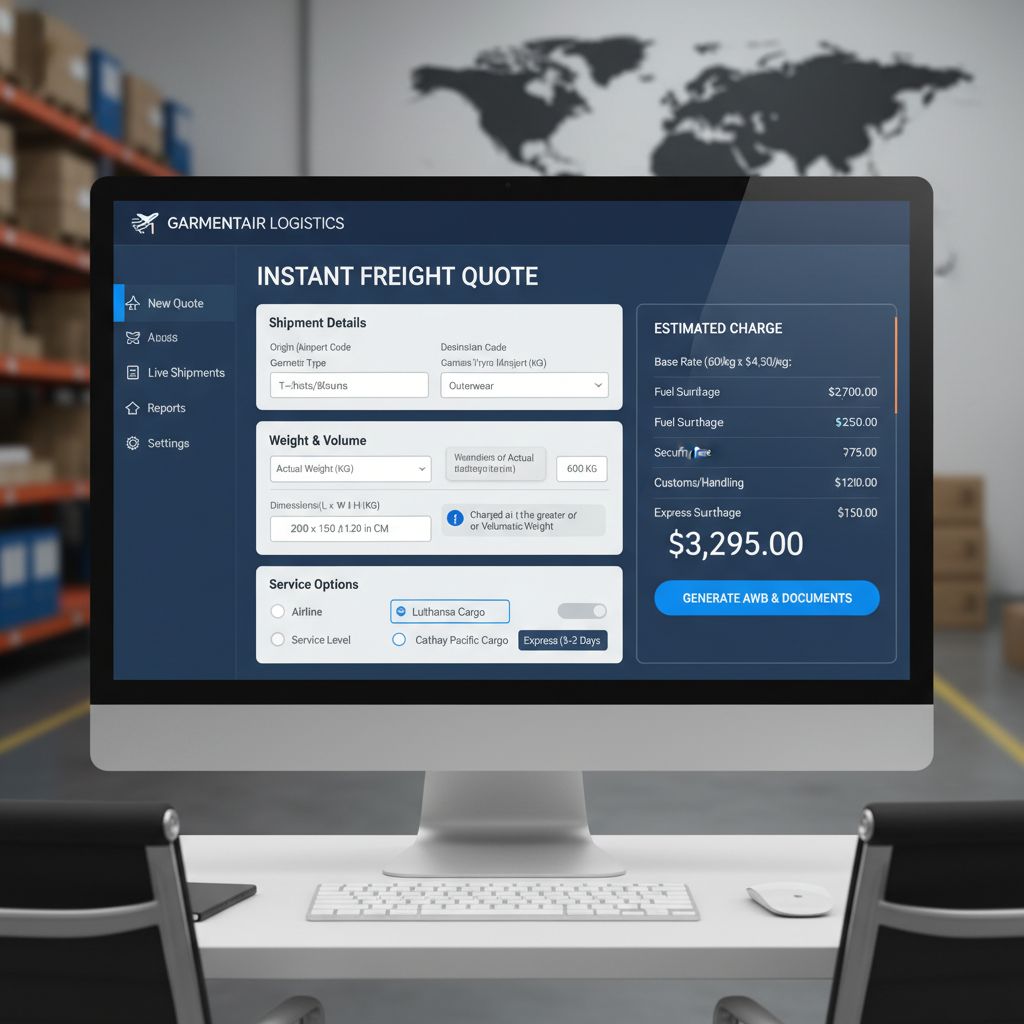


In garment export, shipping cost is one of the key parts of total logistics cost. When goods are shipped by sea under LCL shipment, freight charges are often based on CBM. That is why merchandisers, export staff, and logistics teams should clearly understand how CBM is calculated.
CBM means cubic meter. It is a measurement of cargo volume. Under LCL (Less than Container Load) sea shipment, cargo from different shippers is combined in one container. Since the container space is shared, freight cost is usually charged based on the volume of the cargo rather than a full container rate. This makes accurate CBM calculation very important. If the CBM is calculated incorrectly, shipping cost estimates may be wrong, and that can affect product costing, booking plans, and shipment decisions.
What Is LCL Sea Shipment?
LCL means Less than Container Load. It is used when the shipment volume is not large enough to fill a full container. In this case, the exporter does not pay for one full container. Instead, the cargo is combined with other shipments, and the freight cost is usually calculated based on the cargo volume. This is different from FCL (Full Container Load) shipment. In FCL shipping, the exporter pays for the entire container. In LCL shipping, the exporter pays only for the space used.
What Is CBM?
CBM stands for cubic meter. It is the standard unit used to measure cargo volume in sea freight. In simple terms, CBM shows how much space the cargo occupies inside the container. For LCL shipment, this is very important because the freight forwarder usually charges based on the total CBM of the cargo.
Why CBM Calculation Is Important in Garment Export
In the garment industry, shipments are usually packed in cartons. Even when the garments are light in weight, the cartons may still take up a lot of space. Because of this, volume becomes a key factor in sea freight planning.

Accurate CBM calculation helps garment exporters:
- estimate shipping cost correctly
- compare shipment options
- prepare booking details
- avoid freight cost mistakes
- improve carton planning and packing efficiency
If CBM is overestimated, freight cost may appear higher than it should be. If it is underestimated, the exporter may face unexpected charges later.
Information Needed Before Calculating CBM
Before starting the CBM calculation, you need the following information:
- carton length
- carton width
- carton height
- total number of cartons
You also need to make sure that all carton dimensions are converted into meters before using the CBM formula.
Unit Conversion Before CBM Calculation
In many factories, carton dimensions are recorded in inches. However, CBM must be calculated in meters.
So the conversion must be done in two steps.
Convert Inches to Centimeters

Since: 1 inch = 2.54 cm
you must multiply the inch value by 2.54 to get centimeters.
Convert Centimeters to Meter
Since: 1 meter = 100 cm
you must divide the centimeter value by 100 to get meters.
After that, the carton dimensions will be ready for CBM calculation.
Formula for CBM Calculation Under LCL Sea Shipment
The formula for the CBM of one carton is:
- CBM for 1 carton = Length (m) × Width (m) × Height (m)
After finding the CBM of one carton, calculate the total CBM of the order:
- Total CBM = CBM for 1 carton × Total number of cartons

This is the standard method used for LCL sea shipment.
Step-by-Step Method
- Step 1: Measure the Carton Dimension – Find the length, width, and height of one carton.
- Step 2: Convert the Dimensions into Meters – If the measurements are in inches, first convert them into centimeters, then convert centimeters into meters.
- Step 3: Calculate the CBM of One Carton – Multiply the carton length, width, and height in meters.
- Step 4: Calculate the Total CBM – Multiply the CBM of one carton by the total number of cartons.
Example of CBM Calculation
Suppose:
- Total carton quantity = 5000 cartons
- Length of each carton = 22 inches
- Width of each carton = 15 inches
- Height of each carton = 6 inches
Assume that every carton has the same dimensions.
Step 1: Convert Length into Meters
Carton length = 22 inches
- = 22 × 2.54 cm
- = 55.88 cm
- = 55.88 ÷ 100 m
- = 0.5588 m
Step 2: Convert Width into Meters
Carton width = 15 inches
- = 15 × 2.54 cm
- = 38.10 cm
- = 38.10 ÷ 100 m
- = 0.3810 m
Step 3: Convert Height into Meters
Carton height = 6 inches
- = 6 × 2.54 cm
- = 15.24 cm
- = 15.24 ÷ 100 m
- = 0.1524 m
Step 4: Calculate CBM for One Carton
- CBM for 1 carton = 0.5588 × 0.3810 × 0.1524
- CBM for 1 carton = 0.03244639 m³
Step 5: Calculate Total CBM
- Total CBM = 0.03244639 × 5000
- Total CBM = 162.23195 m³
So, the total CBM for 5000 cartons is 162.23195 m³.
Important Notes
CBM should always be expressed in cubic meters (m³), not meters.

One common mistake is writing the final result as m instead of m³. That is incorrect because CBM is a volume measurement, not a length measurement.
Another common mistake is using carton dimensions in inches or centimeters directly in the formula without converting them into meters first. This gives the wrong result.
Also, if carton sizes are not the same, you should not use one carton size for the whole order. In that case, each carton group should be calculated separately.
Common Mistakes in CBM Calculation
There are a few mistakes that often happen during CBM calculation:
- using the wrong unit
- forgetting to convert inches to meters
- mixing up carton size and carton quantity
- writing “cartoon” instead of “carton”
- giving the final result in m instead of m³
- assuming all cartons have the same size when they do not
These small mistakes can create large errors in shipment planning and freight cost estimation.
Practical Advice for Garment Exporters
Before confirming an LCL shipment, it is a good idea to check:
- carton dimensions
- number of cartons
- whether all cartons are the same size
- total estimated CBM
- freight quote basis from the forwarder
This helps the export team compare shipment options more accurately and avoid avoidable cost surprises. It is also smart to review carton design. Better carton sizing can improve space use and reduce total shipment volume.
Conclusion / Final Words
CBM calculation under LCL sea shipment is simple, but it must be done carefully. Since LCL freight cost is usually based on cargo volume, accurate CBM calculation is very important in garment export.

The basic method is:
- CBM for 1 carton = Length × Width × Height
- Total CBM = CBM for 1 carton × Total number of cartons
As long as the carton dimensions are converted into meters correctly and the carton quantity is confirmed, the total CBM can be calculated easily. For garment merchandisers and export teams, understanding CBM is not just a technical skill. It is also a practical way to estimate shipping costs better, improve planning, and reduce logistics mistakes.