

Estimating garment production accurately is one of the most important tasks in apparel manufacturing. A good production estimate helps factories plan manpower, machine loading, delivery schedules, and shipment dates more effectively. It also helps merchandisers, production managers, and buyers stay aligned on what can realistically be achieved within a given timeline.

However, production estimation is not always simple. Even when a factory has enough orders and available workers, actual output may still vary from the original plan. That happens because garment production is influenced by several operational factors, and even a small change in one of them can affect the final result.

In most cases, five key factors have the strongest impact on garment production estimation. These are standard allowed minutes, number of operators, daily production line running time, average line efficiency, and total break time. Understanding these factors can help improve planning accuracy and reduce the risk of shipment delays.
Why Production Estimation Is Important in the Garment Industry
Production estimation is the process of calculating how many garments a sewing line or factory can produce within a specific period. This calculation is essential because it supports production planning, capacity booking, labor allocation, and delivery commitment. If the estimation is too high, the factory may fail to meet the shipment date. If the estimation is too low, production capacity may not be used efficiently. In both cases, the business can face losses, delays, and customer dissatisfaction. That is why factories need to evaluate the factors affecting production estimation carefully before confirming delivery schedules.
5 Factors Affecting Estimation of Garments Production
1. Standard Allowed Minutes (SAM)
Standard Allowed Minutes, commonly known as SAM, is the time required to produce one complete garment under normal working conditions. It is one of the most important factors in production estimation.
SAM is usually determined through method study, time study, or predetermined motion systems. It includes the standard sewing time for all operations needed to complete a garment. If a garment has more complicated construction details, the SAM will be higher. If the style is simple, the SAM will be lower.
A higher SAM means each piece takes more time to make, so total production output becomes lower. A lower SAM means more pieces can be produced within the same amount of time.
For example, if one T-shirt has a SAM of 12 minutes and another style has a SAM of 20 minutes, the second style will naturally require more production time. Because of this, SAM must be accurate before making any production estimate. If the SAM is wrong, the entire planning result may be misleading.
2. Number of Operators Working in a Line
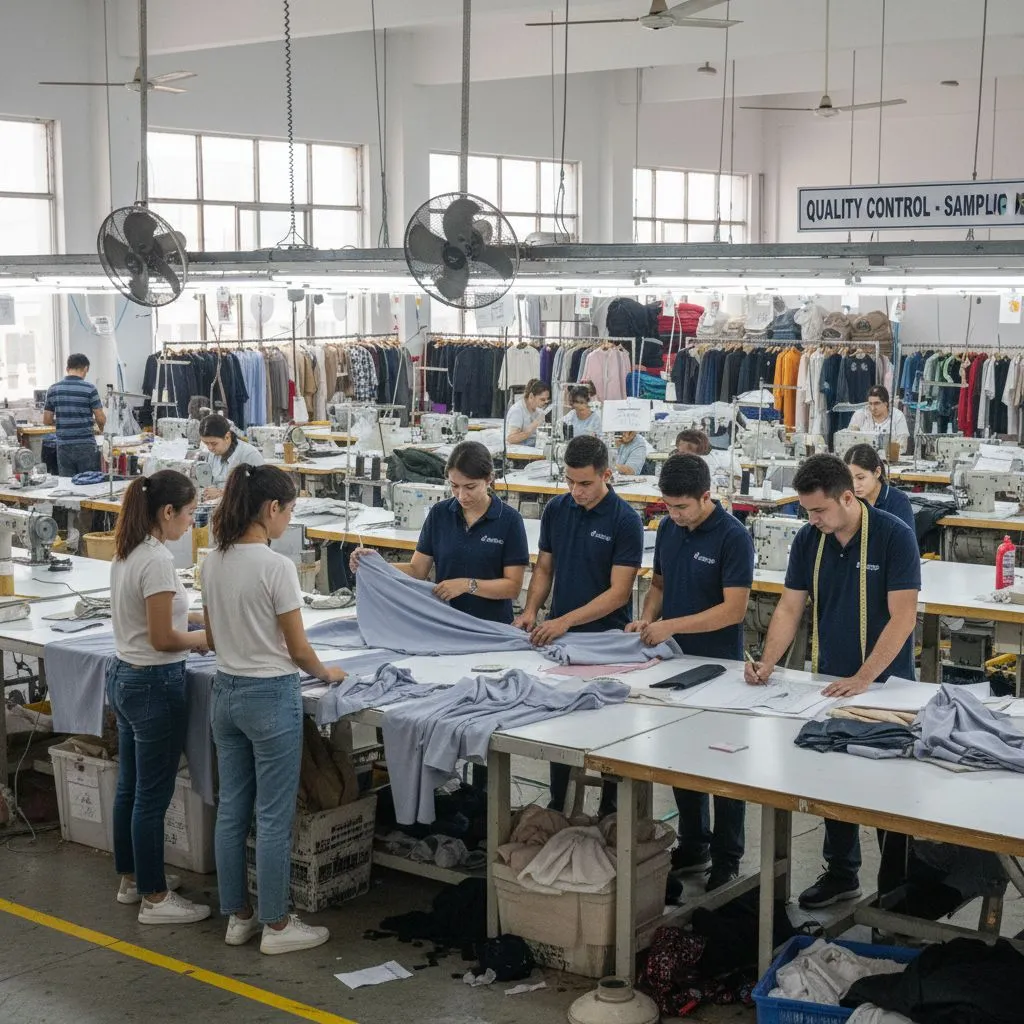
The number of operators assigned to a sewing line also has a major effect on garment production estimation. In general, a line with more operators can handle more operations at the same time, which may increase output.
However, this does not mean that simply adding more workers will always produce better results. The line must also be balanced properly. If too many operators are placed in one section while another section remains slow, production flow will still be interrupted.

Even so, when all other conditions remain stable, the number of operators is a key factor in estimating output. A line with 40 operators will usually produce more than a line with 25 operators, especially if both are working on the same style with similar efficiency.
That is why planners must know the actual manpower available for each line before estimating daily or monthly production capacity.

3. Production Line Running Time in a Day
Daily running time refers to the number of hours or minutes a production line actually operates in one working day. This factor directly affects how many garments can be produced.
If the line runs for a longer period, more production can be completed. If the line runs for fewer hours, output will decrease. Factories with overtime, extra shifts, or longer working schedules may achieve higher production than factories with shorter operating time.
For example, a line running for 10 hours per day will usually produce more than a line running for 8 hours per day, assuming the other factors remain the same.
When estimating production, it is important to use net available working time, not just the official duty hours. Managers must consider real operating time after excluding breaks, meetings, delays, and interruptions.

4. Average Line Efficiency
Average line efficiency is another major factor that affects production estimation. In garment manufacturing, efficiency shows how well a sewing line performs compared to its standard target.
Even if a line has enough operators and enough working hours, poor efficiency can reduce actual production significantly. Line efficiency is affected by many practical issues, such as:
- machine breakdown
- line imbalance
- poor work allocation
- operator absenteeism
- lack of feeding
- quality problems and rework
- low operator skill level
- frequent style interruptions
A line with 75% efficiency will produce much more than a line with 45% efficiency, even if both lines have the same number of workers and the same running time.
Because of this, production estimation should always use a realistic efficiency percentage based on factory history, line performance, and style complexity. Using an overly optimistic efficiency rate can create inaccurate planning and missed delivery dates.
5. Total Break Time
Break time also affects garment production estimation because it reduces the total working time available for actual sewing operations. In most factories, workers take scheduled breaks for lunch, tea, rest, or other approved pauses during the workday.
If total break time is high, the line has fewer minutes available for production. If break time is lower, the line has more time to work. For this reason, planners must deduct all fixed break periods when calculating line capacity.
For example, if the official workday is 8 hours but total break time is 1 hour, then actual working time is only 7 hours. This net working time should be used for estimating output. Factories that ignore break time may overestimate production and create unrealistic daily targets.
How These 5 Factors Work Together
These five factors do not work separately. They are connected, and together they determine the actual production capacity of a sewing line. A simple garment with a low SAM may still have poor output if line efficiency is weak. A line with many operators may still perform poorly if working hours are short or break time is too long. In the same way, long working hours will not guarantee high production if machine breakdowns and rework reduce efficiency. That is why production estimation should always be made by considering all five factors together, not one by one.

Basic Formula for Estimating Garments Production
A common formula used in garment manufacturing is:
- Production per day = (Number of operators × Working minutes per day × Efficiency %) ÷ SAM
This formula gives an estimated number of garments that can be produced in one day.
Example of Production Estimation
Suppose a sewing line has:
- 30 operators
- 480 working minutes per day
- 70% average efficiency
- 15 SAM per garment
Then:
- Production per day = (30 × 480 × 70%) ÷ 15
- Production per day = (30 × 480 × 0.70) ÷ 15
- Production per day = 672 pieces per day
This is only an estimate, but it gives management a practical basis for planning production and shipment.
Common Mistakes in Garment Production Estimation

Many factories make production estimates that look good on paper but fail in actual execution. This usually happens because one or more key factors are not calculated correctly. Some common mistakes include:
- Using an Incorrect SAM – If the SAM is too low, the factory may expect a much higher output than what is actually possible.
- Assuming Full Efficiency from the Start – A new style or a new line usually needs time to reach stable efficiency. Estimating at peak efficiency from day one is risky.
- Ignoring Break Time and Downtime – Official working hours are not the same as actual production time. Breaks, meetings, power issues, and machine stoppages must be considered.
- Not Considering Line Balancing Problems – Even when operator numbers are sufficient, poor line balancing can reduce output.
- Overlooking Quality and Rework – Defects, repair work, and checking delays can lower effective productivity and should not be ignored.
- Tips to Improve the Accuracy of Production Estimation – Factories can improve production estimation by using a more realistic and data-based approach.
- Use Verified SAM Data – Always confirm the SAM through proper study before finalizing any production plan.
- Check Actual Manpower Availability – Use the real number of available operators, not the planned number only.
- Calculate Net Working Time – Deduct lunch, tea breaks, and any planned downtime from total working hours.
- Use Realistic Efficiency Rates – Base efficiency on previous line performance, operator skill level, and style difficulty.
- Review the Estimate Regularly – Production estimation should be updated if style changes, absenteeism increases, or line performance drops.
Conclusion / Final Words
Accurate garment production estimation is essential for proper planning and on-time shipment in the apparel industry. Among the many variables in factory operations, five factors play the biggest role in estimating production output: standard allowed minutes, number of operators, production line running time, average line efficiency, and total break time.
Each of these factors directly affects how many garments a sewing line can produce within a given time. If any one of them is ignored or miscalculated, the production plan may become inaccurate and lead to delays. By understanding these five factors and using them correctly, garment factories can make better production plans, improve line performance, and reduce the risk of missing shipment deadlines.