

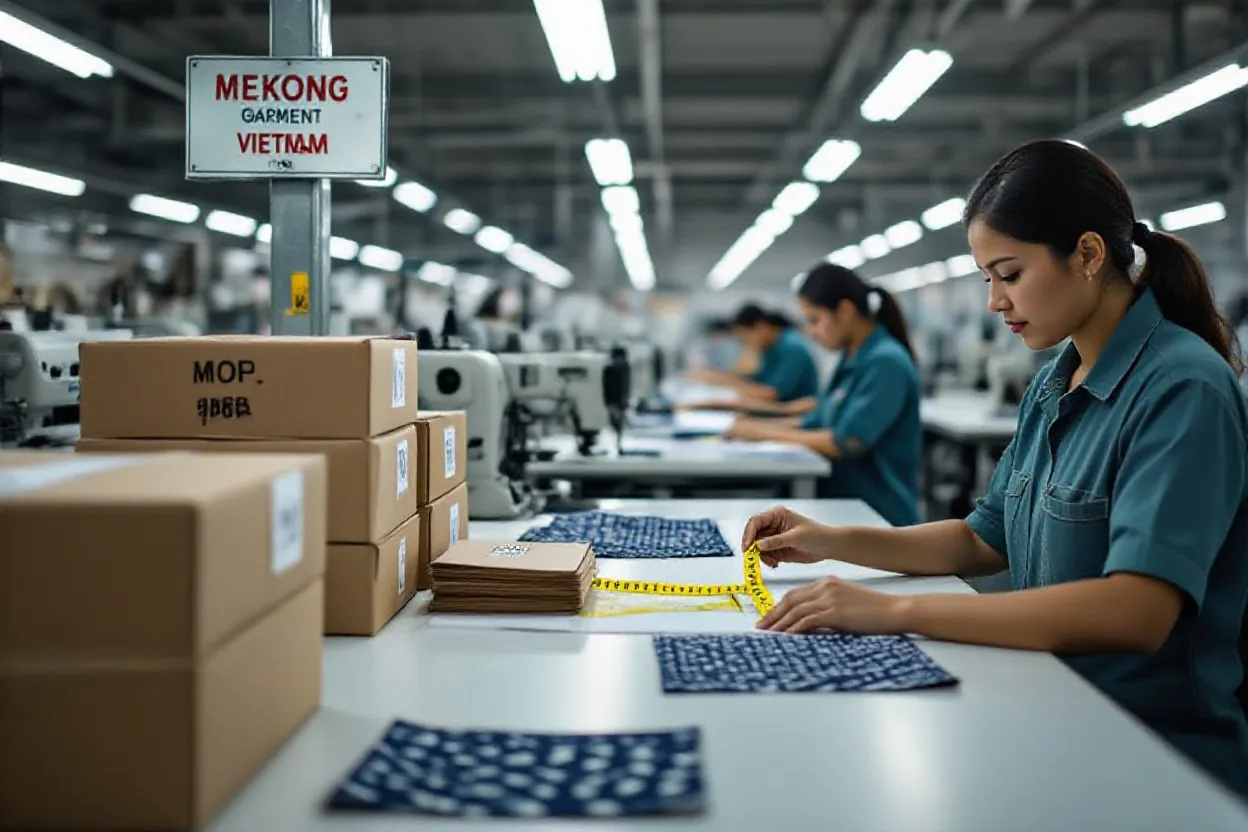
What are MOQ, SPQ, and MPQ in Garment Industry?

Supplier quotes may appear straightforward, but three critical abbreviations often dictate your true landed cost: MOQ, SPQ, and MPQ. These terms determine the minimum threshold for your order, how your goods are bundled, and the exact “multiples” you must follow when buying. Ignoring these technical rules can lead to unplanned inventory, higher freight rates, or production delays because your quantities don’t align with factory systems. Understanding how these factors interplay allows you to optimize your budget and logistics before confirming a single unit.
What are MOQ, SPQ, and MPQ in Garment Manufacturing?
MOQ (Minimum Order Quantity)
MOQ is the starting line: the absolute minimum quantity a manufacturer will accept to start a production run. Below this number, the factory cannot cover the setup costs for patterns, markers, cutting, and sewing line calibration. In the garment industry, MOQ is rarely just a total number; it is often applied per style, per color, or per size range. Confirming exactly what the MOQ covers is the first step in protecting your production schedule.
- The Goal: Covers fixed setup time and material purchase minimums (fabric MOQs).
- Buyer Tip: Always ask if the MOQ is per style or per color. “MOQ 300” might secretly mean 300 per color, significantly increasing your total investment.
SPQ (Standard Pack Quantity)
SPQ is a packing rule, not a production rule. It dictates exactly how many units fit into one standard master carton. Suppliers use SPQ to ensure consistent shipping volume and reduce transit damage. For example, if an SPQ is 50, you receive 50 units per box. The trap for buyers is “rounding up”—if your order is 170 units, you may be forced to buy 200 or pay a specialized “partial-carton” handling fee to cover the extra labor and materials.
- The Goal: Streamlines warehouse labor and optimizes freight volume (CBM/Cubic Meter).
- Buyer Tip: Ask if SPQ is mandatory. Knowing if partial cartons are allowed prevents surprise repacking or rounding charges.
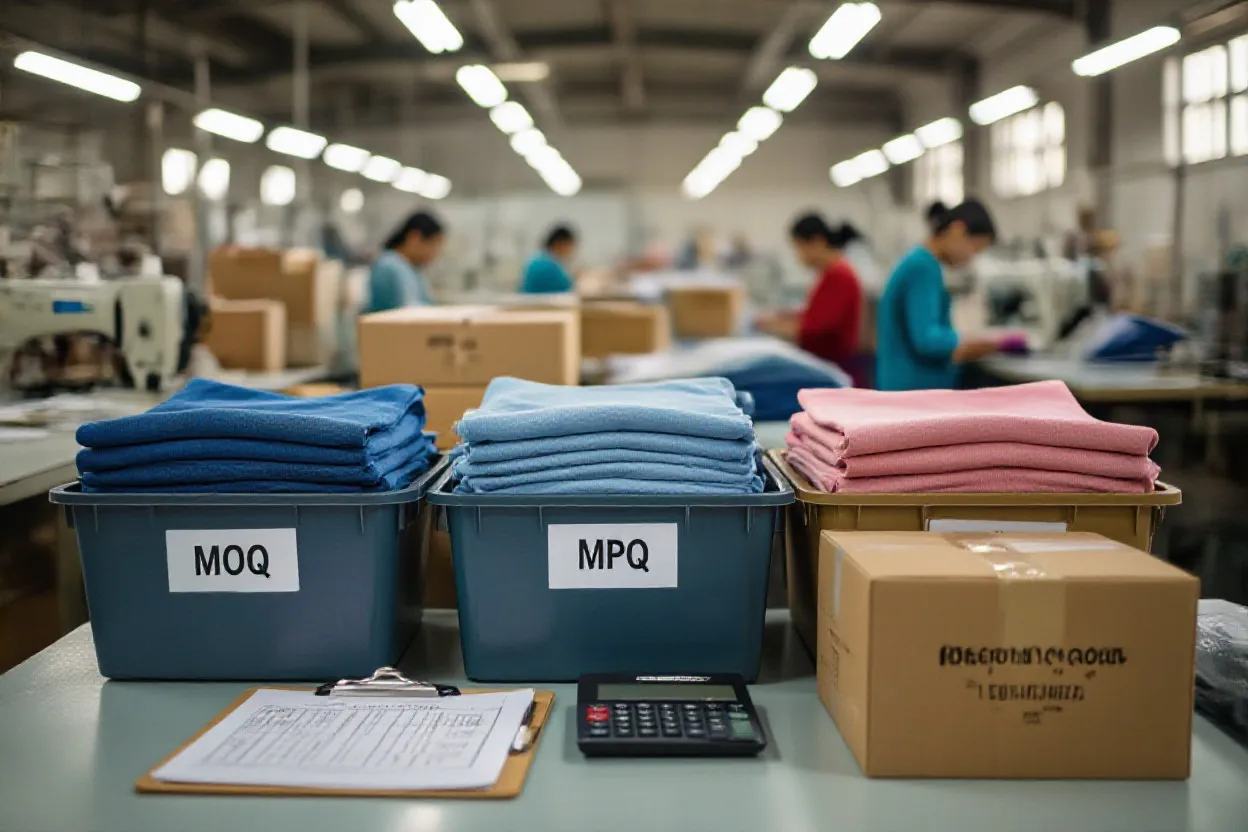
MPQ (Minimum Pack Quantity)
MPQ acts as the “math rule” for your order quantity. It is the smallest ordering multiple allowed, often matching how items are bundled in inner packs (e.g., in steps of 10, 12, or 24). You cannot order a random number; you must order in valid multiples. This is common for items like socks, underwear, or basic tees that are pre-bundled before being packed into master cartons.
- The Goal: Reduces packing errors and simplifies inventory counting and picking.
- Buyer Tip: Confirm if MPQ applies per size. This can drastically change your intended size breakdown for the entire collection.


Quick Comparison Table: MOQ vs. SPQ vs. MPQ
| Term | Meaning | What it Controls | Technical Impact |
|---|---|---|---|
| MOQ | Minimum Order Quantity | Total volume required | Order acceptance or price surcharges. |
| SPQ | Standard Pack Quantity | Units per shipping carton | Freight cost and partial-box fees. |
| MPQ | Minimum Pack Quantity | Ordering “steps” or multiples | Final unit count and size ratio accuracy. |
A Realistic Garment Example: The “Polo Shirt” Math
Imagine you want to order 320 polo shirts. Here is how these manufacturing rules change your order structure:
- MOQ: 300 pcs (Your order is high enough to be accepted).
- MPQ: 10 pcs per size (Your size breakdown must land on 10s: e.g., 80S, 80M, 80L, 80XL).
- SPQ: 50 pcs per carton (320 units ÷ 50 = 6.4 cartons).
The Result: You will likely be pushed to adjust your order to 300 or 350 units to achieve “clean” cartons and avoid partial-carton fees. Planning your quantity around these three numbers can save up to 10% in unnecessary logistics costs.

Conclusion
MOQ, SPQ, and MPQ are the hidden technical levers that shape your final margins. MOQ defines your commitment, MPQ ensures ordering precision, and SPQ optimizes your delivery efficiency. Professional buyers don’t just ask for price; they ask for the rules. By aligning your order with những technical standards này, you reduce freight waste and ensure a smoother production journey. Precision in planning leads to perfection in delivery.
FAQs: Navigating MOQ, SPQ, and MPQ in Apparel Sourcing
In Short, What is MOQ in the garment industry?
MOQ (Minimum Order Quantity) is the smallest number of units a supplier will accept for a single order. Suppliers set MOQ to cover fabric cut-planning, machine setup, and line efficiency. MOQ can apply per style, per color, or per size group – for example a factory may require MOQ 300 pcs per color, so three colors would mean 900 pcs total. If you quote a smaller run, the supplier may refuse, charge a premium, or propose a different price-break.
In Short, What does SPQ mean and why does it matter?
SPQ (Standard Pack Quantity) is the number of units the supplier packs into one carton or inner pack. It’s a packing rule used to standardize cartons and speed warehouse operations. For example, SPQ = 50 means 50 pcs per carton; an order of 320 pcs would fill 6 full cartons (300 pcs) plus a partial carton (20 pcs). Partial cartons may be allowed, but they can trigger extra packing fees or handling rules and affect freight dim-weight calculations.
In Short, What is MPQ and how is it different from MOQ?

MPQ (Minimum Pack Quantity) sets the ordering multiple you must follow – sizes or bundles must be ordered in increments like 6, 10, 12, 24, or 50. Unlike MOQ (a floor), MPQ is a step rule: your order quantity must be MOQ or higher and also a valid multiple (for example MPQ = 10 means you can order 300, 310, 320 but not 305). Some suppliers use MPQ to mean “minimum purchase quantity,” so always confirm the exact meaning on the quote.
How do MOQ, SPQ and MPQ relate and how do they differ?
MOQ defines the minimum allowable total; MPQ defines the allowed increments or size/bundle multiples; SPQ defines how those units are packed into cartons. They interact because a valid order must meet the MOQ, follow MPQ multiples across sizes or packs, and result in cartons following SPQ rules. Example contrast: MOQ = 300 pcs (production limit), MPQ = 10 pcs/size (size multiples), SPQ = 50 pcs/carton (packing). A compliant order might be 300 or 310 if MPQ allows, but cartons will be calculated in 50s, potentially creating partial cartons.
How should I read MOQ, MPQ and SPQ on a supplier quote?
Check the single-line notes for exact scope: confirm whether MOQ is per style, per color, or per size; confirm MPQ units and whether it applies per size or inner-pack; confirm SPQ as units per carton and whether partial cartons are allowed or billable. Ask explicitly: “Is MOQ per color/size? Is MPQ applied per size or per bundle? Are partial cartons permitted and are there packing fees?” Use those answers to recalculate net units, cartons, and freight before confirming.
Can you give a realistic polo-shirt example showing how they work together?
Suppose a quote from Mekong Garment Vietnam shows MOQ 300 pcs per color, MPQ 10 pcs/size, and SPQ 50 pcs/carton. You want 320 pcs in one color across 4 sizes. MPQ 10 allows size splits in tens, so 320 can be split (for example 80/80/80/80). SPQ 50 means cartons = ceil(320/50) = 7 cartons → 350 pcs capacity; if supplier does not accept partial cartons without fees you may either reduce to 300 (6 cartons) or increase to 350 by adding 30 pcs following MPQ (e.g., add 10 pcs each to three sizes). Each choice affects unit cost, freight, and lead time.
What practical buyer actions prevent surprises from MOQ, MPQ and SPQ?
Confirm scope (per style/color/size), request the exact MPQ definition, and get SPQ and partial-carton policy in writing. Recalculate cartons and freight both for the requested quantity and for the nearest valid adjustments (down to MOQ or up to the next SPQ multiple). Negotiate options such as consolidated cartons, split-color MOQs, or temporary waivers for samples. Include packing and handling fees in your landed-cost calculation so you won’t be surprised at shipment time.