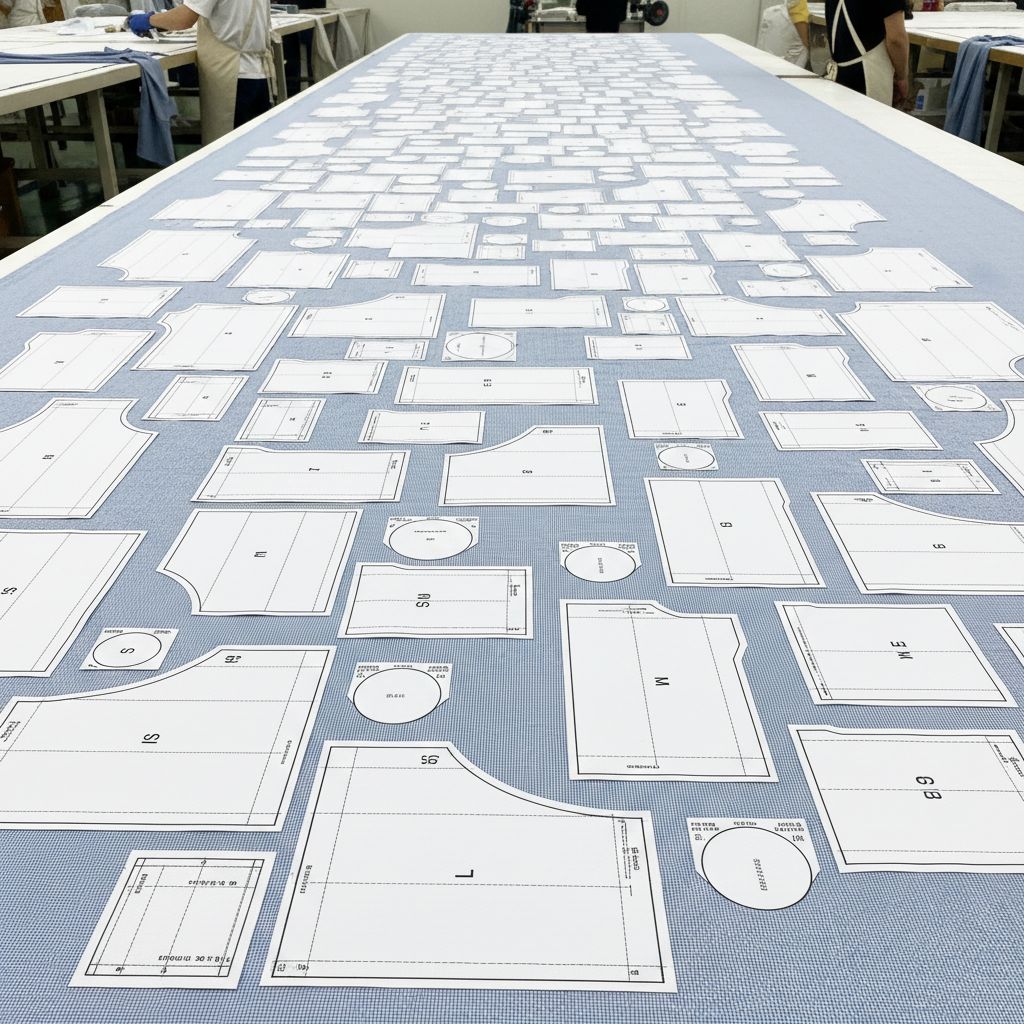


Fabric consumption calculation is one of the most important tasks in garment merchandising. If the calculation is wrong, the factory may order too much fabric and increase cost, or order too little fabric and delay production. For woven shirts, accurate fabric consumption is even more important because the garment has many separate parts, such as the body, sleeves, collar, cuffs, pocket, and yoke.

In this article, we will explain how to calculate fabric consumption for a woven shirt in a simple and practical way. We will also show the common formula, the basic measurement chart, and the consumption of each shirt part. This guide is useful for merchandisers, production planners, sourcing teams, and garment factory staff who need a clear method for woven shirt costing.
Why Fabric Consumption Calculation Matters
Fabric is usually the main material cost in a woven shirt. In many cases, fabric cost takes the biggest share of the total garment cost. Because of that, even a small mistake in fabric consumption can affect the profit of the order.
A proper fabric consumption calculation helps the factory:
- estimate fabric requirement correctly
- prepare costing more accurately
- reduce wastage
- support fabric booking and sourcing
- avoid shortage during production
For woven shirts, this is especially important because the garment includes several components and each part consumes fabric separately.


Main Parts of a Woven Shirt
Before starting the calculation, it is necessary to identify the main garment parts. A standard woven shirt usually includes the following parts:
- front body
- back body
- sleeve
- collar
- cuff
- collar band or collar stand
- yoke
- placket, if calculated separately
Some factories combine certain parts during estimation, while others calculate each piece one by one. The more detailed the breakdown, the more accurate the result can be at the costing stage.
Basic Information Needed Before Calculation
Before calculating woven shirt fabric consumption, the merchandiser should collect the following information:
- body length
- chest width
- sleeve length
- armhole straight measurement
- collar length and width
- cuff length and width
- collar band length and width
- pocket length and width
- yoke length and height
- fabric width
- sewing allowance
- expected wastage percentage
Without correct measurements, the final consumption will not be reliable.
Measurement Chart with Allowance
Below is an example of shirt measurements with added allowance:
| Part | Actual Measurement | Allowance | Measurement with Allowance |
|---|---|---|---|
| Body Length from HSP | 65 cm | 6 cm | 71 cm |
| 1/2 Chest | 43 cm | 5 cm | 48 cm |
| Sleeve Length | 35 cm | 5 cm | 40 cm |
| Arm Hole Straight | 20 cm | 5 cm | 25 cm |
| Collar Length | 40 cm | 4 cm | 44 cm |
| Collar Width | 6 cm | 2 cm | 8 cm |
| Cuff Length | 9 cm | 3 cm | 12 cm |
| Cuff Width | 2.5 cm | 0.5 cm | 3 cm |
| Collar Band Length | 30 cm | 3 cm | 33 cm |
| Collar Band Width | 2 cm | 2 cm | 4 cm |
| Pocket Length | 12 cm | 2 cm | 14 cm |
| Pocket Width | 10 cm | 1 cm | 11 cm |
| Yoke Length | 44 cm | 4 cm | 48 cm |
| Yoke Height | 10 cm | 3 cm | 13 cm |
Fabric Consumption Calculation for Each Shirt Part
Body Consumption
- Formula: (Body Length with Allowance × 1/2 Chest with Allowance × 2 × 12) / (Fabric Width × 36 × 2.54 × 2.54)
- Calculation: (71 × 48 × 2 × 12) / (55 × 36 × 2.54 × 2.54)
- Result: = 6.40 yds per dozen
So, the fabric consumption for the body parts is 6.40 yards per dozen.
Sleeve Consumption
- Formula: (Sleeve Length with Allowance × Arm Hole Straight with Allowance × 2 × 2 × 12) / (Fabric Width × 36 × 2.54 × 2.54)
- Calculation: (40 × 25 × 2 × 2 × 12) / (55 × 36 × 2.54 × 2.54)
- Result: = 3.76 yds per dozen
So, the fabric consumption for the sleeves is 3.76 yards per dozen.
Collar Consumption
- Formula: (Collar Length with Allowance × Collar Width with Allowance × 2 × 12) / (Fabric Width × 36 × 2.54 × 2.54)
- Calculation: (44 × 8 × 2 × 12) / (55 × 36 × 2.54 × 2.54)
- Result: = 0.66 yds per dozen
So, the fabric consumption for the collar is 0.66 yards per dozen.
Cuff Consumption
- Formula: (Cuff Length with Allowance × Cuff Width with Allowance × 2 × 2 × 12) / (Fabric Width × 36 × 2.54 × 2.54)
- Calculation: (12 × 3 × 2 × 2 × 12) / (55 × 36 × 2.54 × 2.54)
- Result: = 0.14 yds per dozen
So, the fabric consumption for the cuffs is 0.14 yards per dozen.
Collar Band Consumption
- Formula: (Collar Band Length with Allowance × Collar Band Width with Allowance × 2 × 12) / (Fabric Width × 36 × 2.54 × 2.54)
- Calculation: (33 × 4 × 2 × 12) / (55 × 36 × 2.54 × 2.54)
- Result: = 0.25 yds per dozen
So, the fabric consumption for the collar band is 0.25 yards per dozen.
Pocket Consumption
- Formula: (Pocket Length with Allowance × Pocket Width with Allowance × 2 × 12) / (Fabric Width × 36 × 2.54 × 2.54)
- Calculation: (14 × 11 × 2 × 12) / (55 × 36 × 2.54 × 2.54)
- Result: = 0.29 yds per dozen
So, the fabric consumption for the pocket is 0.29 yards per dozen.
Yoke Consumption
- Formula: (Yoke Length with Allowance × Yoke Height with Allowance × 2 × 12) / (Fabric Width × 36 × 2.54 × 2.54)
- Calculation: (48 × 13 × 2 × 12) / (55 × 36 × 2.54 × 2.54)
- Result: = 1.17 yds per dozen
So, the fabric consumption for the yoke is 1.17 yards per dozen.
Total Fabric Consumption for the Woven Shirt
Now let us add the consumption of all main parts:
- Body = 6.40 yds
- Sleeve = 3.76 yds
- Collar = 0.66 yds
- Cuff = 0.14 yds
- Collar Band = 0.25 yds
- Pocket = 0.29 yds
- Yoke = 1.17 yds
Total = 12.67 yds per dozen
This total gives a basic estimate of the fabric consumption for one dozen woven shirts.
Add Fabric Wastage Percentage
In actual production, extra fabric is needed to cover wastage. Wastage may come from:
- marker loss
- cutting loss
- end bit loss
- fabric defects
- shade variation
- shrinkage allowance
A common practice is to add 5% to 10% wastage, depending on fabric type, order quantity, and factory condition.
- If we add 10% wastage: 12.67 × 1.10 = 13.94 yds per dozen
- So, the final estimated fabric consumption becomes: 13.94 yds per dozen
Example for Total Order Fabric Requirement
Suppose the order quantity is 10,000 pieces.
- Since 1 dozen = 12 pieces: 10,000 / 12 = 833.33 dozen
- Now multiply by the final consumption: 833.33 × 13.94 = 11,616.2 yards
- So, the estimated total fabric requirement for 10,000 woven shirts is about: 11,616.2 yards
This number can be rounded based on factory policy and fabric supplier terms.
Factors That Affect Woven Shirt Fabric Consumption

Fabric consumption is not fixed for every shirt. It can change due to many factors.
- Fabric Width: A wider fabric can reduce consumption because more pattern parts can fit across the width.
- Shirt Design: A basic shirt uses less fabric than a fashion shirt with extra pockets, flaps, panels, or long tails.
- Size Range: Larger sizes consume more fabric than smaller sizes. Average consumption should consider the size ratio of the order.
- Sewing Allowance: If the allowance is higher, the consumption also increases.
- Pattern Matching: Checks, stripes, and directional prints often require more fabric because the pattern must match correctly.
- Shrinkage: If the fabric has high shrinkage, extra fabric may be needed to maintain garment measurement after washing.
- Marker Efficiency: In real production, CAD marker planning gives a more accurate result than a simple formula because it reflects actual pattern placement.
Important Note About This Method
This formula method is very useful for quick costing and preliminary planning. However, it is still a simplified estimation method. In real bulk production, actual fabric consumption should be checked through marker planning or CAD marker efficiency. That means this formula is a good starting point, but it should not be the only basis for final fabric booking in a large order.
Tips for More Accurate Fabric Consumption
To improve accuracy, merchandisers should follow these practices:
- use approved measurements only
- include realistic sewing allowance
- confirm actual fabric width from the supplier
- consider shrinkage test results
- add suitable wastage percentage
- verify the result with CAD marker if possible
- check whether the shirt has special design features
These steps help reduce errors and improve material planning.
Conclusion / Final Words
Fabric consumption calculation for woven shirts is a key part of garment costing and production planning. Since a woven shirt includes many components, each part should be measured and calculated carefully. By using the correct formula, adding allowances, and applying a reasonable wastage percentage, merchandisers can estimate fabric requirement more accurately.
For quick costing, the formula method is practical and easy to use. For final production planning, it is always better to confirm the result with marker planning or CAD data. A careful approach to fabric consumption not only saves cost but also supports smoother production and better order control.