

Buying a T-shirt sounds simple—until you shop across countries. A size “M” in one market can fit like a “S” or even a “L” in another. That’s because European sizing and Asian sizing often use different body standards, different labeling systems, and even different shirt cuts. In this article, you’ll learn the key differences between European and Asian T-shirt sizes, how to read common Chinese size codes like 160/84A, and how to convert sizes across International, US, UK, FR, and IT charts. Most importantly, you’ll see how to use real measurements (bust, waist, hips) to choose the right fit with confidence.
- Letter sizes like XS / S / M / L / XL (very common in Europe and many global brands)
- Measurement or number systems (very common in Asia), such as height-based codes like 150/76A, 155/80A or size numbers like US 0–16, UK 4–20, FR 30–46, IT 36–52

Because each brand can change its own fit, you should still check the store’s size guide. But the charts below help you compare fast.
Why European sizes often feel bigger
When people say “European size runs large,” they usually mean the shirt is cut wider and longer. Even if the label says the same letter size, the shape can feel different on your body. This happens because brands design for different average body builds and styling trends. So, a European “M” may look more relaxed than an Asian “M.” That’s why you should treat the label as a hint, not a rule. A common difference is the cut:
- European-fit T-shirts are often wider and longer
- Asian-fit T-shirts are often more fitted and shorter
So if two shirts show the same letter size (like “M”), the European one may feel looser on the same person. Also, the way sizes are written is different:
- Europe/international: XS, S, M, L, XL
- Asia: written as height + bust in cm, like 160/84A, plus body type (often “A”).
Asian size code vs International sizes
In many Asian stores, you won’t only see XS–XL. You may see codes like 160/84A, which can look confusing at first. The good news is: it’s more “data-based” than “guess-based.” It often tells you a body height and bust range in centimeters. Once you know this format, comparing sizes becomes much easier. In many Chinese or Asia size charts, you’ll see codes like 150/76A. This usually means:
- 150 = height (cm)
- 76 = bust (cm)
- A = a standard body type category
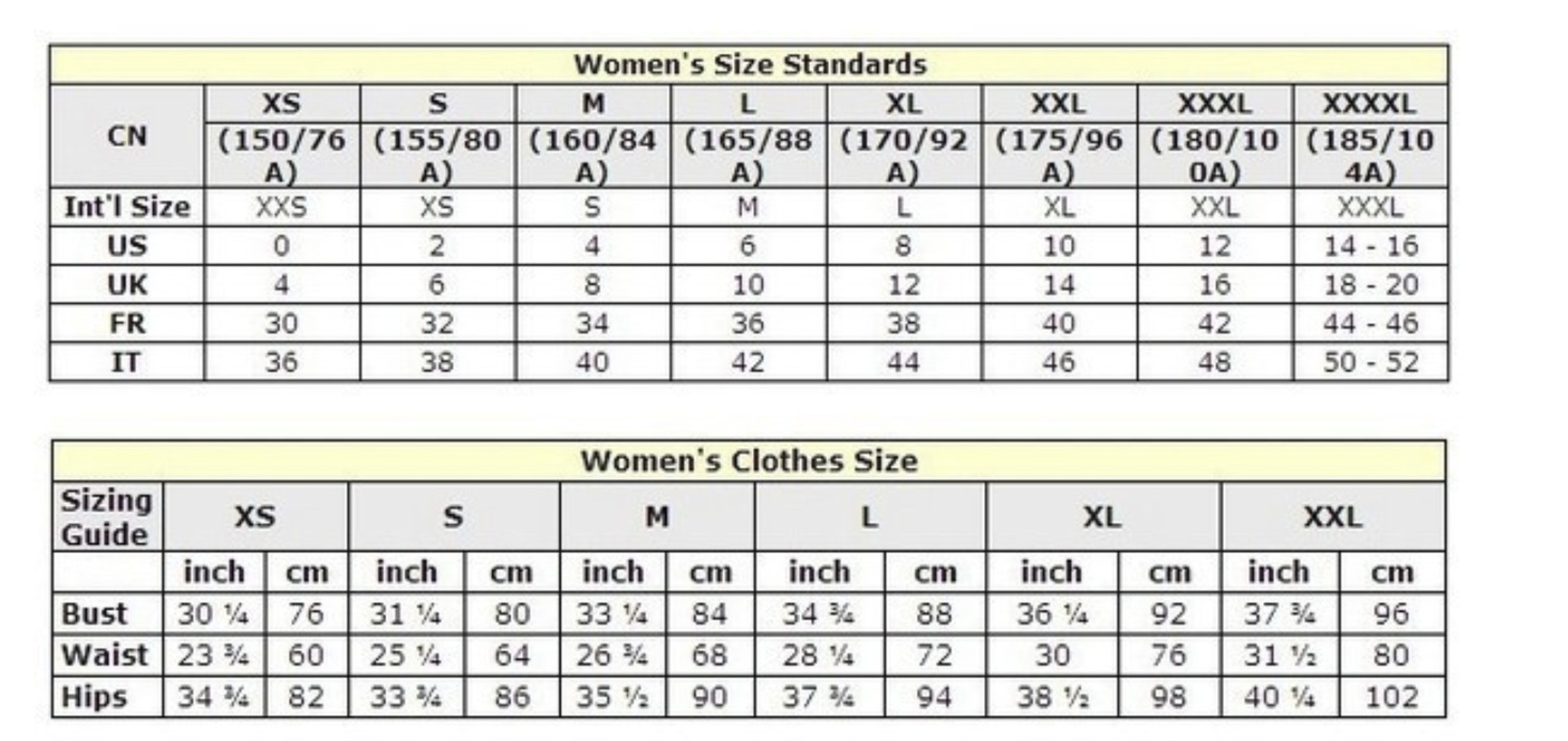
Here is the matching guide:
- XS (150/76A) ≈ International XXS
- S (155/80A) ≈ International XS
- M (160/84A) ≈ International S
- L (165/88A) ≈ International M
- XL (170/92A) ≈ International L
- XXL (175/96A) ≈ International XL
- XXXL (180/100A) ≈ International XXL
- XXXXL (185/104A) ≈ International XXXL
Asian Size vs US / UK / FR / IT numbers
Sometimes, the same shirt can show several size systems at once. For example, you might see US, UK, FR, and IT numbers next to Asian sizes. This is helpful, but it can also be overwhelming if you don’t know how they connect. A conversion table makes the match fast and clear. It also reduces the risk of ordering the wrong size online. Many buyers get confused because Europe/UK/US also use number sizes. This table helps you convert:
- XS (150/76A) → US 0 / UK 4 / FR 30 / IT 36
- S (155/80A) → US 2 / UK 6 / FR 32 / IT 38
- M (160/84A) → US 4 / UK 8 / FR 34 / IT 40
- L (165/88A) → US 6 / UK 10 / FR 36 / IT 42
- XL (170/92A) → US 8 / UK 12 / FR 38 / IT 44
- XXL (175/96A) → US 10 / UK 14 / FR 40 / IT 46
- XXXL (180/100A) → US 12 / UK 16 / FR 42 / IT 48
- XXXXL (185/104A) → US 14–16 / UK 18–20 / FR 44–46 / IT 50–52
Real Body Measurements (best way to choose)
Size letters can change from brand to brand, but measurements are more stable. That’s why bust, waist, and hips are the safest way to pick a T-shirt size. With one tape measure, you can compare yourself to any chart in minutes. This is especially useful when buying across countries. If you want comfort, measurements will guide you better than labels. Letter sizes can change by brand. So the safest method is to use your body measurements, especially for T-shirts. Here is a simple women’s guide (cm):
- XS: Bust 76 / Waist 60 / Hips 82
- S: Bust 80 / Waist 64 / Hips 86
- M: Bust 84 / Waist 68 / Hips 90
- L: Bust 88 / Waist 72 / Hips 94
- XL: Bust 92 / Waist 76 / Hips 98
- XXL: Bust 96 / Waist 80 / Hips 102
Tip for T-shirts:
- If you like a regular fit, pick the size that matches your bust
- If you like an oversize fit, go up 1 size
- If you are between two sizes, pick the bigger one for comfort
Quick example: why “same size” can look different
If a buyer wears M (160/84A), that often matches International S. But if they buy a European brand marked “S,” it may still feel roomier, because European cuts are often larger. That’s why it’s smart to use bust measurement first, not only the letter.
Custom production note (for factories)
Custom orders are different from ready-made retail sizing. Many buyers do not follow one fixed standard, especially when they sell in different countries. So the best approach is to collect key body data and the target fit style. Then you adjust patterns to match local expectations, like Asian fit or European fit. This creates fewer complaints and better repeat orders. For customized T-shirts, customers often do not follow one “standard” size system. So the best practice is:
- collect height, bust, waist, hips, and the desired fit (slim / regular / oversize)
- then adjust the pattern to match the local market fit (Asian fit vs European fit)
Final Word / Conclusion
European and Asian T-shirt sizes can look the same on the label, but they often fit very differently in real life. European cuts are usually looser and longer, while Asian cuts are often slimmer and shorter. To avoid returns and unhappy customers, don’t rely on “S/M/L” alone use body measurements, compare with a size chart, and choose based on the fit you want (slim, regular, or oversize). For custom production, the best result always comes from clear customer data (height, bust, waist, hips) and a confirmed target market standard. That simple step saves time, cost, and mistakes—while delivering a fit that feels “right” to the buyer.
Our Contact Information – MEKONG GARMENT FACTORY
- Vietnam Phone: +84 947 729 829
- WeChat: +84 947 729 829
- WhatsApp: +84 947 729 829
- Email: hanh@kimmy.vn