
V-Neck T-Shirts: A Brand Owner’s Guide to Design, Risk, and Reorder Reality

V-neck T-shirts sit in an interesting space between basic and fashion. They look simple, but they are less forgiving than crew necks in both design and production. For brand owners, V-necks can add variety and perceived style to a collection or quietly reduce reorder rates if handled poorly. This guide breaks down what V-neck T-shirts really are from a production, fit, and market-acceptance perspective, so brands can decide when they make sense and when they don’t.
=> Read More: T Shirts Manufacturing Vietnam | Mekong Garment Factory
What Is a V-Neck T-Shirt?
A V-neck T-shirt features a neckline that dips into a “V” shape at the front instead of a round collar. The depth and angle of this V vary widely, from shallow everyday cuts to deeper fashion-forward versions. From a technical standpoint, a V-neck is not just a different shape. It introduces a stress point at the V apex, where two neckline seams meet. This single detail is what separates a clean, premium V-neck from one that quickly looks cheap. V-necks look simple, but they demand tighter control than crew necks.
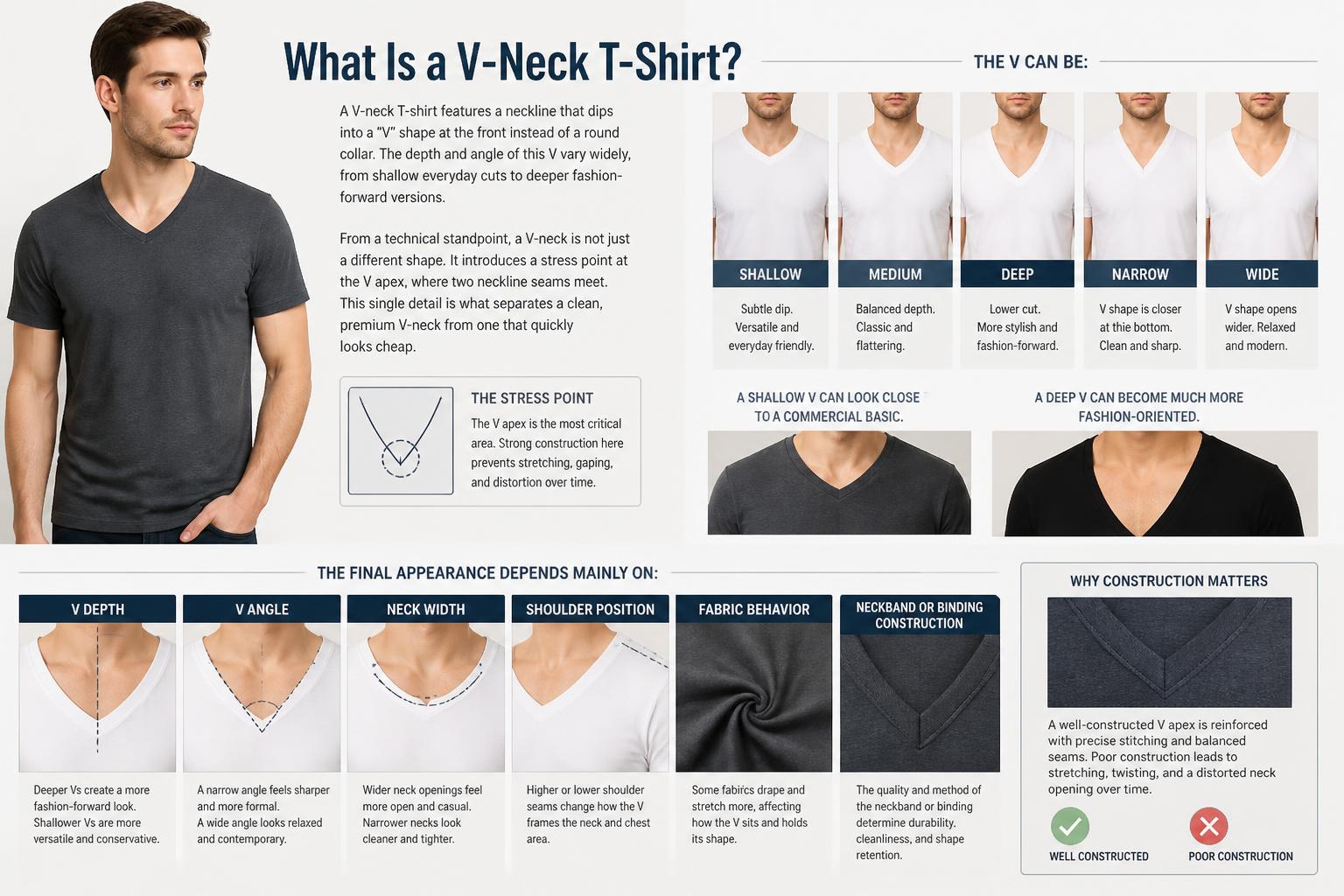
The V can be:
- Shallow
- Medium
- Deep
- Narrow
- Wide
The final appearance depends mainly on:
- V depth
- V angle
- Neck width
- Shoulder position
- Fabric behavior
- Neckband or binding construction

A shallow V can look close to a commercial basic. A deep V can become much more fashion-oriented.
Why the V Point Matters So Much
The most important area of a V-neck is the apex, or the point where the two sides of the neckline meet. This is a concentrated stress area. If the V point is not controlled properly, the neckline may:
- Stretch
- Twist
- Open
- Pucker
- Become asymmetrical
That is why V-neck sewing generally requires more precision than a standard crew neck. A useful principle is: The V Point Is Small, but It Controls the Look of the Entire Neckline
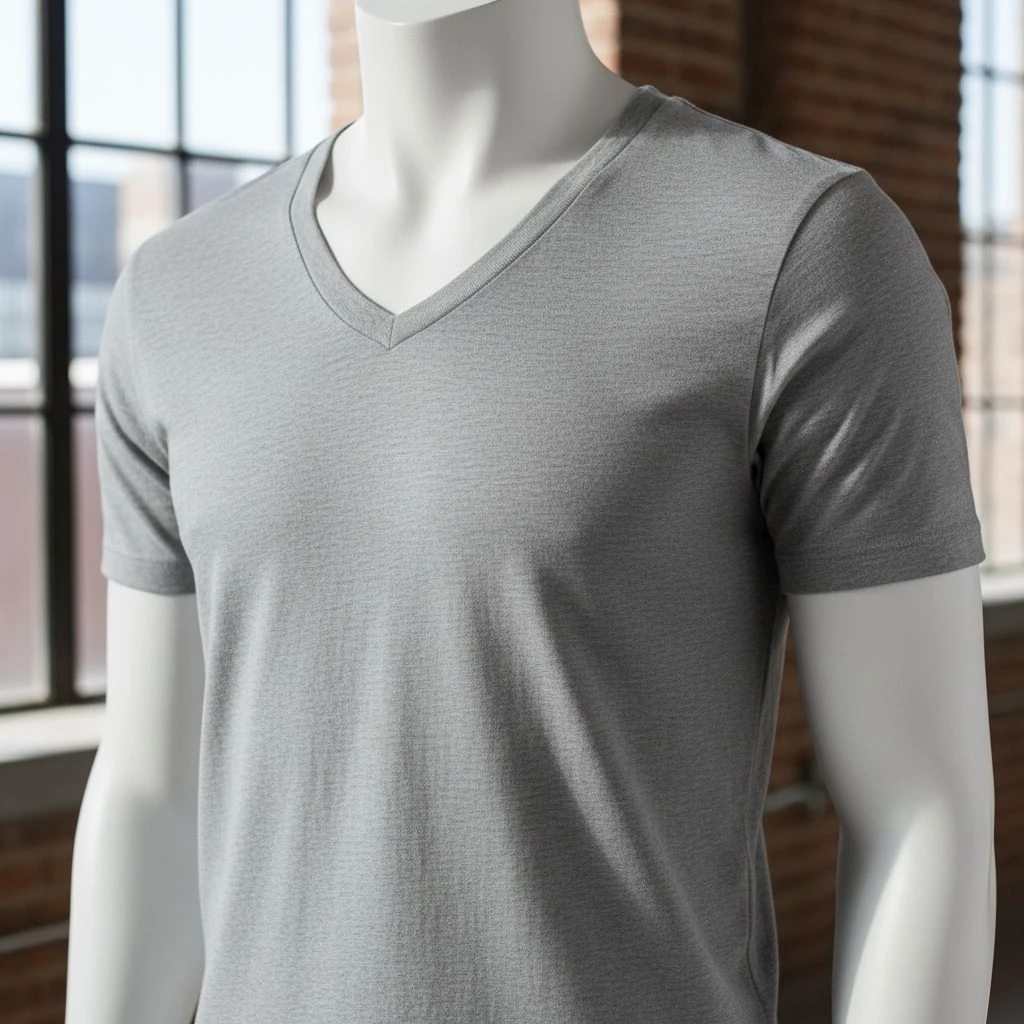
A V-neck T-shirt has a neckline that forms a V-shaped opening at the front instead of a rounded crew neckline.
Not All V-Necks Are the Same
The term “V-neck” is too broad by itself. Different V-neck styles create different fit and market outcomes. Common V-Neck Directions
- Shallow V
- Classic V
- Deep V
- Narrow V
- Wide V
Each should be defined technically.
Pros & Cons of V-Neck T-Shirts
| Pros | Cons |
|---|---|
| More styled than crew neck | Apex requires precise sewing |
| Good for layering | Can become too deep |
| Open neckline | Market acceptance varies |
| Works for men and women | Poor recovery can distort V |
| Suitable for premium basics | Grading needs control |
| Strong visual identity | Asymmetry is easy to notice |
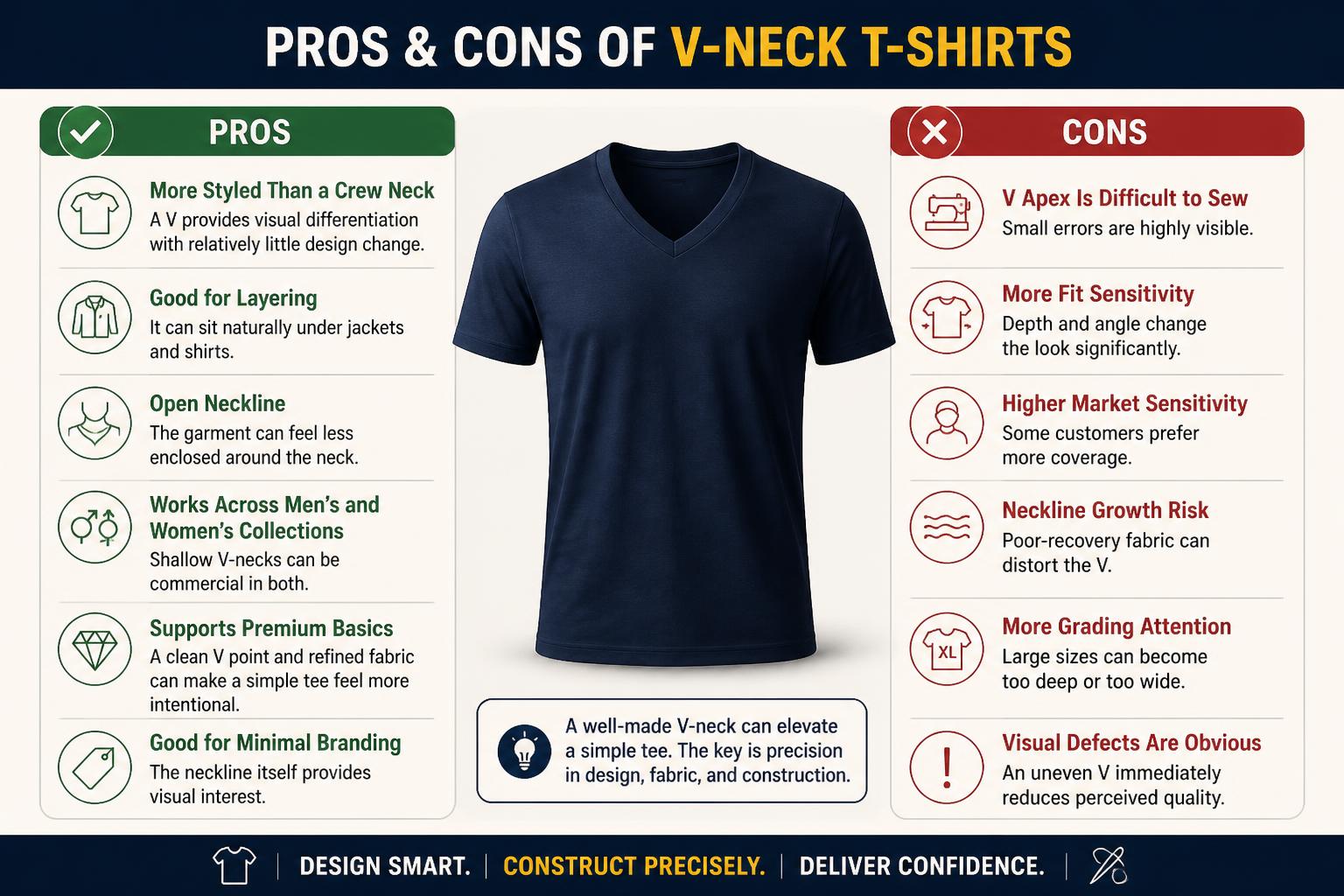
Pros:
V-necks offer several advantages when they match the brand and customer.
- More Styled Than a Crew Neck: A V provides visual differentiation with relatively little design change.
- Good for Layering: It can sit naturally under jackets and shirts.
- Open Neckline: The garment can feel less enclosed around the neck.
- Works Across Men’s and Women’s Collections: Shallow V-necks can be commercial in both.
- Supports Premium Basics: A clean V point and refined fabric can make a simple tee feel more intentional.
- Good for Minimal Branding: The neckline itself provides visual interest.
Cons:
V-necks also create several risks.
- V Apex Is Difficult to Sew: Small errors are highly visible.
- More Fit Sensitivity: Depth and angle change the look significantly.
- Higher Market Sensitivity: Some customers prefer more coverage.
- Neckline Growth Risk: Poor-recovery fabric can distort the V.
- More Grading Attention: Large sizes can become too deep or too wide.
- Visual Defects Are Obvious: An uneven V immediately reduces perceived quality.
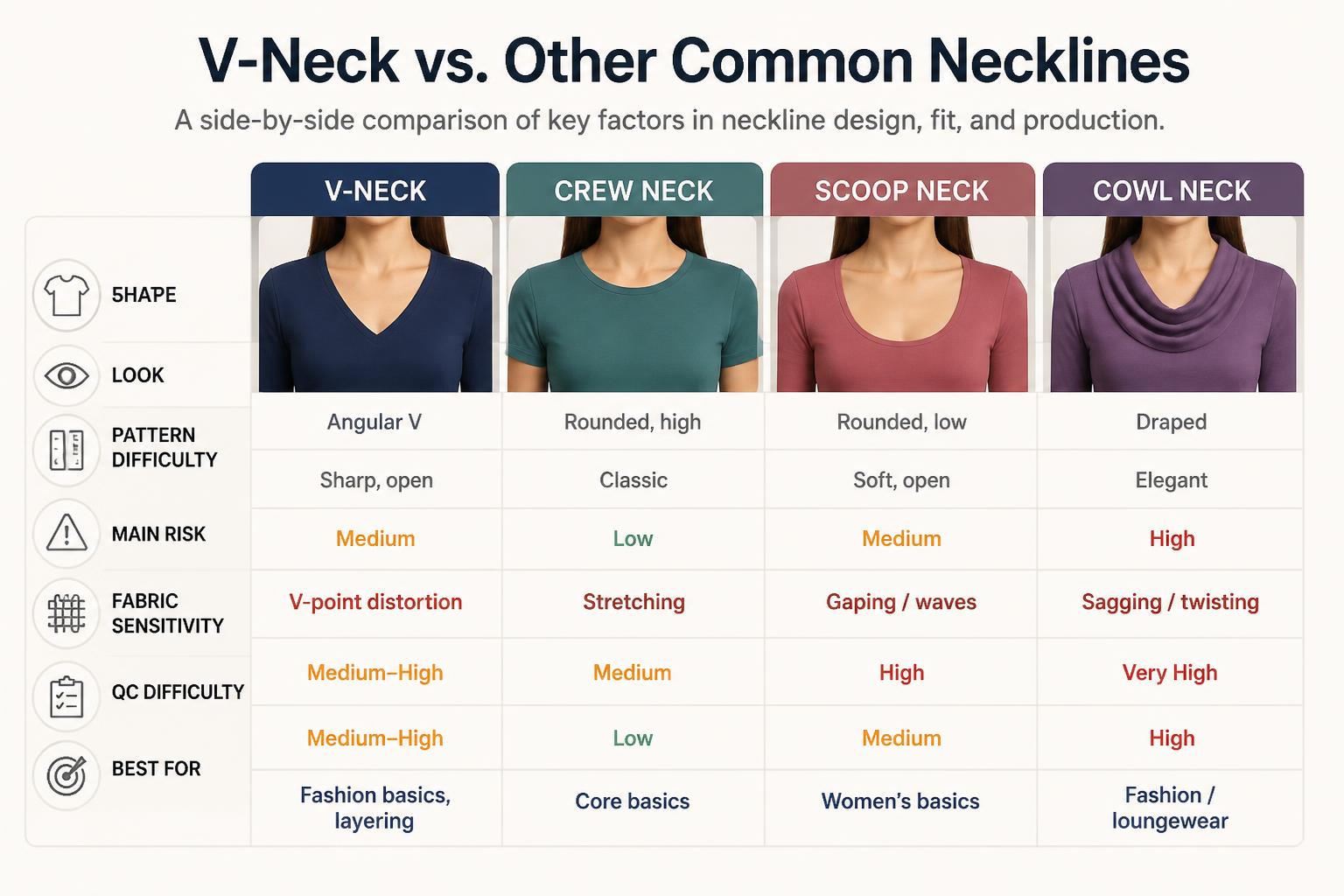
V-Neck vs. Other Common Necklines
| Factor | V-Neck | Crew Neck | Scoop Neck | Cowl Neck |
|---|---|---|---|---|
| Shape | Angular V | Rounded, high | Rounded, low | Draped |
| Look | Sharp, open | Classic | Soft, open | Elegant |
| Pattern Difficulty | Medium | Low | Medium | High |
| Main Risk | V-point distortion | Stretching | Gaping / waves | Sagging / twisting |
| Fabric Sensitivity | Medium–High | Medium | High | Very High |
| QC Difficulty | Medium–High | Low | Medium | High |
| Best For | Fashion basics, layering | Core basics | Women’s basics | Fashion / loungewear |

Why Brands Add V-Necks to a Collection (And Why Some Avoid Them)
V-necks are often added to collections to make basics feel more styled without moving fully into fashion silhouettes. However, many brands underestimate how much market sensitivity and fit tolerance a V-neck requires. This section explains why some brands succeed with V-necks, and why others quietly phase them out after one or two seasons.
Brands often introduce V-necks to:
- Make basics feel more styled and intentional
- Offer an alternative to crew neck fatigue
- Create better layering pieces under shirts or jackets
However, many brands quietly limit V-neck volume or remove them entirely after early runs because V-necks are less universal across age groups, conservative markets reject deeper cuts, and poor V shape or weak stitching damages brand perception fast. A crew neck hides mistakes. A V-neck exposes them.

Fit and Visual Impact: The Hidden Risk
The shape of a V-neck directly changes how the upper body looks on real customers, not models. For brands selling at scale, fit control here is not aesthetic; it’s commercial risk management.

V-necks change how the upper body is perceived. What works: visually elongates the neck, can make the torso look leaner, and feels more open around the throat. What goes wrong: too deep looks unintentional, too wide collapses after washing, and poor angles lead to awkward chest exposure on real bodies.
Neckline Construction: Where Quality Is Won or Lost
The V point is the most fragile and revealing part of the garment. Reinforcement, stitch accuracy, and material recovery determine whether a V-neck looks premium or cheap after repeated wear.
The V point is the most critical detail of the entire garment. Common construction methods: overlapped rib with reinforcement stitching, self-fabric binding with bar-tack at the apex, or double-needle reinforcement. Once the V stretches or twists, customers simply don’t reorder.
Fabric Choices That Actually Work for V-Necks
Fabric choice matters more for V-necks than for most basic tees. Recovery, stability, and shrink behavior all influence how the neckline holds its shape over time.

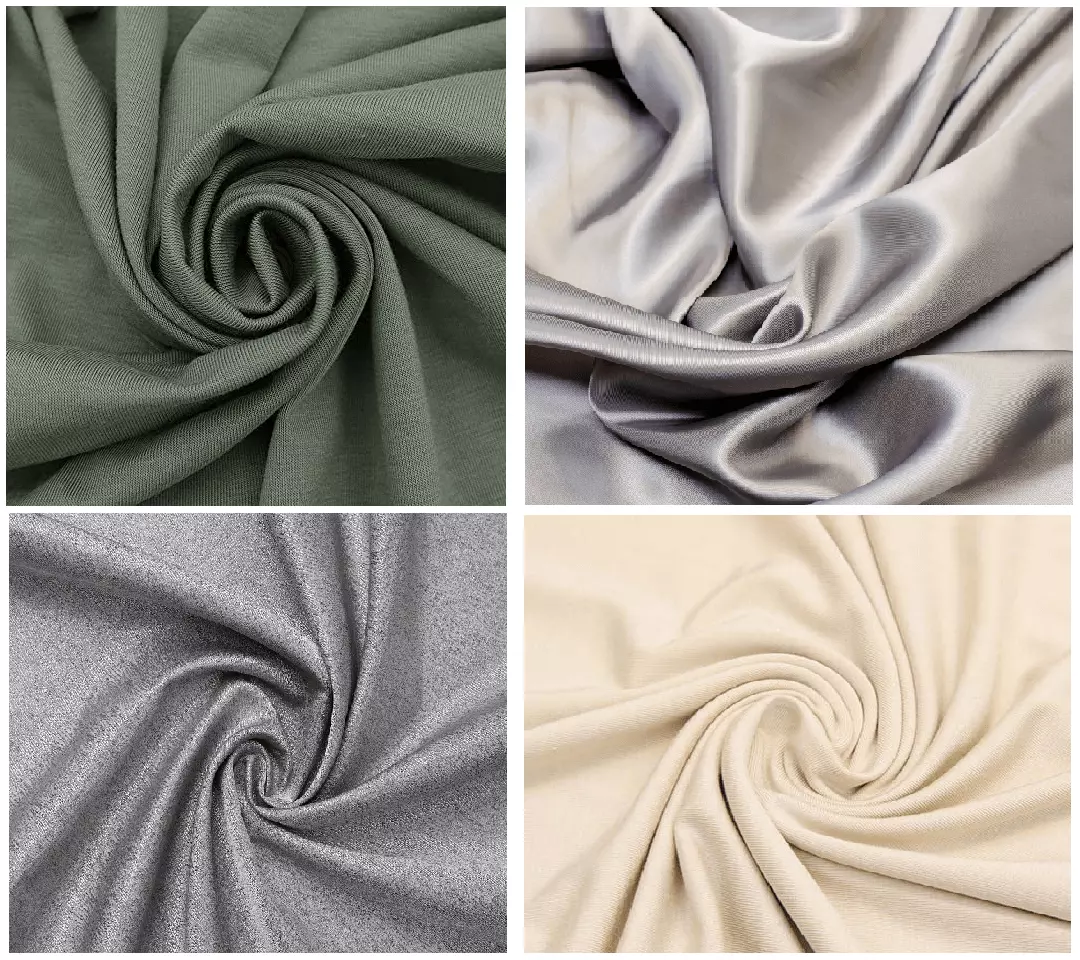
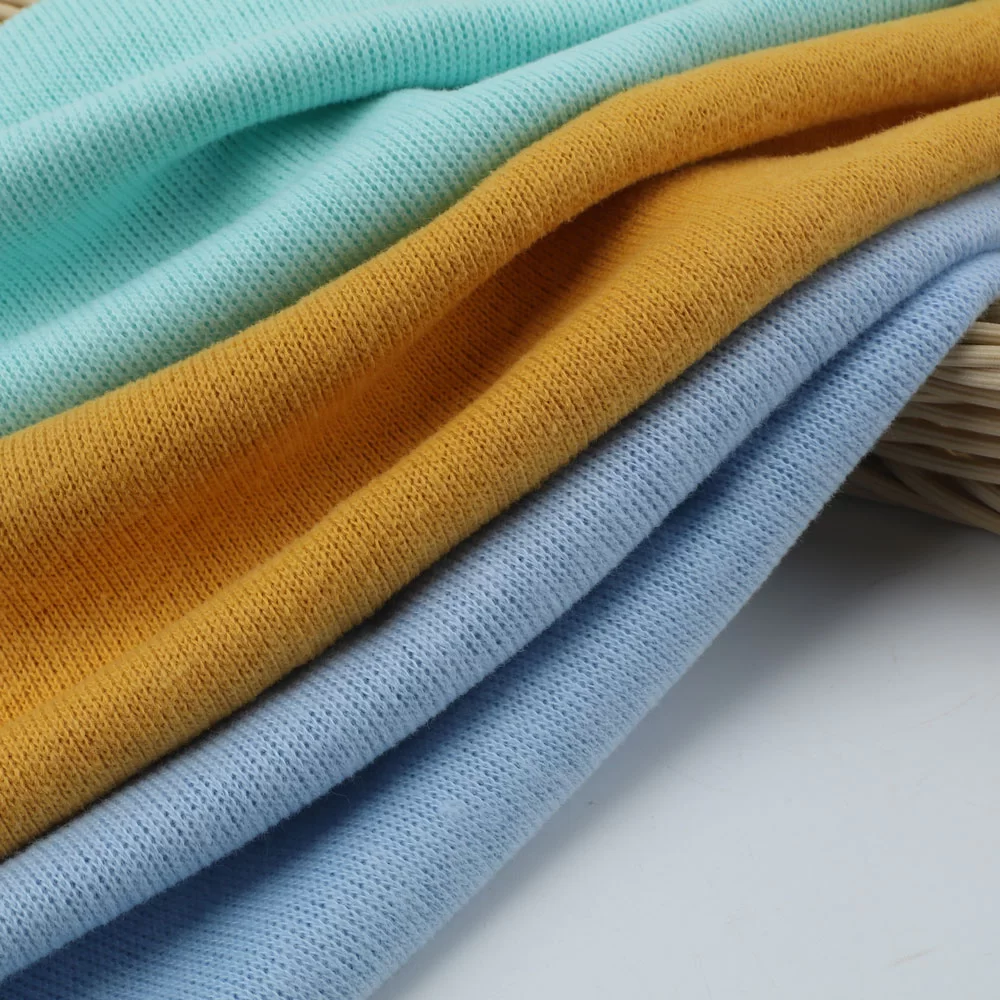
Safer options: Combed cotton, ring-spun cotton, cotton-modal blends, and tri-blends with controlled stretch. Higher risk: cheap carded cotton or low-GSM jerseys without recovery. Soft fabric feels great on day one, but a weak neckline shows on wash three.
Printing, Branding, and Placement Considerations
The V-neck opening reduces usable chest space and shifts visual balance downward. This impacts logo placement and scale. Understanding these limitations early helps brands avoid awkward graphics and mismatched design expectations at retail. V-necks work best with: minimal branding, left-chest prints, or tonal premium finishes. They are not ideal for bold, oversized graphics.
Market Suitability: Where V-Necks Perform Best
V-necks are not universally accepted. Cultural norms and customer comfort levels influence sell-through. Strong markets: Fashion basics, warm or humid climates, lifestyle brands, and layering-focused collections. Weak markets: Uniform programs, corporate apparel, and conservative regions.

Common applications include:
- Fashion basics
- Lifestyle collections
- Premium casualwear
- Warm-weather ranges
- Layering programs
But market suitability depends on:
- Customer age
- Cultural expectations
- Product use
- V depth
- Gender positioning
There is no universal “strong” or “weak” market for all V-necks.
Production and Reorder Reality
Initial sales data can be misleading. A style may sell on launch but fail at reorder due to wash behavior or fit feedback from broader size ranges. Brands that succeed with V-necks usually: keep the V shallow and controlled, use better neckline specs than crew necks, and limit quantities early. Test small. Observe reorders. Scale carefully. What Brands Should Put in the Tech Pack – Avoid using only: “V-Neck T-Shirt” The technical specification should include:
- Neck width
- Front V depth
- Back neck drop
- V angle or curve reference
- Finished neckband width
- Neckband construction
- V-point construction
- Shoulder width
- Fabric composition
- GSM
- Stretch/recovery requirement where relevant
The approved sample should also serve as a visual reference.
Conclusion: When V-Neck T-Shirts Make Sense for Brands
Brands that approach V-necks with the same specifications as crew necks often face quality issues. When aligned with the right fabric, construction, and audience, V-necks can strengthen a collection but only as a deliberate choice. They work when the V depth is conservative, construction is reinforced, and the target market accepts the look. They fail when brands treat them like crew necks with a different cut. For brand owners, the decision isn’t “Do V-necks sell?” It’s “Can my design, factory, and market handle them?”