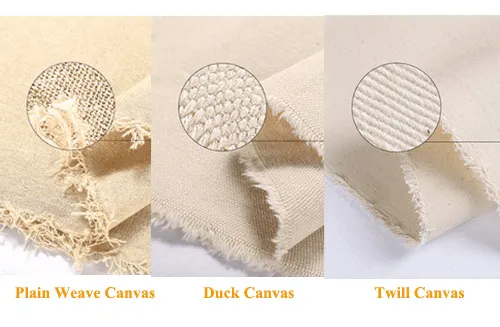
Which Cotton Fabrics Best Suited for Heavy‑Duty Items and Workwear

Cotton is everywhere in clothing because it’s natural, breathable, and comfortable. But not all cotton fabrics are built the same. When you need something that stands up to tough use—tools, dirt, constant bending, and abrasion—you need heavier, well-structured cotton weaves that resist tearing and wear. Below, we explore the cotton textiles that are truly heavy-duty: what they are, why they work, and how to identify fabrics that are actually up to hard labor.
What Makes a Cotton Fabric Heavy-Duty?
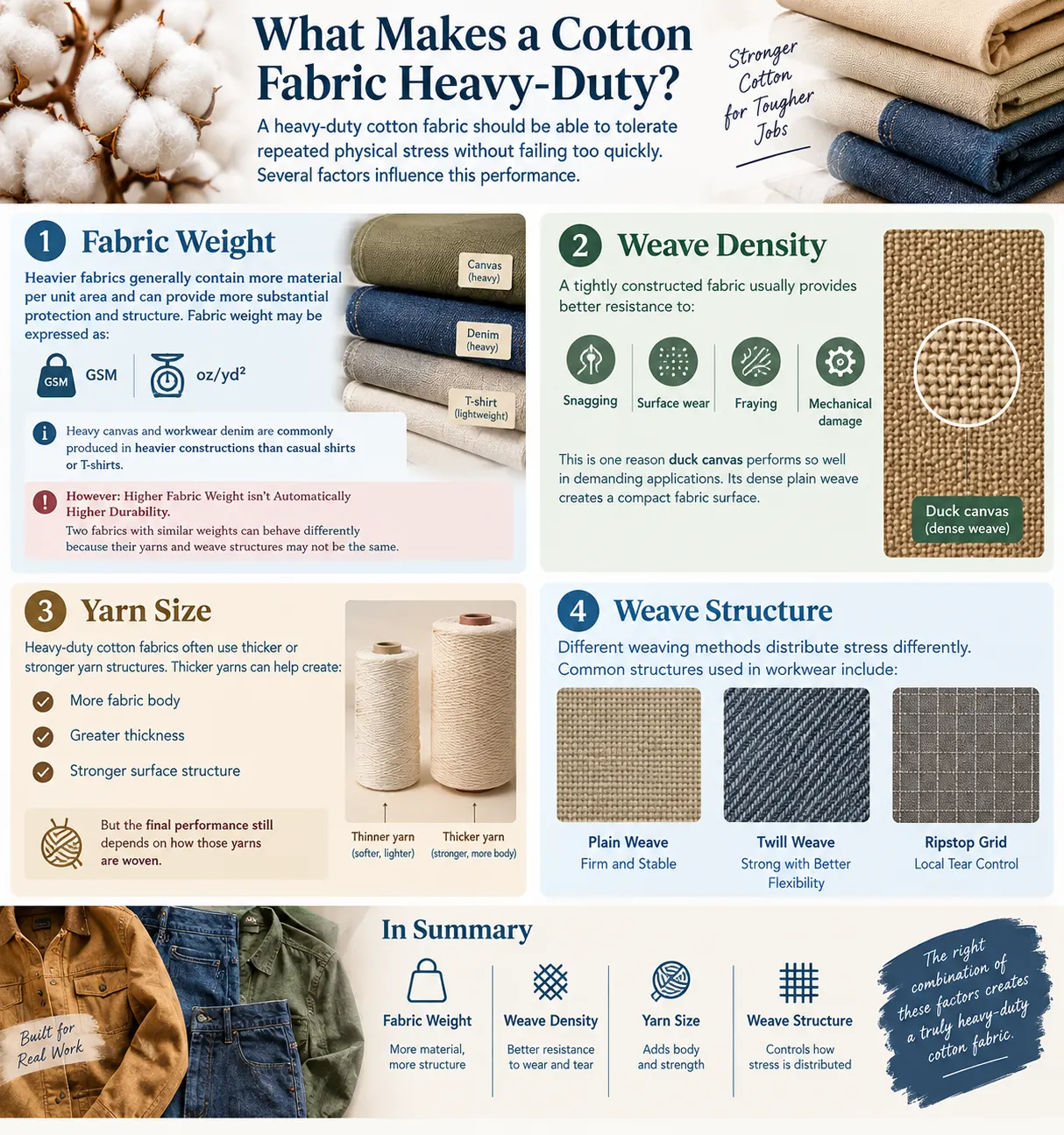
A heavy-duty cotton fabric should be able to tolerate repeated physical stress without failing too quickly. Several factors influence this performance.
Fabric Weight
Heavier fabrics generally contain more material per unit area and can provide more substantial protection and structure. Fabric weight may be expressed as:
- GSM
- oz/yd²
Heavy canvas and workwear denim are commonly produced in heavier constructions than casual shirts or T-shirts. However: Higher Fabric Weight isn’t Automatically Higher Durability Two fabrics with similar weights can behave differently because their yarns and weave structures may not be the same.
Weave Density
A tightly constructed fabric usually provides better resistance to:
- Snagging
- Surface wear
- Fraying
- Mechanical damage
This is one reason duck canvas performs so well in demanding applications. Its dense plain weave creates a compact fabric surface.
Yarn Size
Heavy-duty cotton fabrics often use thicker or stronger yarn structures. Thicker yarns can help create:
- More fabric body
- Greater thickness
- Stronger surface structure
But the final performance still depends on how those yarns are woven.
Weave Structure
Different weaving methods distribute stress differently. Common structures used in workwear include:
- Plain weave
- Twill weave
- Ripstop reinforcement grid
Each produces different performance. A simple comparison is:
- Plain Weave => Firm and Stable
- Twill Weave => Strong with Better Flexibility
- Ripstop Grid => Local Tear Control
Top Cotton Fabrics Best Suited for Heavy‑Duty:
1. Canvas (Especially Duck Canvas) – One of the Strongest Cotton Choices
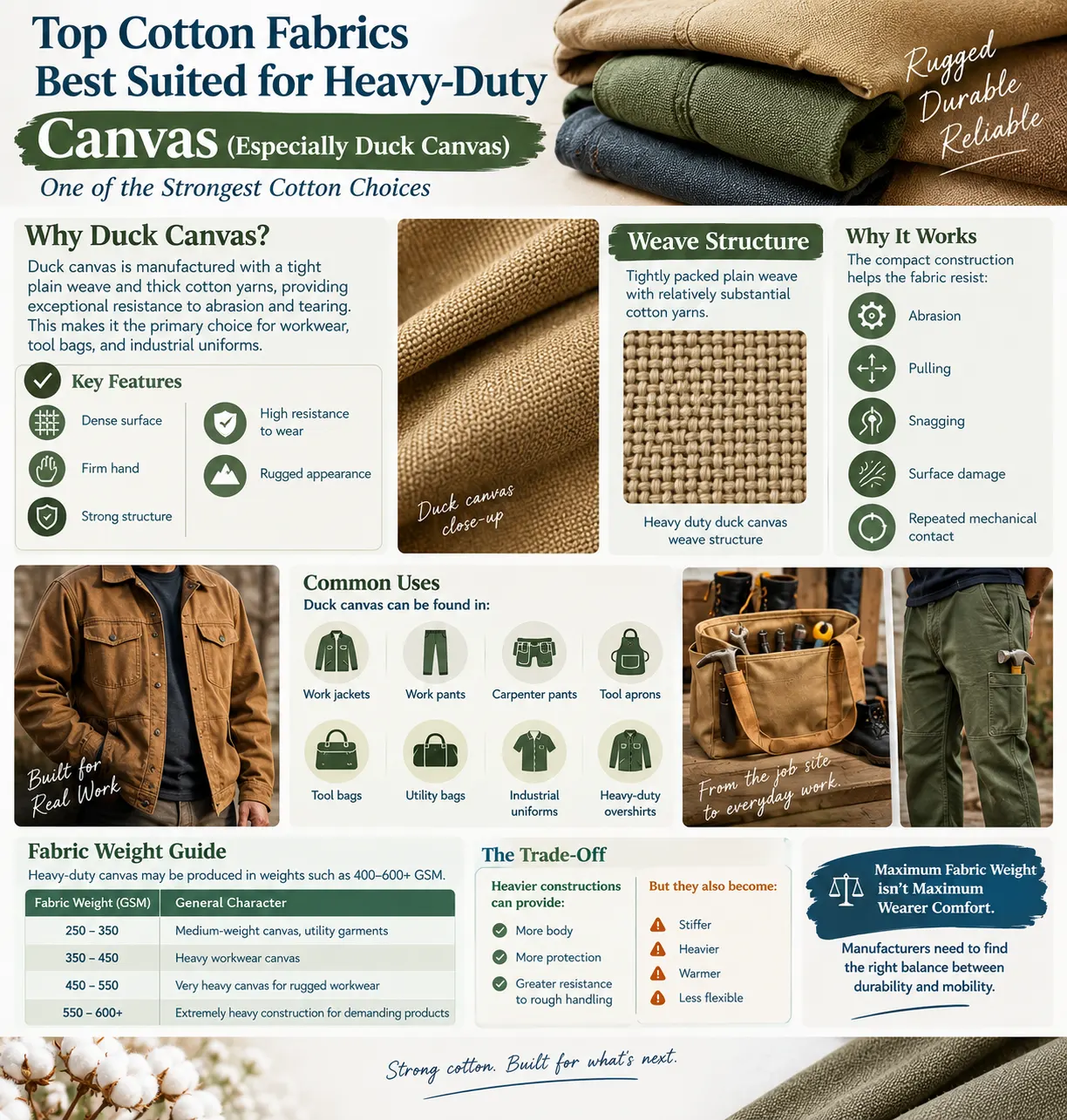
When discussing heavy-duty cotton fabric, canvas is the undisputed industry standard. Duck canvas is manufactured with a tight plain weave and thick cotton yarns, providing exceptional resistance to abrasion and tearing. This makes it the primary choice for workwear, tool bags, and industrial uniforms.
This gives the material a:
- Dense surface
- Firm hand
- Strong structure
- High resistance to wear
- Rugged appearance
It is widely associated with products that must tolerate repeated physical use.
Why Duck Canvas Works for Heavy-Duty Products
The major advantage of duck canvas is its compact construction. The tightly woven yarns help create a fabric that can resist:
- Abrasion
- Pulling
- Snagging
- Surface damage
- Repeated mechanical contact
Compared with lighter cotton fabrics, duck canvas usually feels much firmer and more substantial.
Duck canvas is made using a tightly packed plain weave and relatively substantial cotton yarns. – Heavy duty duck canvas weave structure
Common Uses of Duck Canvas
Duck canvas can be found in:
- Work jackets
- Work pants
- Carpenter pants
- Tool aprons
- Tool bags
- Utility bags
- Industrial uniforms
- Heavy-duty overshirts
- Protective outer garments
It is particularly useful where the fabric regularly comes into contact with rough tools or surfaces.
Heavyweight Duck Canvas
Heavy-duty canvas may be produced in substantial weights such as 400–600+ GSM, depending on the product.
| Fabric Weight | General Character |
|---|---|
| 250–350 GSM | Medium-weight canvas, utility garments |
| 350–450 GSM | Heavy workwear canvas |
| 450–550 GSM | Very heavy canvas for rugged workwear |
| 550–600+ GSM | Extremely heavy construction for demanding products |
Heavier constructions can provide:
- More body
- More protection
- Greater resistance to rough handling
But they also become:
- Stiffer
- Heavier
- Warmer
- Less flexible
Therefore: Maximum Fabric Weight isn’t Maximum Wearer Comfort. Manufacturers need to find the right balance between durability and mobility.
2. Denim: Rugged Twill That Still Breathes
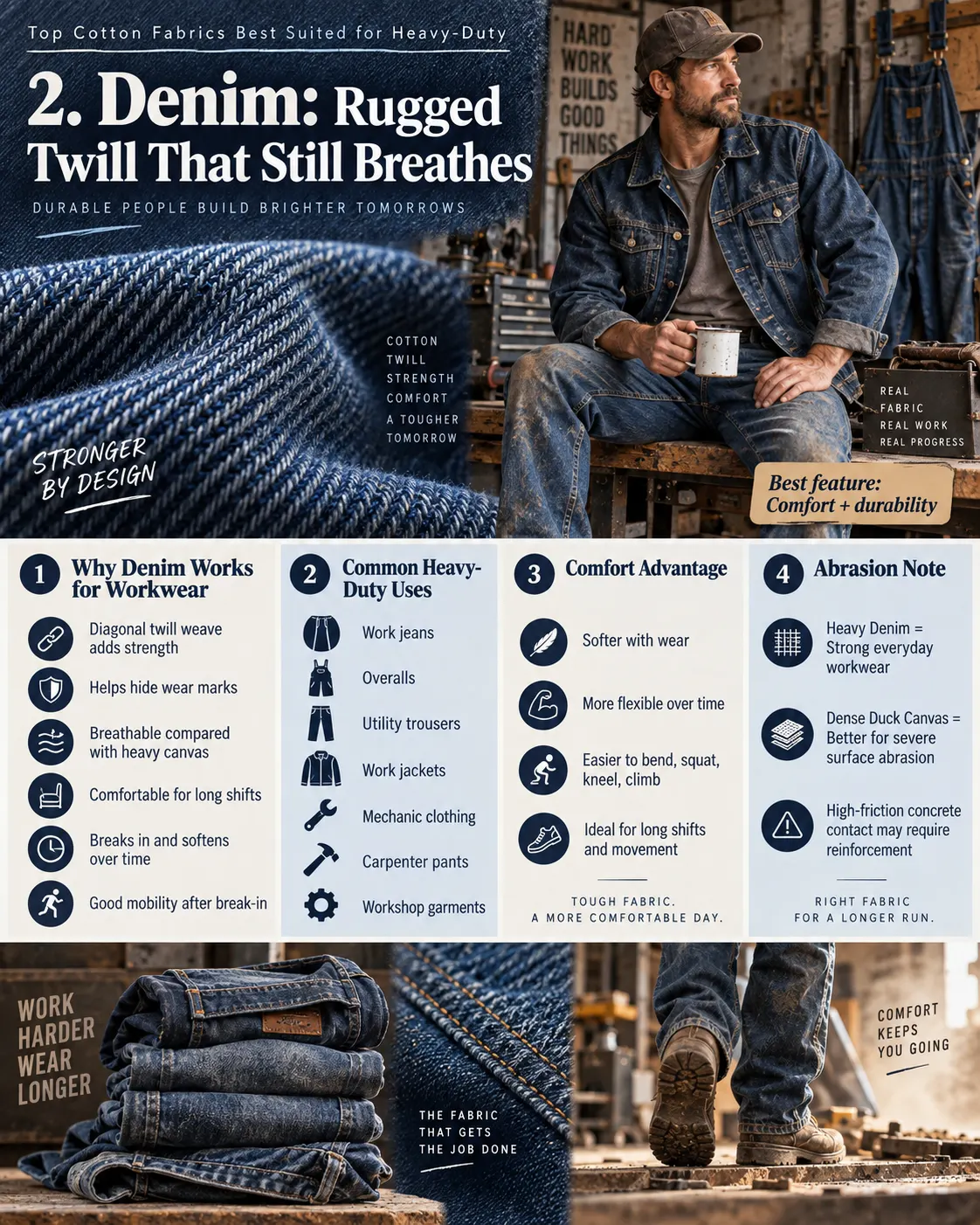
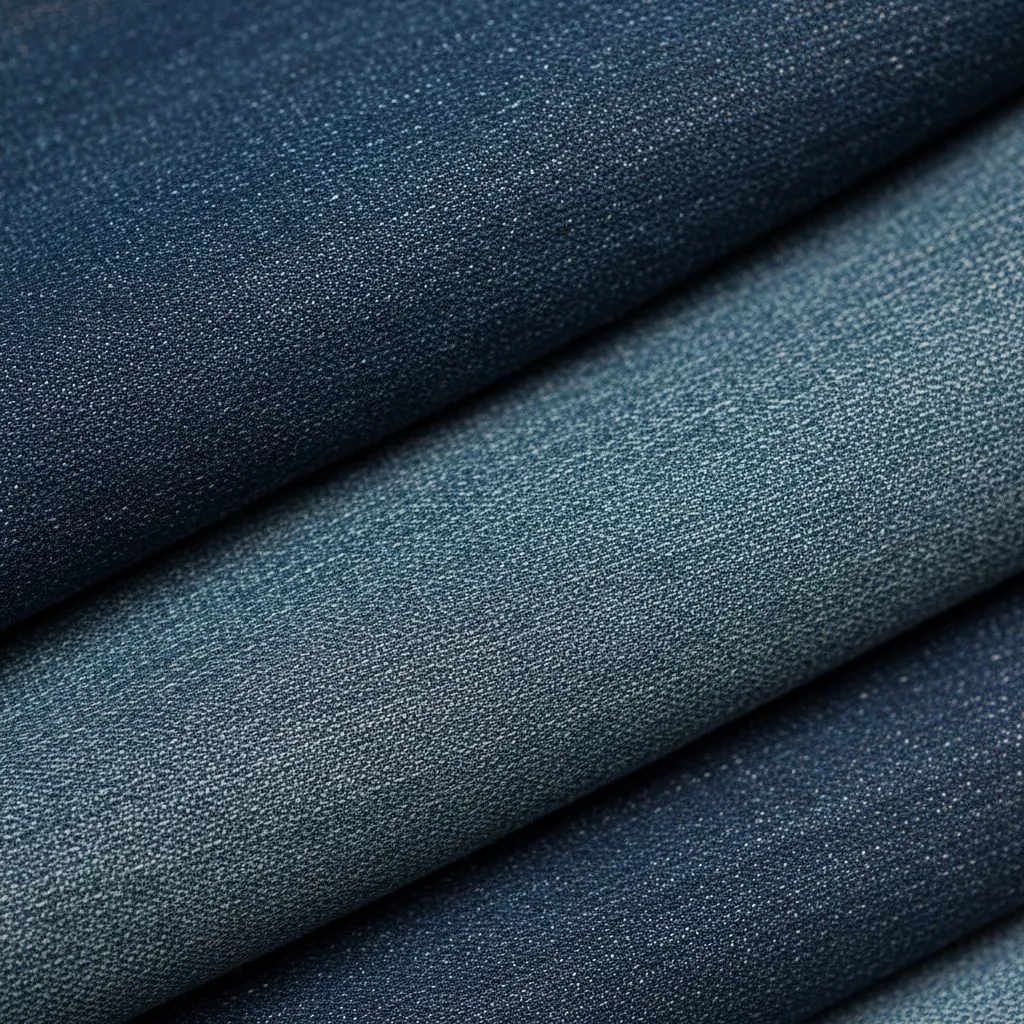
Denim is a classic twill weave where the diagonal pattern adds structural integrity and hides wear marks. It handles daily stresses in work pants and overalls effectively while remaining more breathable than heavy canvas. While durable, denim is not as abrasion-resistant as canvas in high-friction environments (like concrete contact). Its main advantage is comfort; denim breaks in and softens over time, making it ideal for long shifts where mobility is key.
Why Denim Works for Workwear
Heavy denim can provide a useful combination of:
- Strength
- Durability
- Comfort
- Body
- Flexibility after break-in
New heavyweight denim may initially feel stiff. Over time, however, repeated wear and laundering can soften the fabric. This makes denim particularly useful when workers need both protection and freedom of movement.
Common Heavy-Duty Denim Applications
Denim is widely used for:
- Work jeans
- Overalls
- Utility trousers
- Work jackets
- Mechanic clothing
- Carpenter pants
- Workshop garments

Its workwear history is one reason denim remains strongly associated with rugged clothing.
Denim and Abrasion
Heavy denim handles repeated daily wear effectively, but extremely abrasive environments may favor dense canvas. For example, workers frequently kneeling or rubbing against rough concrete may require stronger reinforcement or different fabric construction.
- Therefore: Heavy Denim = Strong Everyday Workwear
- while: Dense Duck Canvas = Stronger Choice for Severe Surface Abrasion
The exact result still depends on the specific fabric.
Why Denim Can Feel More Comfortable Than Canvas
The twill structure gives denim a different feel from tightly woven plain-weave canvas.
As the garment breaks in, it can become:
- Softer
- More flexible
- Easier to bend
- More comfortable for long shifts
This makes denim useful for work requiring frequent:
- Walking
- Squatting
- Kneeling
- Climbing
- Bending
3. Cotton Drill: Strong, Practical, and Versatile
Cotton drill is another important workwear fabric. It generally uses a strong twill weave, creating diagonal lines similar to those seen in other twill fabrics. Drill often sits between very heavy canvas and lighter everyday cotton. This makes it highly practical for uniforms and utility clothing.
Why Cotton Drill Works for Workwear
Cotton drill can provide:
- Good durability
- Smooth surface
- Moderate structure
- Better flexibility than very heavy canvas
- Comfortable everyday wear
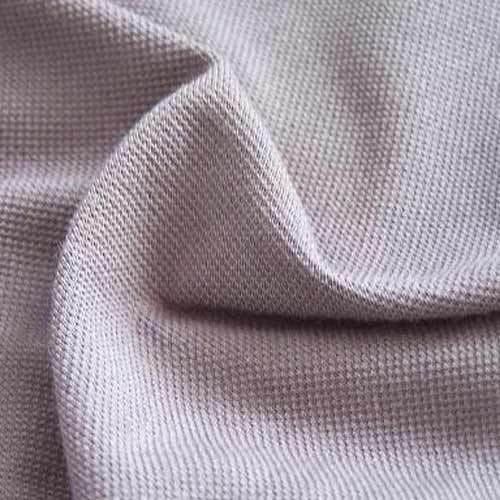
This balance makes it useful when clothing needs to be strong but should not feel excessively rigid.
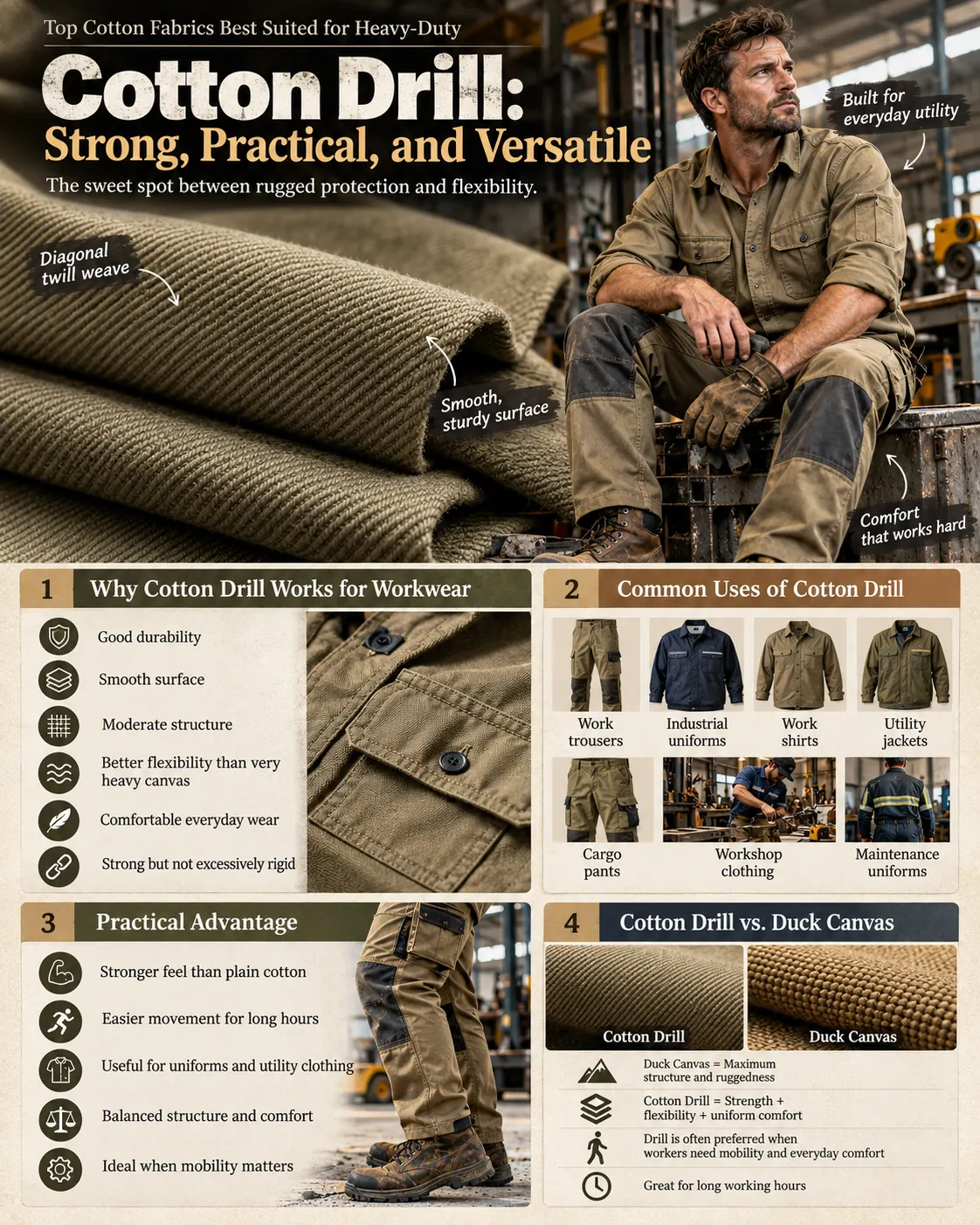
Common Uses of Cotton Drill
Cotton drill may be used for:
- Work trousers
- Industrial uniforms
- Work shirts
- Utility jackets
- Cargo pants
- Workshop clothing
- Maintenance uniforms
It works especially well for garments worn for long working hours.
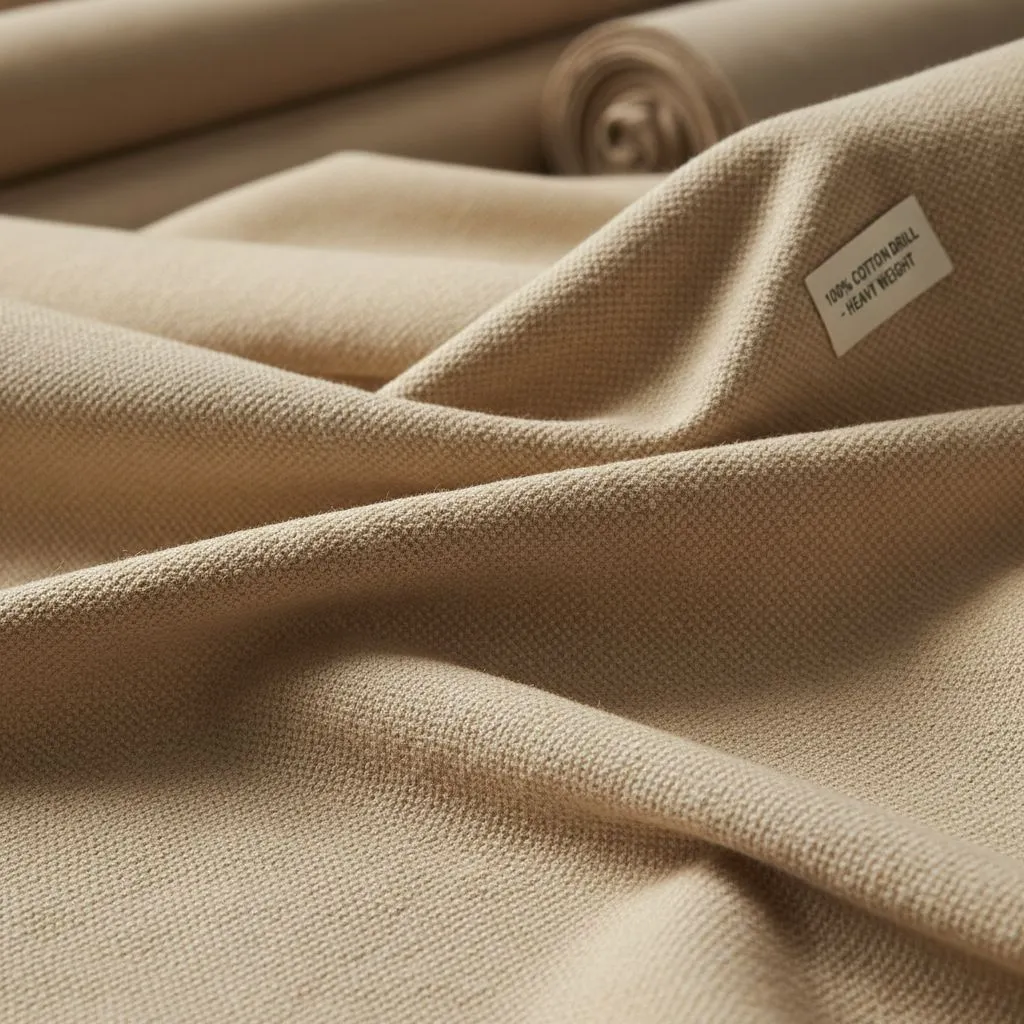
Drill fabric is a heavyweight cotton with a strong diagonal weave, similar to denim but often with a sturdier, smoother feel. It represents the “sweet spot” between rugged protection and flexibility—stronger than plain cotton but lighter than armor-like canvas.
Cotton Drill vs. Duck Canvas
Duck canvas is generally selected when maximum ruggedness is the main priority. Cotton drill may be preferable when workers require more mobility and everyday comfort. A simple comparison is:
- Duck Canvas = Maximum Structure and Ruggedness
- Cotton Drill = Strength + Flexibility + Uniform Comfort
4. Cotton Twill: A Flexible Workwear Category
Twill is not one single fabric. It refers to a weave structure characterized by diagonal ribs or lines. Many durable cotton fabrics use twill construction because it can provide a useful balance between strength and flexibility.
Why Twill Is Useful
The diagonal weave can help the fabric handle mechanical stress while remaining comfortable enough for clothing.
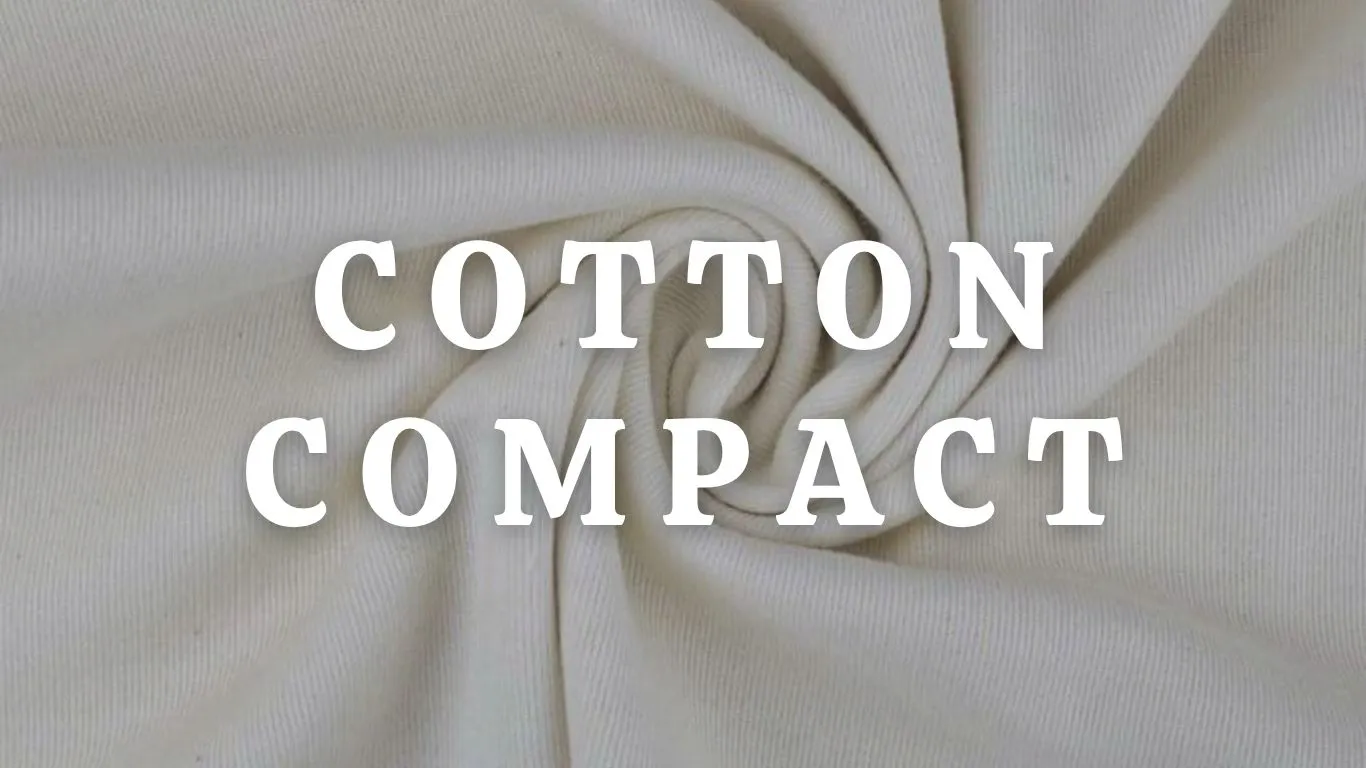
Cotton twill may provide:
- Good durability
- Smooth surface
- Flexible movement
- Strong garment structure
- Good suitability for uniforms
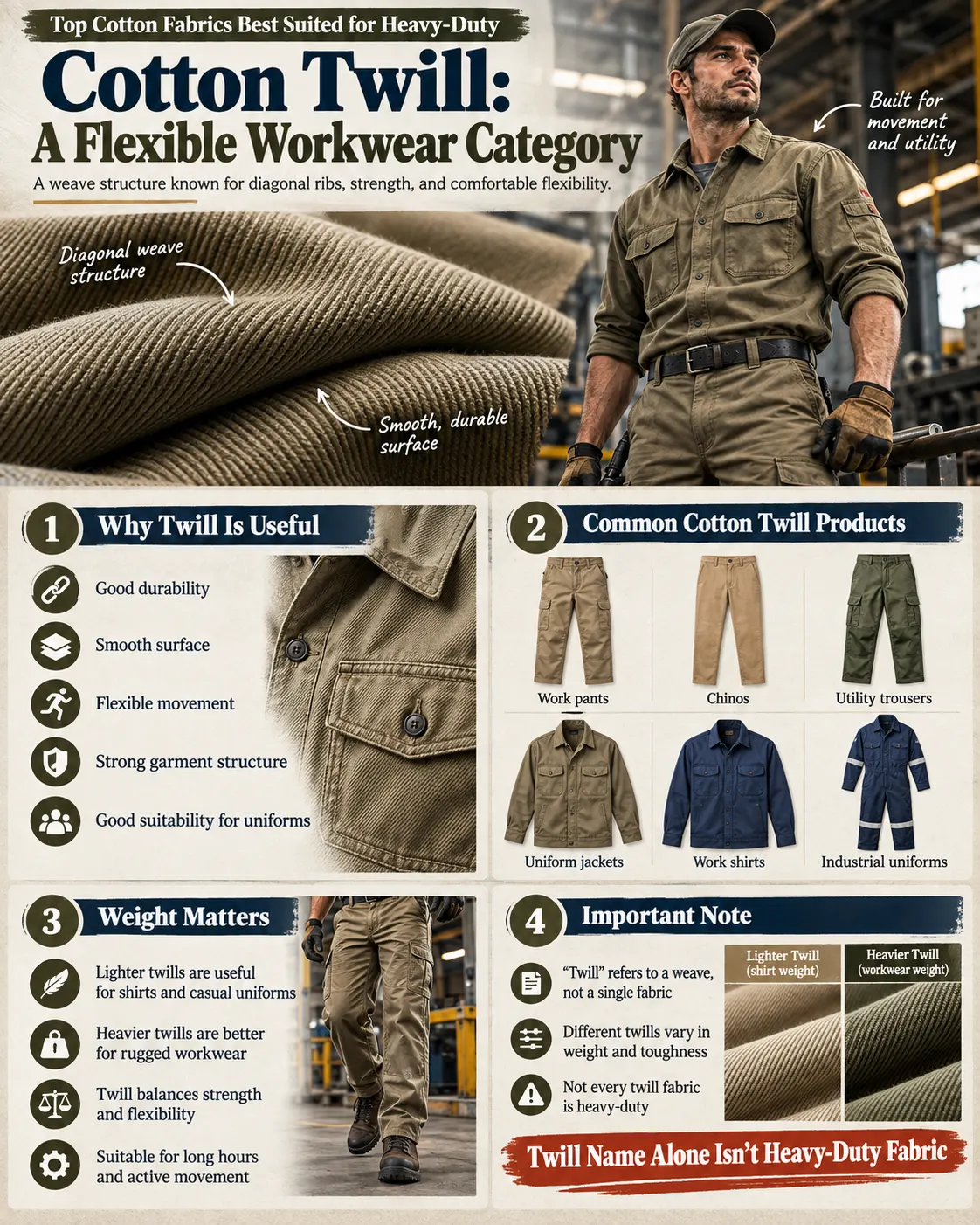
Common Cotton Twill Products
Cotton twill can be used for:
- Work pants
- Chinos
- Utility trousers
- Uniform jackets
- Work shirts
- Industrial uniforms
Lighter twills can be used for shirts and casual uniforms, while heavier constructions are more appropriate for rugged workwear. Therefore: Twill Name Alone isn’t Heavy-Duty Fabric
5. Ripstop: The Tear-Resistant Specialist
Ripstop is a fabric construction that includes reinforcing yarns arranged in a visible or subtle grid. The purpose of this grid is to help prevent a small tear from spreading easily across a large section of fabric. A simplified concept is: Small Tear + Reinforcement Grid = Reduced Tear Propagation
How Ripstop Works
The reinforcement yarns form a crosshatch pattern throughout the fabric. If the fabric is punctured or torn, the reinforced areas can help limit how far the damage travels. That makes ripstop useful in products exposed to:
- Branches
- Tools
- Equipment
- Outdoor terrain
- Repeated field use
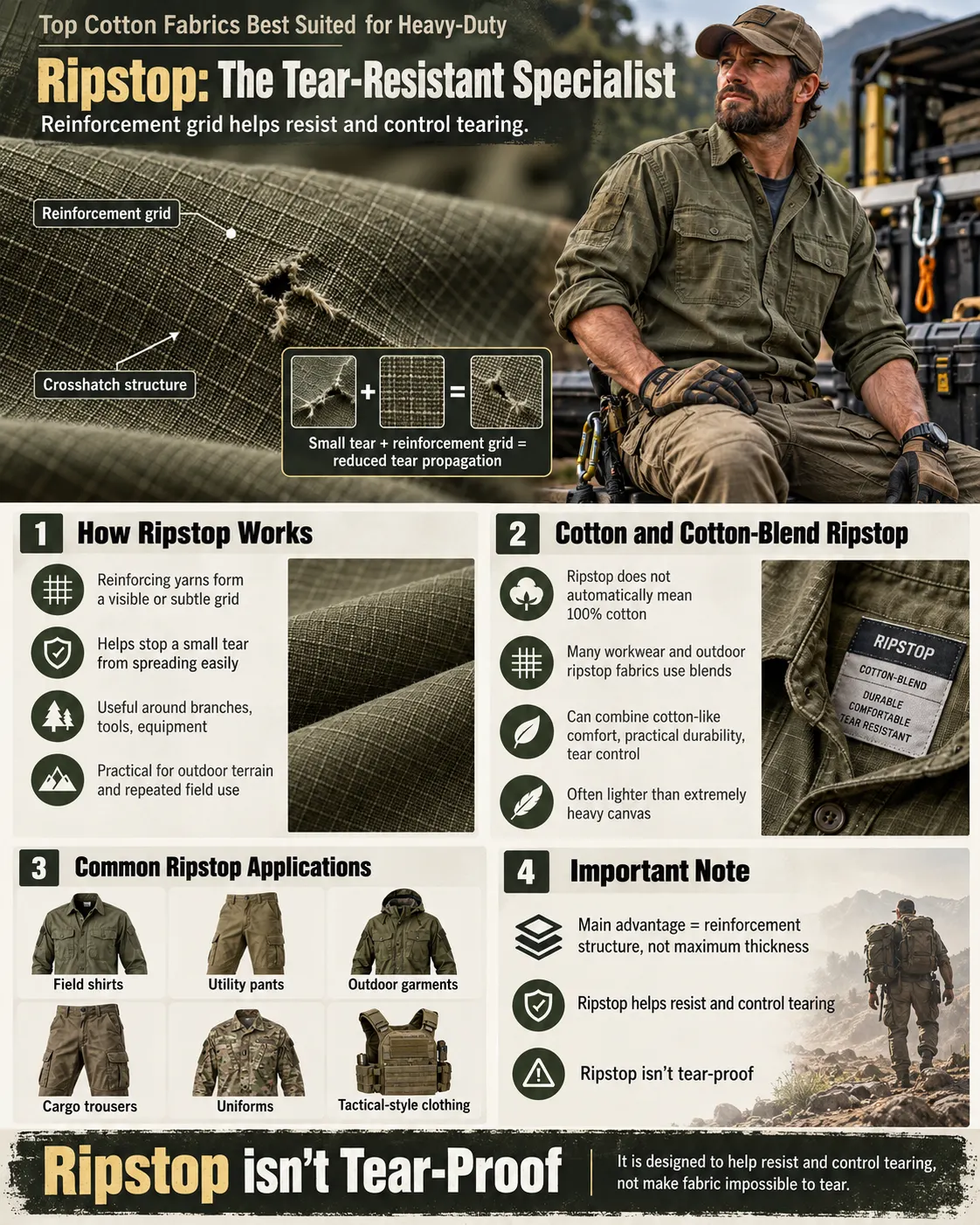
Cotton and Cotton-Blend Ripstop
Ripstop does not automatically mean 100% cotton. Many workwear and outdoor ripstop fabrics use blends. Cotton-containing ripstop may be selected when manufacturers want to combine:
- Cotton-like comfort
- Practical durability
- Tear control
- Reduced weight compared with extremely heavy canvas
Common Ripstop Applications
Ripstop may be used in:
- Field shirts
- Utility pants
- Outdoor garments
- Cargo trousers
- Uniforms
- Tactical-style clothing
Its main advantage is not necessarily maximum fabric thickness. Its advantage is the reinforcement structure. Therefore: Ripstop isn’t Tear-Proof It is designed to help resist and control tearing, not make fabric impossible to tear.
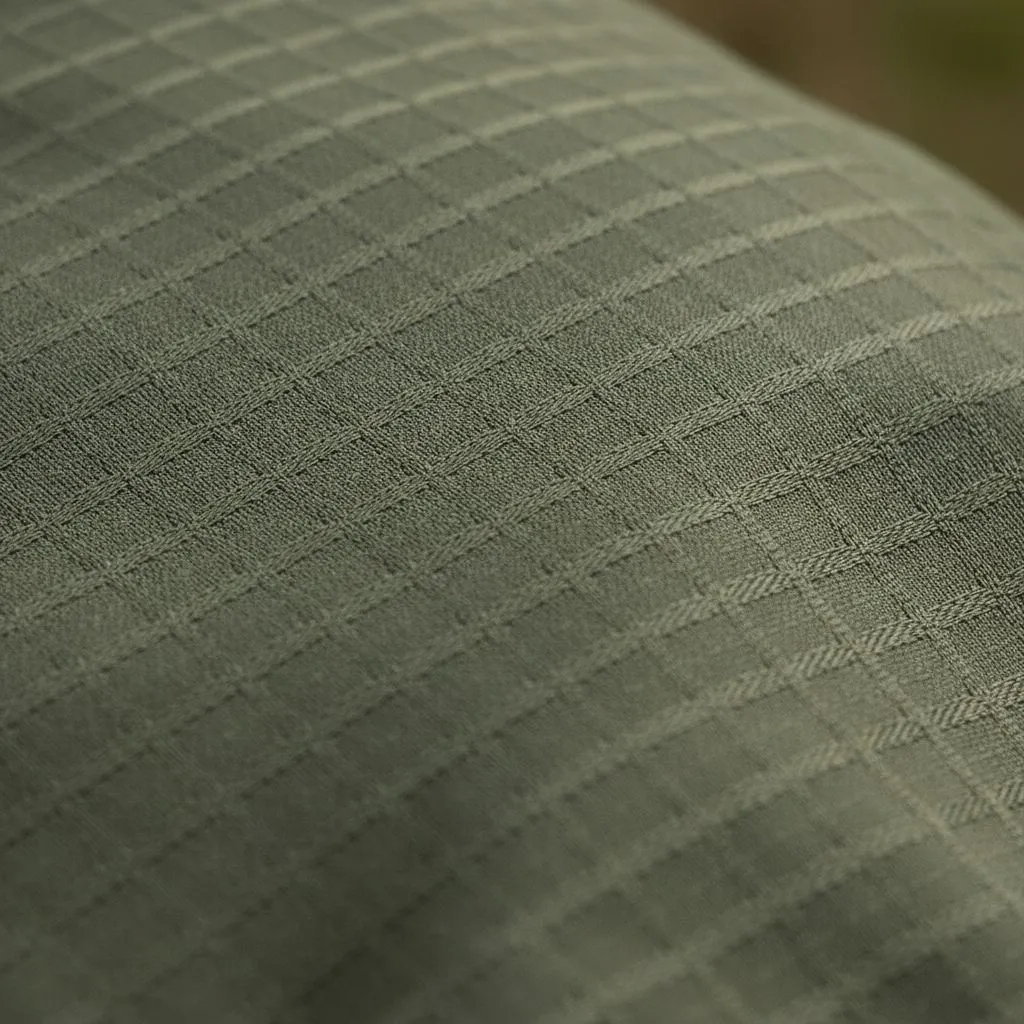
Ripstop is a weave pattern that incorporates reinforcing threads in a crosshatch grid. This structure stops small punctures from turning into large, destructive rips. Cotton-blend ripstop is often preferred in field wear and outdoor jobs for its lightweight yet high-tenacity performance. – Ripstop weave pattern for tear resistant apparel
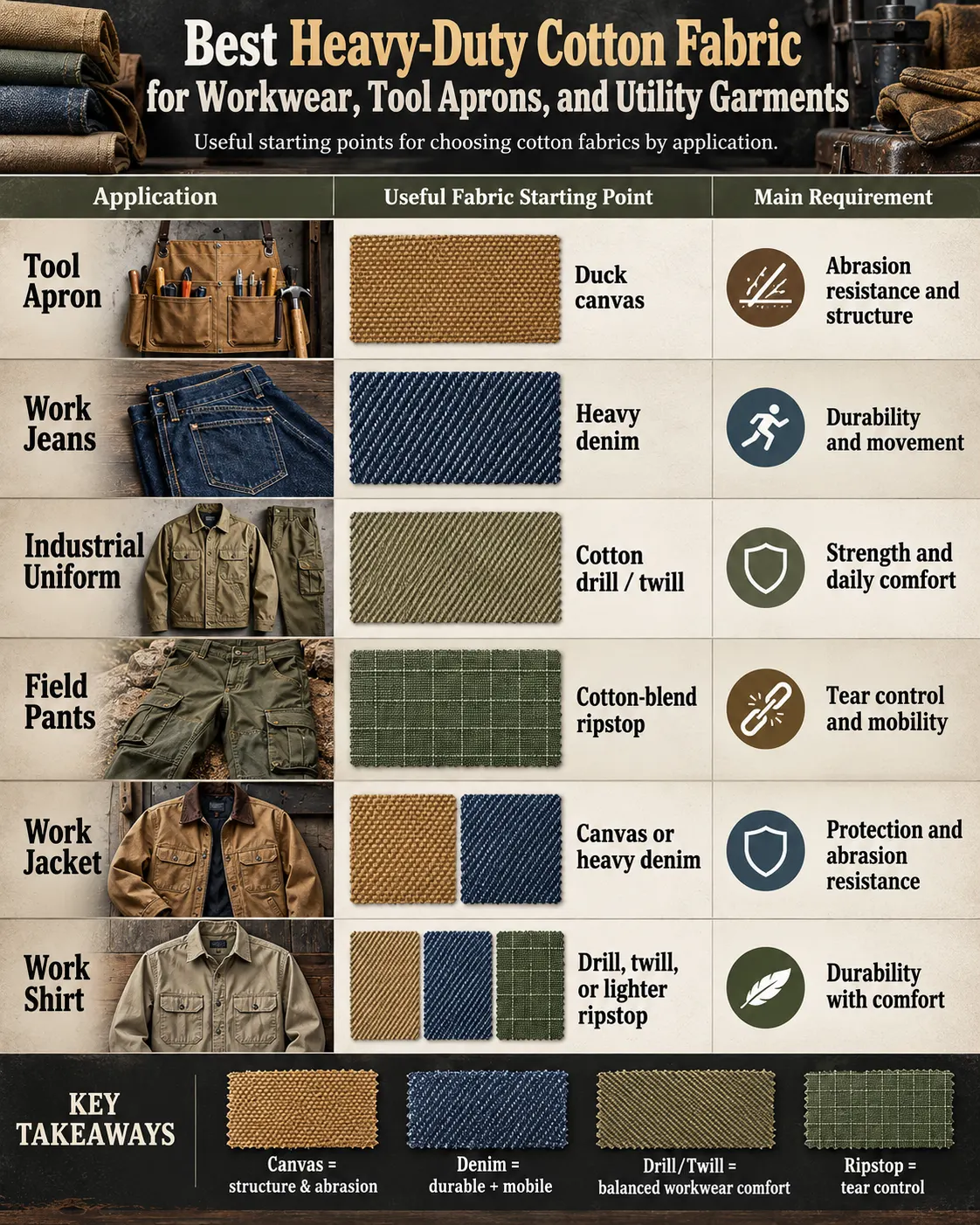
Best Heavy-Duty Cotton Fabric for Workwear, Tool Aprons, and Utility Garments
| Application | Useful Fabric Starting Point | Main Requirement |
|---|---|---|
| Tool Apron | Duck canvas | Abrasion resistance and structure |
| Work Jeans | Heavy denim | Durability and movement |
| Industrial Uniform | Cotton drill / twill | Strength and daily comfort |
| Field Pants | Cotton-blend ripstop | Tear control and mobility |
| Work Jacket | Canvas or heavy denim | Protection and abrasion resistance |
| Work Shirt | Drill, twill, or lighter ripstop | Durability with comfort |
Which Fabric Is Best for Work Pants?
Several fabrics can work.
Duck Canvas Work Pants
Best suited when durability and abrasion resistance are major priorities.
Useful for:
- Construction
- Carpentry
- Workshop environments
- Tool-intensive jobs
Denim Work Pants
Useful when durability must be combined with long-term comfort.
Good for:
- Mechanics
- Workshops
- General trades
- Everyday rugged wear
Cotton Drill Work Pants
Useful when workers need:
- Strength
- Mobility
- Uniform appearance
- Long-shift comfort
Ripstop Work Pants
Useful where snagging or small tears are a major concern.
Which Fabric Is Best for Work Jackets?
The answer depends on jacket function.
- For rugged outerwear: Duck Canvas, can provide substantial protection and structure.
- For classic work jackets: Heavy Denim, offers durability with better break-in flexibility.
- For uniforms: Cotton Drill or Twill, can provide a cleaner, more professional appearance.
- For outdoor utility clothing: Ripstop, may provide a useful balance of durability and reduced weight.
Which Fabric Is Best for Work Shirts?
Extremely heavy canvas is generally less practical for a standard work shirt because it may restrict movement and feel too warm. Cotton drill, twill, or lightweight ripstop may provide a better balance. A work shirt typically needs: Durability + Airflow + Mobility + Washability rather than maximum fabric weight.
Which Fabric Is Best for Tool Aprons?
Tool aprons experience concentrated stress from:
- Metal tools
- Sharp edges
- Repeated pocket use
- Surface rubbing
Dense duck canvas is therefore a strong option.
Reinforcement may also be needed around:
- Pocket openings
- Tool loops
- Stress points
- Corners
- Attachment points
Fabric alone does not determine durability.
Comparison Table: Strength vs. Comfort
| Fabric | Typical Construction | Approx. GSM Range | Abrasion Resistance | Tear Resistance | Flexibility | Breathability / Comfort | Best Workwear Uses |
|---|---|---|---|---|---|---|---|
| Canvas / Duck Canvas | Dense plain weave with substantial yarns | 300–600+ GSM | Very High | High | Low–Medium | Medium-Low | Work jackets, carpenter pants, tool aprons, utility garments, rugged industrial wear |
| Heavy Denim | Strong twill weave with visible diagonal structure | 300–500 GSM | High | High | Medium; improves after break-in | Medium | Work jeans, overalls, mechanic clothing, work jackets |
| Cotton Drill | Dense twill weave with a smooth, firm surface | 240–350 GSM | Medium-High | Medium-High | Medium-High | Good | Industrial uniforms, work trousers, utility jackets, maintenance wear |
| Cotton Twill | Diagonal twill weave; available in many weights | 200–350 GSM | Medium-High | Medium | High | Good | Work shirts, uniforms, cargo pants, utility trousers |
| Ripstop | Woven fabric with reinforcing yarns forming a grid | 180–320 GSM | Medium-High | High, especially for limiting tear growth | High | Medium-High | Field pants, outdoor workwear, cargo trousers, utility uniforms |
Conclusion / Final Words
Choosing the right heavy-duty fabric depends on your environment. If you need maximum abrasion resistance, Duck Canvas is the technical winner. For jobs requiring movement and flexibility without sacrificing strength, Denim and Drill are better choices. At Mekong Garment, we help our partners choose based on the intended use—ensuring your garments are as tough as the work they are designed for.